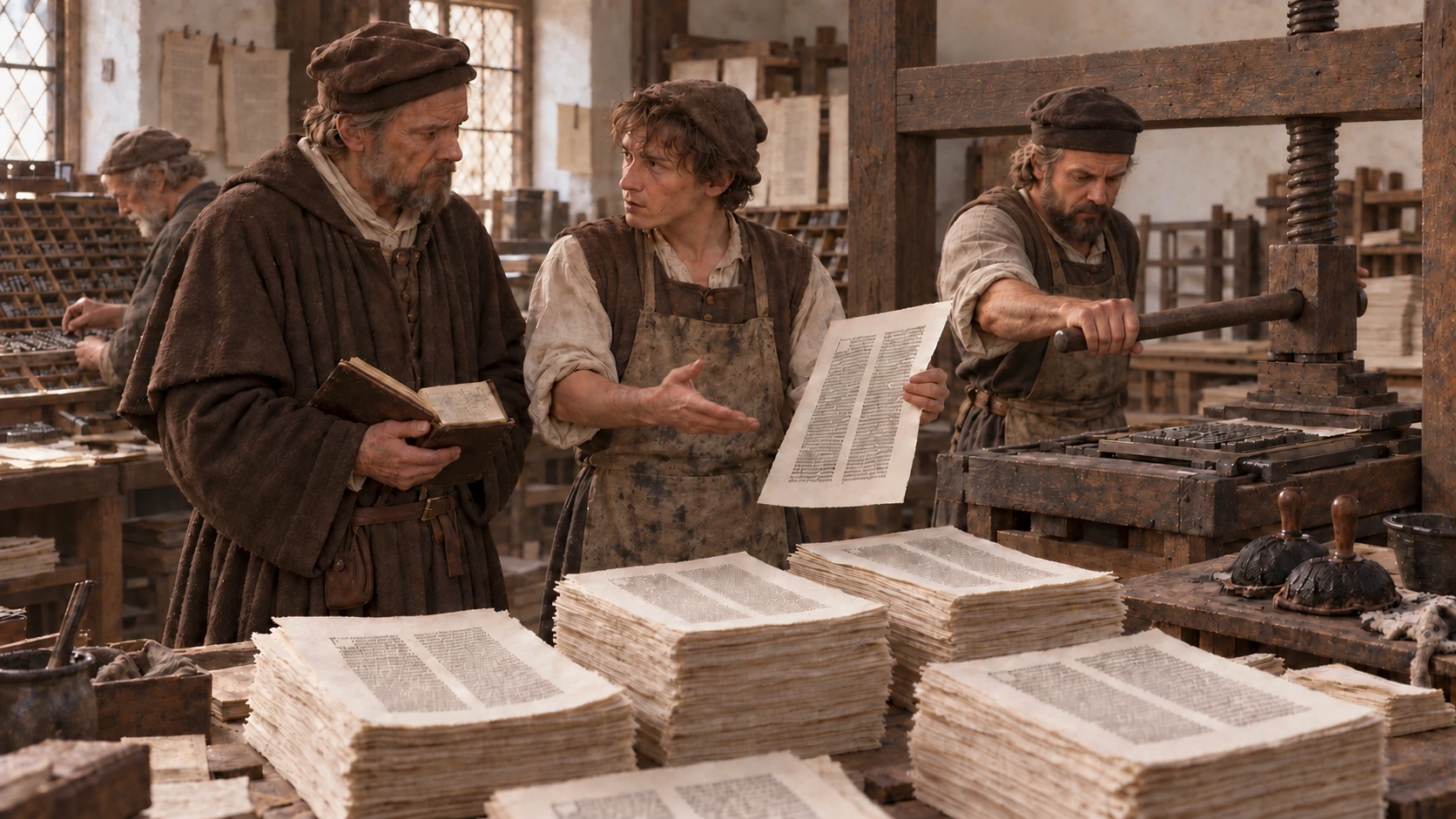
Before Gutenberg's Bible changed the world, it turned my ledger red.
I kept the accounts for a paper merchant in Mainz. Every delivery to Johannes Gutenberg's workshop added another line of debt, yet no finished books ever seemed to come out.
At last, my employer gave me an order.
“No payment today, no next cart.”
I had brought a ledger instead of paper, and no one was pleased to see me. When I opened the workshop door, hot air rolled over me, thick with the smell of metal and oil. Workers arranged pieces of type into lines, spread black ink, and turned the press to force paper against the letters.
Martin, one of the apprentices, sighed the moment he saw me.
“We need that paper today.”
“And we need money before paper moves.”
“Give us a few more days.”
“My ledger already has enough promises in it to fill a book.”
I looked around. Printed sheets rose in stacks across the tables, but I could not see a single bound Bible.
“You've printed all this and still haven't finished one book?”
Martin lifted a bundle of sheets.
“We aren't finishing them one at a time. We print this page for every copy we need, take the type apart, and set the next page. What you see here isn't part of one book. It's the same part of many books.”
I looked again, and the stacks changed before my eyes. A scribe had to finish the first copy before starting the second. In this workshop, the first Bible was not yet complete, but more than a hundred copies were growing together.
The trouble was that growth cost a fortune.
Pressing one more sheet took little effort. Getting started was the expensive part. The workshop needed enough metal type of uniform height, workers to set it, ink that would cling without running, a press, and people trained to operate the whole system. Paper had to keep arriving long before there was a finished book to sell.
The power of Gutenberg's printing system did not come from one machine. It came from joining metal type, ink, presses, paper, skilled labor, and capital into a single method of production. The initial cost was enormous, but every additional sheet from the same setting lowered the cost of each copy. Books were beginning to change from individual works of craft into goods that could be made in quantity.
I picked up the top sheet from one of the stacks. The letters stood as evenly as a careful scribe's hand. Blank spaces had been left for red headings and decorated initials to be added later.
“This still isn't a book.”
“No,” Martin said. “It still needs red headings and decorated initials, and the pages have to be gathered and bound. But no one has to copy the entire body of the text by hand.”
A scribe waiting in the corner to take on some of the finishing work looked thoroughly offended by the workshop. He had spent the morning complaining that the press would destroy his trade. Yet he was already reading the printed lines and searching for errors.
“Here.”
He stabbed a finger at the page.
“These two letters are reversed. Keep going and you'll have a hundred wrong Bibles.”
Martin went pale. The workshop stopped at once. Two pieces of type changed places, and the next impression put the sentence right again.
The scribe sniffed.
“So a faster machine still needs human eyes.”
“Perhaps those eyes could look at my ledger too,” I said.
He glanced at my ledger and gave an even louder sniff.
I did not collect our money that day. Instead, I counted the printed sheets and the work still to be done, then told my employer we should risk one more cart. The debt remained dangerous. At least I could finally see where the money had gone.
The money was not tied up in just one book. It was spread across all those books waiting to be assembled.
The workshop's troubles did not end there. Johann Fust, who had financed Gutenberg's work, eventually took him to court. Their fight over debt and the workshop became nearly as fierce as the technical struggle itself. But the production system they had set in motion did not remain confined to one man's accounts. People saw books from Mainz and opened printing shops in other cities.
The man in the front row leaned away from the back of his chair.
“So this isn't really a story about Gutenberg inventing one machine by himself and changing the world?”
“No. He brought earlier techniques together and turned them into a system that could produce books repeatedly. That does not diminish Korea's earlier movable metal type, and Korea's achievement does not diminish Gutenberg's. They show what printing could become under different social and economic conditions.”
Lower copying costs did more than spread existing knowledge. More readers created a reason to publish more books, and more books created more readers. Printing grew beyond a technology for copying information. It helped create a market in which knowledge could be produced, sold, challenged, and expanded again and again.
Years later, I saw a Bible from Mainz in the market of another city. Red initials, gold decoration, and a leather binding had transformed it into something almost unrecognizable from the loose sheets I remembered.
The bookseller opened it and showed it off to the crowd.
I looked past the decoration and studied the text.
The same lines. The same spacing. The same letters.
Only then did I understand. The thing we had hauled on credit was not paper.
It was the beginning of a way to make the next book faster and cheaper.