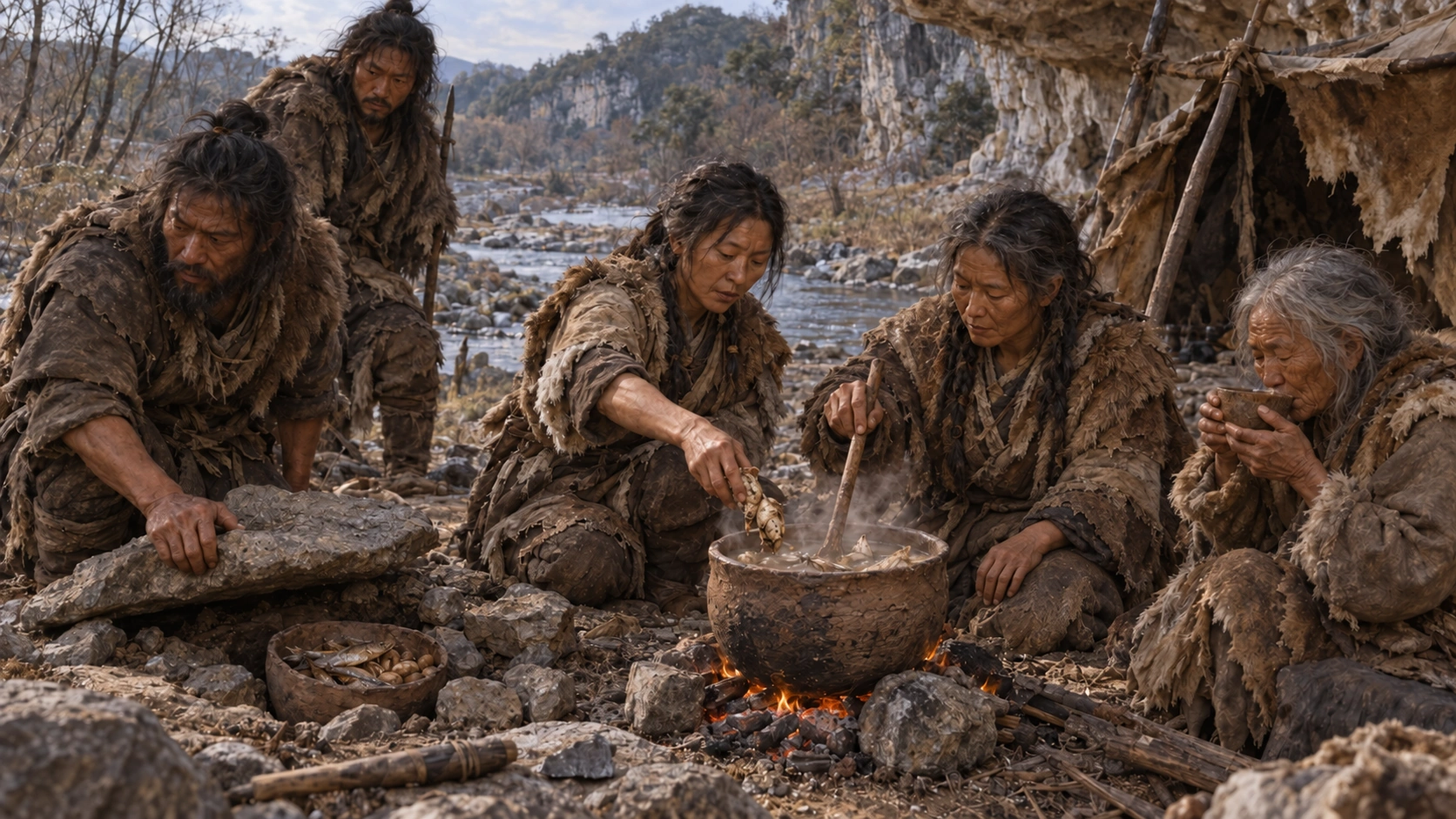
“We’re leaving that behind.”
A woman in my group pointed to a clay vessel she had hardened in the fire.
I thought I had misheard her.
“Why make something we’re only going to leave behind?”
To us, a good possession was one we could carry when we moved. We kept stone blades and needles on our bodies and slung hide bags over our shoulders.
But a clay pot was heavy. It broke if dropped and was awkward to tie to your back if you needed to run. If we could not take it with us, I saw no reason to put effort into making it.
Instead of answering, my companion filled the pot with water.
Every year, we came to that river when fish gathered there in great numbers. We roasted or dried what we caught. But on days when the catch was too large, some fish spoiled before we could eat or preserve them.
We also threw away heads, small bones, and tough roots that were difficult to roast directly over the fire.
My companion put those things into the pot with water and set it near the fire.
“You dropped our food in the water.”
“Taste it first.”
Much later, fat shimmered on the surface. The tough flesh and roots were now soft enough to crush between two fingers. Even an elder with bad teeth could drink the broth and eat the meat that had broken into small pieces.
Parts we would normally have thrown away gave several people another meal.
Pottery did more than hold food. A vessel could sit near the fire with water inside it, allowing us to boil roots and parts of fish that were difficult to roast. Ingredients that had been too hard or tough to eat became soft, increasing the range of food people could use.
When the fish grew scarce, we prepared to leave in search of other food. My companion placed dried fish and nuts in another pot.
“Are we taking that one?”
“No. We’re leaving this one too.”
“Then an animal—or someone else—will eat it.”
“If it is still here, we will eat it.”
She added the next part as if it were obvious.
“So we’ll have to come back.”
Until then, we had returned to the river because the fish returned. Now the food we had left behind gave us another reason to come back.
We covered the pot with stones, memorized the shape of the surrounding land, and left the river. I expected to find nothing but a broken pot when we returned.
That year, the cold arrived earlier than expected, and we failed to catch enough game. We went back to the river in search of food.
The pot was still there.
But the stones that had covered it had been moved aside, and half the food was gone.
A group we had never seen before was staying by the river. One of them was chewing our dried fish.
“We put that there,” my companion said.
The stranger looked around.
“There was no one here.”
“Just because no one was here doesn’t mean it had no owner.”
“You left it.”
We had no rule for deciding who was right. When someone held food in their hands, it was clear who had it. Food that remained in one place after the people who stored it had gone was different.
We were hungry, and so were they. My companion did not take back the remaining fish and hide it. Instead, she poured water into the pot and added the roots and meat both groups had brought.
Separately, the food would not have been enough. Together in one pot, it made enough warm broth for everyone in both groups.
When we had eaten, my companion placed the empty pot between us.
“Next time, let’s fill it together.”
A woman from the other group studied the pot for a moment, then nodded.
We agreed to meet at the same river during the next fish season. Before leaving, each group placed some of its dried food in the pot.
After that, we left more behind every time we returned to the river: firewood and nets for later, stones for a windbreak, and empty pots.
We still moved from place to place as different foods came into season. But whenever we left the river, food and tools remained there for our next visit.
Storing food allowed us to save part of a plentiful season for a season of hunger. People returned to the same place to recover what they had stored. As food and tools continued to accumulate there, a temporary camp became a place people returned to and used again and again.
Stored food also created new problems. People had to decide who had filled the pot, who could eat from it once that group had left, who would guard it, and how it should be divided.
Once people began leaving food behind for later, they also had to think about who owned it and how it would be shared.
“Did one pot create a village?”
The teenage girl asked.
“No. One pot cannot make people settle down. But when people keep leaving food and tools in one place, they have a reason to return after they leave.”
The pot remained by the river after the people had gone.
After that, we did not return only for the fish.
We also returned for the food and tools we had left behind.