“So is this where real people finally show up?”
The youngest child asked, and the girl in the school uniform frowned before I could answer.
“Then who do you think was breaking stones, tending fires, and hunting bison all this time?”
“Cavemen.”
“Cavemen were people too.”
“You’re both right.”
I stepped in, and both children turned the same puzzled look on me.
“The people you’ve heard about so far were human too. But from here on, the story follows Homo sapiens—the same species as you. That does not mean the first Homo sapiens simply appeared one day and pushed everyone who came before them aside.”
“Then when did people become Homo sapiens?”
“If I gave you a single day, I would have to lie.”
A species does not change all at once, the way a person changes clothes. Children resemble their parents without being exact copies. As this continues across countless generations, people living much later give a name to one stretch of that long process of change.
Looking back now, the people I lived with in North Africa some 300,000 years ago had faces surprisingly close to our own. At the time, however, I did not wake each morning to inspect everyone’s brow and jaw for signs that a new species had arrived.
What I remember firsthand is not how their facial bones changed, but how people learned from one another and passed on what they knew.
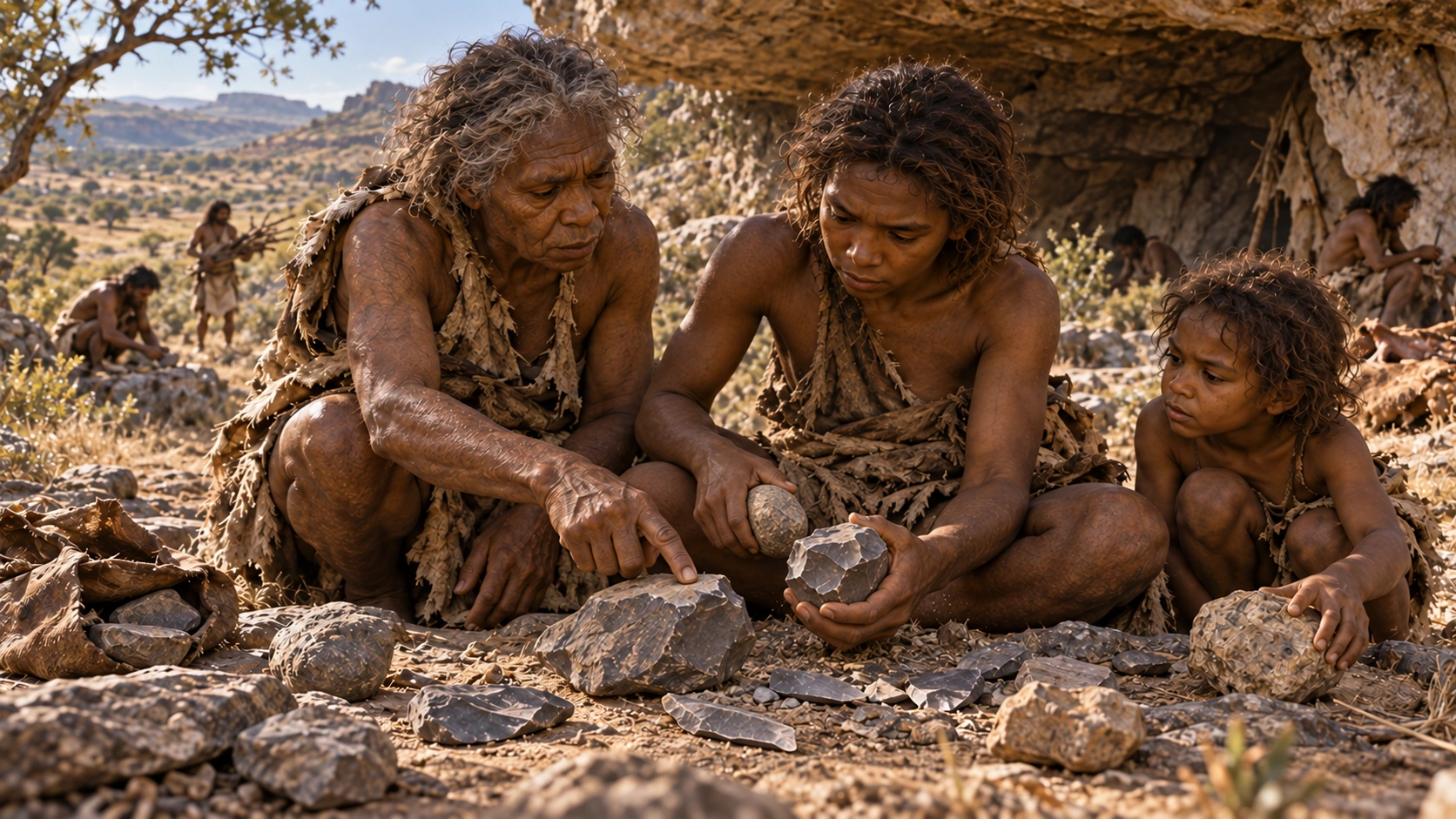
There was an old woman in the group whose finger joints had curled with age. Even in a dry land, she knew which valleys would hold water the longest. She could choose, from stones that looked alike, the ones that would split cleanly. When the smell of the wind changed, she knew before the rest of us which path the animals would take.
I had lived longer than she had, but I knew far less about that land. Surviving longer and knowing every place were two entirely different things.
That year, the old woman’s hands began to shake badly. Twice she reached for a stone and dropped it. Even after drinking, she needed a long time to catch her breath. I thought I had to learn what she knew, and quickly. I had seen too many people die with their memories still inside them.
But I was not the one she called to sit beside her. She chose a child who had arrived with another group several seasons earlier and stayed with us. They were not related by blood.
I tried to squeeze between them and reached out, only to have the back of my hand slapped. Imagine brushing aside a hand that had worked stone for more than a million years. I admit, I was offended.
I soon understood why. My hands carried too many old habits. When the woman pointed to a stone, I picked it up the way I already knew. Before she could move her wrist, I was guessing what would happen. My guesses were often right, which was exactly why I missed the new movement she was trying to show me.
The child was different. When the woman’s hand stopped, the child stopped. When her fingers traced one side of a stone, the child touched the same place. At first, the child chose nothing but the wrong stones. Even after several slaps across the hand, they kept coming back to sit beside her. Whenever the child chose correctly, the woman made a short sound and opened her palm.
This was the same imitation and teaching people had practiced for a very long time. Culture did not suddenly appear one day because Homo sapiens had arrived. But people were learning more and more of what they needed to survive from others, then passing it on again.
Not long afterward, the old woman did not wake again. The group had to leave in search of water, and I could not guess how much of what she knew had vanished with her.
Several days later, we reached an unfamiliar field of stone. I picked one up and struck it first, but the inside crumbled and would not take a proper edge. Then the child went beneath the shade of an outcrop, tapped several stones, and chose one. It was the same sequence the old woman had followed.
When the child struck, a long flake with a strong, sharp edge came away cleanly.
That evening, a younger child tried to imitate what they had seen. The first child copied the old woman, stopping the younger child’s hand and choosing a different stone for them.
The first child kept taking the younger child’s hand and correcting it, trying to pass on the exact sequence they had learned.
“Could the child do that because they were Homo sapiens?”
The girl asked.
“It isn’t that simple. Watching, learning, and teaching had existed for a very long time. The emergence of Homo sapiens was not the moment culture appeared inside an empty mind. It was closer to a new lineage inheriting what earlier humans had already built.”
Homo sapiens did not begin civilization from nothing. Stone and fire, composite tools and cooperation had existed before Homo sapiens appeared. The people of the new lineage learned the skills earlier humans had left behind and added their own experience.
Bodies changed only as generations changed. But the skills the old woman had learned across a lifetime could pass to a child who shared not a drop of her blood. The child did not need to be born with more skillful hands to make another person’s lifetime of learning their own starting point.
Civilization did not speed up because everyone suddenly became smarter. It sped up because the next generation could learn what the previous generation knew instead of repeating the same trials and errors from the beginning. People could start where those before them had stopped.
Until then, I had thought that living a long time was the only way to keep memory from being lost.
But even after the old woman’s hands stopped, they kept moving in another child’s.