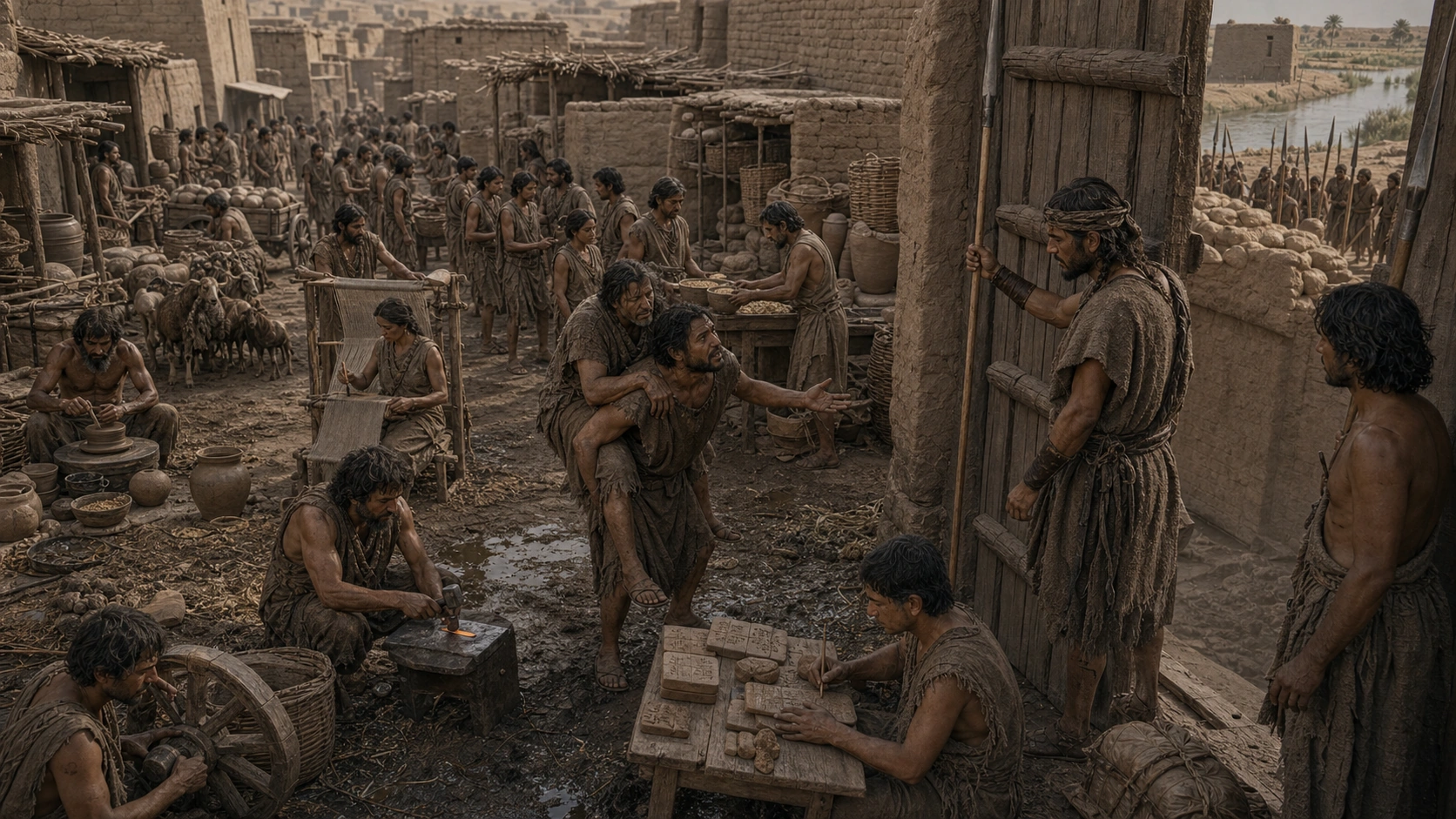
City walls kept enemy soldiers out.
But in the year disease spread, they also kept sick people from getting out.
I entered a city in southern Mesopotamia carrying a sack of grain on my back. I had no fields and no relatives there. Still, I assumed there would always be work for an able body.
The man hiring workers inside the city gate asked me a question.
“What are you good at?”
“I can do most things.”
“Then there is nothing you are especially good at.”
That was how I became a grain porter.
In a village, someone who could do a little of many things was useful. In a city, more people specialized in a single task. Some shaped pots all day. Others wove cloth, worked metal, or did nothing but record quantities.
They repeated the same work for so long that they became faster and more skilled than I could hope to imitate after watching briefly.
What happened when a cart axle broke surprised me too. While a woodworker selected a new piece for the axle, another person repaired the wheel. A rope maker brought fresh bindings.
In a village, the cart might have remained broken for days. In the city, it was moving again before sunset.
Most of the fields feeding those specialists lay outside the walls. Grain brought from many villages filled the storehouses of temples and large households. It was distributed among craftspeople, porters, record keepers, and guards.
People who did not farm could keep doing their own work because they received grain produced by others.
A city did not turn everyone into an exceptional craftsperson. It brought people with different skills close together. Once specialists were easy to find and stored grain could feed them, several experts could quickly solve problems that no one person could handle alone.
A man younger than I was worked in the storehouse where I carried sacks. When I had nowhere to sleep, he gave me a corner of his floor. If we lay side by side, there was barely room left to walk, but at least there were walls to keep out the wind and rain.
One day, a guard on the city wall shouted that an army from a neighboring city had appeared across the canal.
People working in the fields drove their carts and livestock through the gates. As soon as the last cart passed, the gates closed.
For the first few days, the city's strength was plain to see. The high walls stopped enemy spears and stones. Guards took turns watching the walls, while grain from the storehouses was distributed to people who could no longer reach the fields.
Even those who had no grain stored at home could survive because of the city's reserves.
But the grain did not reach everyone in the same order. The soldiers defending the walls and the temple workers received theirs first. Porters like us were pushed farther back.
The officials lived in spacious houses with courtyards and storage rooms. In the narrow rooms lining the alleys, refugees crowded together and slept pressed against one another.
After several days, the alleys began to smell different. Manure from the animals brought inside the gates mixed with discarded food and overflowing waste in warm pools of water.
No one knew where the sickness had started. One after another, people clutched their stomachs. Those burning with fever could no longer stand.
The man who had given me a place to sleep collapsed too. At first, I thought he had eaten spoiled food. Then others who shared our room and water jar also fell ill.
With people and livestock packed into a small space and clean water difficult to find, no one could avoid close contact with the sick.
I carried him on my back to the city gate.
“We have to go outside.”
The guard shook his head.
“If we open the gate, the soldiers outside will come in.”
“People are dying in here.”
“And men with spears are waiting out there.”
The guard was not wrong. We had no choice but to turn back.
Without the wall, the neighboring army might have taken the storehouses and homes. But once the gate was closed to keep the enemy out, we could not carry the sick outside either.
The wall protecting the people was trapping those same people inside the city.
The man who had shared his room with me died before the gate opened again.
Cities brought many things close together. When people and skills were nearby, broken objects could be repaired quickly and needed goods could be exchanged more easily. But people, livestock, and waste were also packed together, increasing the danger of disease.
When large amounts of grain accumulated in one place, they could keep feeding craftspeople, record keepers, and guards. At the same time, whoever controlled the storehouses could decide who received grain first.
Walls and armies protected the residents. But a city full of grain, people, and workshops also became a prize that neighboring cities wanted to seize.
As one city grew stronger, the cities around it built higher walls and prepared more soldiers. The grain and population gathered in a city could support a larger army.
A man listening beneath the wall asked a question.
“If cities were so dangerous, why did people keep moving into them?”
“Because cities were dangerous, but that did not make life outside them easy.”
A person without fields could carry sacks in a city and receive grain. Someone without family could be offered a place to sleep by another worker. If a tool broke, there was likely to be someone nearby who could repair it.
In war, the city had walls and soldiers. If the harvest failed, grain in the storehouses could buy people a few more days.
Those benefits were not shared equally. To receive protection, people had to work and obey orders. Even so, a city offered a chance to survive to those who had neither land nor family.
When people gathered close together, skills and goods moved faster. For the same reason, disease and fear spread faster too. Large grain stores fed craftspeople and guards, but they also increased the power of the people who distributed the grain and the size of the army the city could support. Cities brought people together and expanded cooperation. They also increased inequality, infection, and the danger of war.
On the day the gate opened, I buried my dead companion outside the city wall.
Then I went back through the gate before sunset.