“Did people have boats back then?”
The youngest child asked.
“Calling it a boat makes it sound far more impressive than it was.”
“Then what was it?”
“A floating floor. Crude by today’s standards, but enough to carry us past the edge of our world.”
The land across the water had always been visible.
On clear days, a dark forest and a pale strip of shore appeared in the distance. We watched flocks of birds fly across and settle there. But seeing a place and reaching it were entirely different things. The water concealed any ground we might have stood on and never stopped moving. The farther we went, the longer we had to keep ourselves afloat with nowhere to stand. To us, the far shore was somewhere we could see, not somewhere we could go.
“Why go when you didn’t even know what was there?”
“If birds could land, we could guess there was somewhere to rest and something to eat. There were also seasons when shellfish and fruit grew scarce along the shore we knew.”
I remembered how I used to stare across that water.
“When food is scarce and you can see land across the water, you start looking for a way to reach it. We were curious too.”
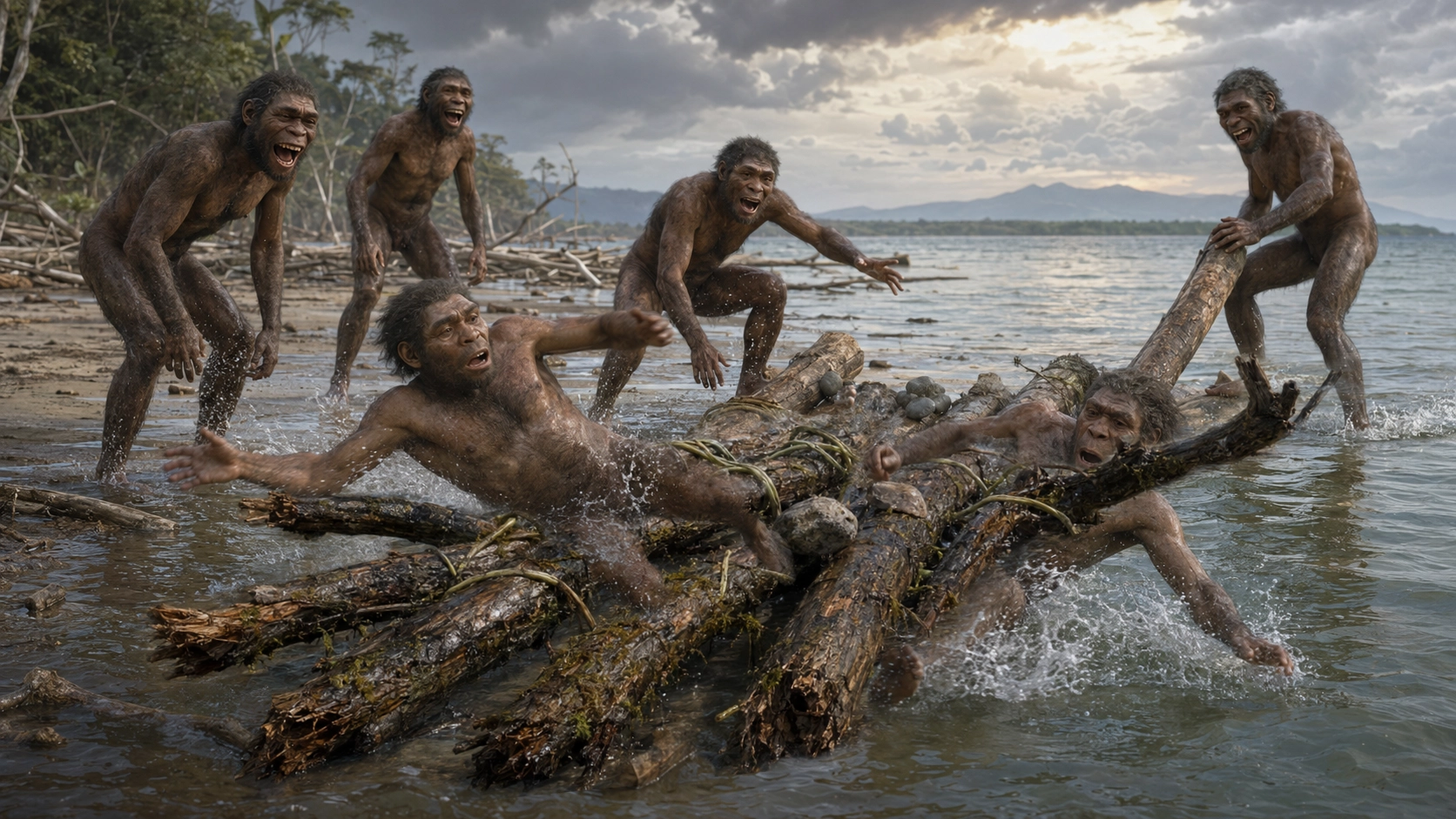
A companion who was not afraid of the water examined the trees washed ashore after a storm. Leaning against light wood could keep a person’s head above water even in the deep. We bound several pieces of driftwood together with vines so that more than one person could climb aboard.
Our first float came apart as soon as a smaller companion and I put our weight on it. We landed in the shallows, and everyone watching bared their teeth and laughed.
“You failed again.”
The youngest child sounded delighted.
“Watch the history of technology long enough and you learn that most great moments begin with someone falling into water or mud.”
“Really?”
“That may have been a slight exaggeration.”
The children laughed. I had not found it funny while spitting out salt water, but the cause of our failure had been right in front of us.
We tied the logs together again and spread people out so that no one side carried too much weight. The companion who understood the water best tossed in a branch, watched which way it drifted, and changed where we would set off. The real trouble began once the bottom dropped away beneath our feet.
The far shore refused to come closer. Every wave made the logs shift separately beneath us, and the wet vines began to loosen. One companion panicked and pressed toward me, tilting the whole float. Instead of pushing them away, I shifted to the opposite side. The others watched and redistributed their weight.
Whenever someone leaned one way, a person on the other side moved to balance them. When the person in front grew tired and stopped, someone behind took over, pushing against the water with a branch. No one could survive on that float by keeping only their own balance. We all had to watch one another and adjust our positions and effort together.
After a while, the water grew paler. The tip of a long branch touched bottom again, and almost all of us jumped into the shallows at once to drag the float ashore. When I felt sand beneath my feet, the strength went out of my legs. I looked back. The shore we had left seemed much smaller, while the water between us still flowed in the same direction as before.
“You really made it.”
“We did.”
“What was there?”
The new land held fruits we had never seen and shellfish in the shallows. A little farther inland, we found stone that broke into sharp, useful edges. There were tracks from unfamiliar animals too, though we did not yet know whether those animals were dangerous or edible. A new land did not offer only new food. It also presented an entire world of things we had to learn.
Some of us wanted to abandon the float on the shore and head inland. The companion who knew the water tightened the loosening vines instead, then pointed back toward the shore we had left. That made even less sense to me than crossing over in the first place. Why risk the same water again after surviving it once?
When the water grew calm, we launched the float again.
“You went back?”
“Being carried across once doesn’t make it a route.”
The second crossing was different. Our bodies had begun to remember where to set off, which way the current would push us, and where each person had to sit to keep the float level. Failure and danger had not disappeared, but crossing no longer depended entirely on a single stroke of luck.
We carried familiar food to the new land and brought stone and fruit back on the return journey. Both shores had always held resources of their own. What changed was our ability to move between them.
The food and stone on the new land had always been there, but they could not help us while they remained beyond our reach. Once we could make repeated journeys across and back, they became real options. Travel technology did not create new resources. It expanded the resources people could actually use.
Much later, roads, ships, railways, and aircraft did the same thing. Without changing where resources were, they reduced the time and danger required to reach them, expanding the world people could use.
The water remained deep, and it still swallowed people. But once we could make repeated journeys across and back, the sea was no longer only where the land ended. It became a route linking two shores. The limits of where people could live began to depend less on natural boundaries and more on how far their means of travel could reach.
Before the first crossing, the far shore was an “over there” we could see but could not reach.
After several journeys in both directions, it became the “next place” we could visit again.