With one finger, I drew a curved back in the dirt and added four short legs beneath it. Then I gave the face a long snout.
“A pig.”
The youngest child recognized it immediately.
“Then why does it have a tail on its head?”
“That is an ear.”
“You’re bad at drawing, aren’t you, mister?”
The children laughed. I wiped away the tail that was supposed to be an ear.
“You still knew what it was.”
“I could tell it was a pig, at least.”
Annoying, but true.
“Back then, that was enough. What mattered most was not how well a picture was drawn, but whether the person looking at it recognized the same animal and brought a story to mind.”
One picture I remember also began with a pig.
We never caught the boar that attacked us that day. It sent five hunters sprawling in the dirt before vanishing into the trees. By any fair accounting, the pig had won that hunt. Yet by the time we gathered around the fire that evening, everyone was talking as if they had driven it away single-handedly.
One person claimed their spear had grazed the boar’s neck. Another insisted it had fled from their shout. I knew those two had been the first ones up the trees.
“Neither of you did it. The boar caught our scent and changed direction.”
My version was not popular. Truth is usually less entertaining than boasting.
One of the women there handled red pigment so often that her fingernails were always stained. I remember her as Redhand. She did not try to decide who was right. Instead, she quietly listened to how differently people described the same hunt.
A few days later, Redhand told me to bring a burning branch and follow her.
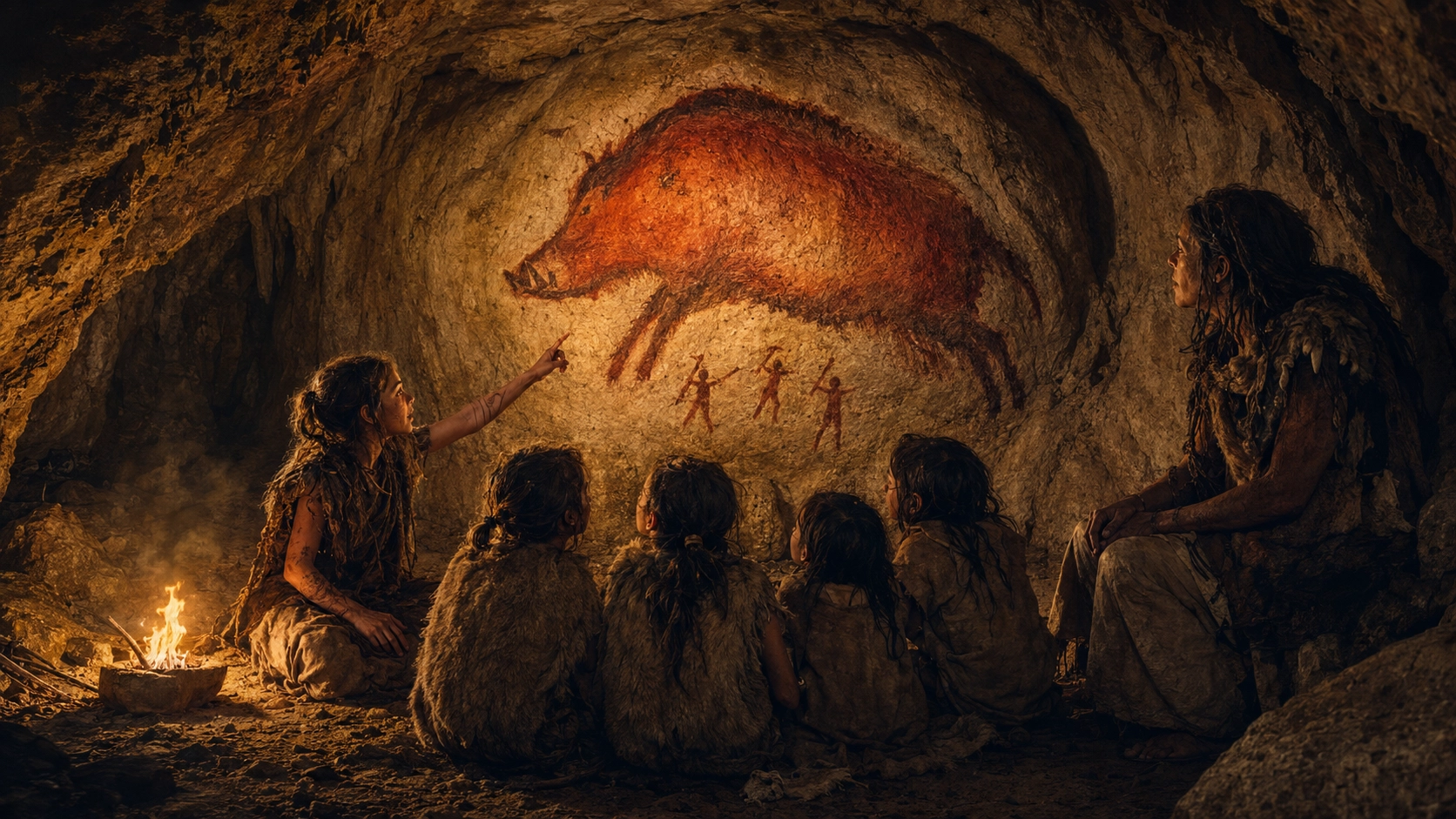
She chose a wall deep inside the cave where the rain could not reach. Whenever the firelight shifted, the bulges in the stone moved like the back of a living animal. Redhand followed one of those curves to form the back of a great pig, then painted three people in front of it.
“There were five people.”
“I know.”
“And the pig ran the other way.”
“I know that too.”
Redhand told me to hold the light a little higher. A small figure in front of the pig emerged, one arm reaching outward.
“Then why are you painting it differently?”
“If I put in everything, no one will see anything.”
She drew one more line on the pig’s belly and stepped back.
“The pig was large. The people were small. Even so, they did more than run. That is what I want to leave behind.”
I did not like the picture. It seemed to preserve that day, but it preserved only what Redhand had chosen. The two people who had climbed the trees were missing. So was the direction the pig had fled, and the ending in which no one brought it down.
The next day, Redhand brought a child who had not seen the hunt into the cave. The child studied the picture in the firelight, then pointed to the small figure in front of the pig.
“Did this person go toward the pig?”
Redhand said nothing. She only looked at me. In the end, I told the child what had happened that day. When I added the part about who had been boasting, the child doubled over with laughter.
As we left the cave, Redhand spoke.
“Even without me, that child will see the wall and ask you for the story.”
“What if I’m not here?”
“Then they’ll ask someone else.”
“And if no one remembers that day?”
Redhand thought for a moment and shrugged.
“Then a different story will begin.”
She was right.
When I returned to the cave years later, children I did not know were sitting before the picture. Redhand was not there. The oldest girl pointed to the wall and told the others a story about a pig and three people.
It was not what I had lived through. The pig had grown fiercer, and the small figure had become a hunter without fear. But when the girl finished, the children crowded toward the picture, arguing over where each of them would have stood.
The pig and the three people on the wall still looked the same after all those years. But the children looking at them could picture a hunt they had never experienced.
A story told aloud survived only if someone remembered it and told it again. A picture remained on the wall and showed the same scene to new people even after the person who made it was gone. Once memory could be left outside the body, it could begin another person’s story even after the first person had died.
The girl in the school uniform looked again at the pig I had drawn.
“So did pictures store memories exactly as they happened?”
“No. Nothing has ever preserved the past exactly as it was.”
I added two horns to the pig in the dirt. The youngest child protested at once.
“Now it isn’t a pig.”
“See? Change only a few lines, and what you imagine changes with them.”
The same event became a different story depending on what was made larger, what was left out, and who was placed at the center.
Pictures allowed memories to remain outside the body for a long time, but they did not show an entire event exactly as it happened. The person making the image chose what to include and what to leave out. A record helped people remember, but it also changed what people in the distant future would remember.
A picture lasted longer than a person’s memory. But what survived was not the whole event. It was the scene Redhand had chosen to paint.