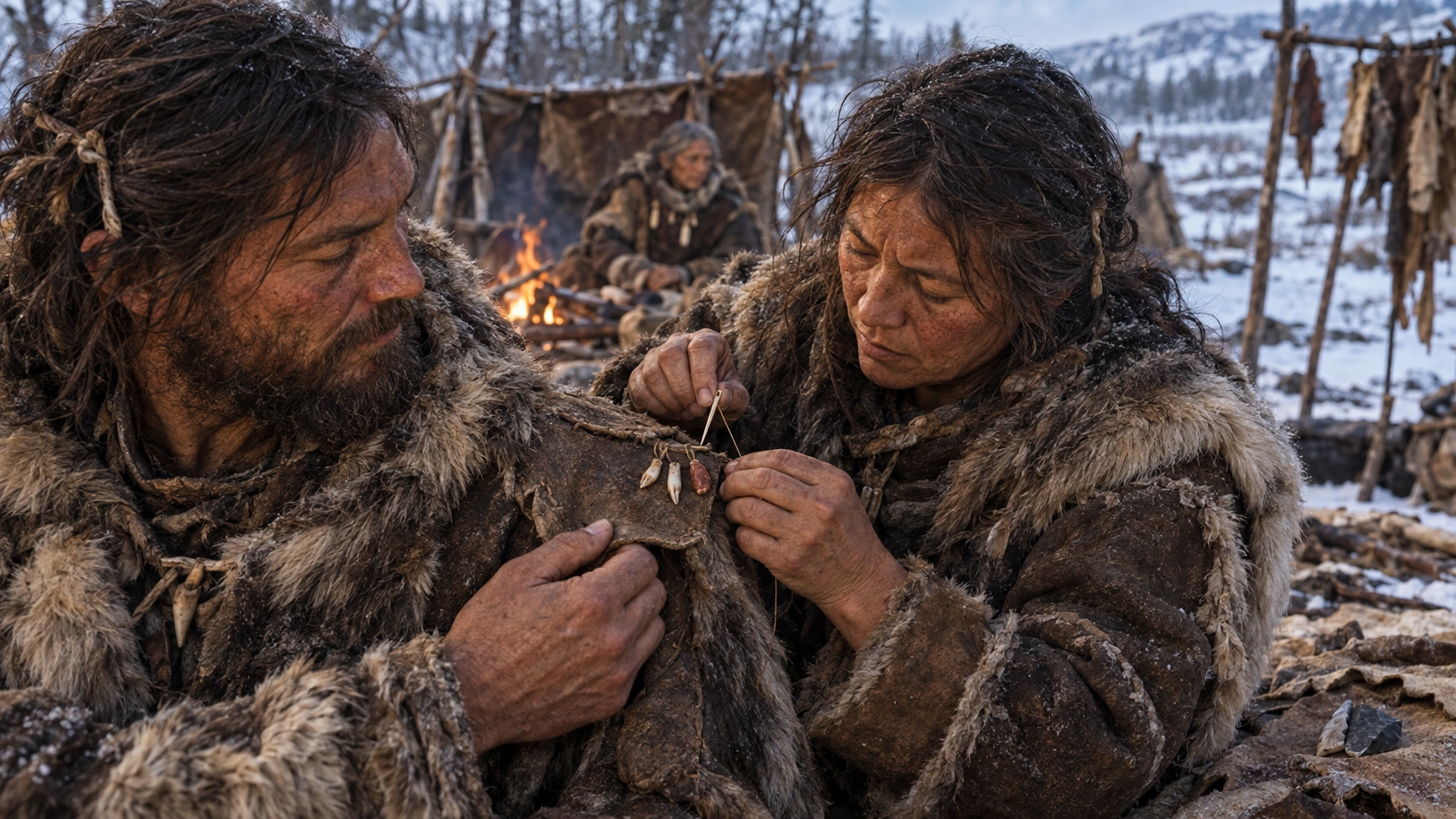
That winter, people mistook me for someone from another group because of what I was wearing.
“Couldn’t they tell by looking at your face?”
The youngest child asked.
“Not where I was living. Leave your face uncovered there, and your skin would freeze.”
Clothing did not begin then. People had been wrapping themselves in animal hides against the cold and rain for a very long time.
But a single hide draped over the shoulders was not enough. Every time you walked or raised an arm, a gap opened and cold air slipped inside. To live in a cold region for long, we needed clothes that stayed in place while we moved.
One woman in our group was especially good at making clothes. She chose several pieces of hide to fit the length of my arms and legs. Then she threaded sinew through a slender bone needle with a small hole at one end.
Each time the needle passed through the hide, it pulled the sinew after it. Compared with pushing a cord through every hole separately, she could join the pieces faster and stitch them more closely together.
What mattered was not how the needle was made. What mattered was how many gaps that small tool could close.
The new clothes did not gape at the shoulders when I lifted my arms. They did not slide down at the waist when I bent my knees. Over the close-fitting layer, I wrapped a broader hide, making it harder for the wind to reach my body.
I could also change what I wore with the weather. When the cold grew worse, I added another layer. When the weather eased, I took off the outer one. If something tore, I patched the hide and sewed it shut again.
Humans did not wait for their bodies to evolve to withstand the cold. By joining hides to fit the body and wearing them in layers, people with little body hair could survive in colder lands. When the weather changed, they changed their clothes. When clothes tore, they repaired the clothes, not their bodies.
My companion did not put down the needle when the clothes were finished. She began sewing small animal teeth, each pierced with a hole, along my shoulder.
“Those won’t keep out the wind.”
“I know.”
“Then why put them there?”
She pulled a hood over my head and raised the edge of the hide until it covered everything below my nose.
“How much of your face can anyone see now?”
“My eyes are still showing.”
“Not many people could recognize you from your eyes alone.”
She arranged the teeth in a pattern our group often used. Even with the wearer’s face covered, the ornaments on the shoulder showed which group they lived with.
I did not like them. The teeth clicked softly against one another whenever I walked, and they did nothing to keep me warm.
Before we left for the winter camp, I cut the sinew and took every tooth off.
A few days later, I reached a camp where several groups had gathered. The wind was so sharp that everyone had covered their faces, leaving only the area around their eyes exposed.
Even so, I could tell from a distance who had come with whom. People with shells on their chests sat around one fire. Those with red cords woven around their sleeves sat around another. Members of my group, with animal teeth sewn across their shoulders, sat at a third.
I walked toward their fire.
Two spears blocked my way.
“It’s me.”
“Who?”
I gave my name, but the spears did not move. The wind muffled my voice beneath the hide covering my face. My clothes no longer had anything my group would recognize.
Then the woman who had made them rose from beside the fire. She studied the way I walked for a long moment, came closer, and pulled off my hood.
“Where are the teeth?”
“I took them off. They were noisy.”
She stared at me in disbelief.
“With those gone, no one can tell you belong with us.”
The people holding the spears laughed and let me pass. Only then did I get a place by the fire.
That night, I set the teeth I had removed in front of her.
“Sew them back on.”
“I thought you said they were useless against the cold.”
“I thought keeping me warm was the only job clothes had.”
Smiling, she sewed the teeth back into place. This time, she added a stone of a different color at the center of the familiar pattern.
“What is that one for?”
“The teeth say you are one of us. The stone says which one.”
As clothing covered more of the body, paint on the skin and marks cut into it became harder to see. People did not stop showing who they were. Instead, they attached shells, teeth, colored cords, and stones to their clothes.
Needles did more than close gaps in clothing. They also attached ornaments that showed which group someone belonged to, what role they held, and who they were within that group. Clothing became both protection from the cold and a visible sign of identity.
The teenage girl looked down at the sleeve of her school uniform. The youngest child followed her gaze and pointed at the school emblem.
“You can tell which school my big sis is from just by looking at her clothes.”
“Which school I go to,” the teenage girl corrected.
I laughed.
Clothes hid the body, but people used ornaments on their clothes to show who they were all over again.