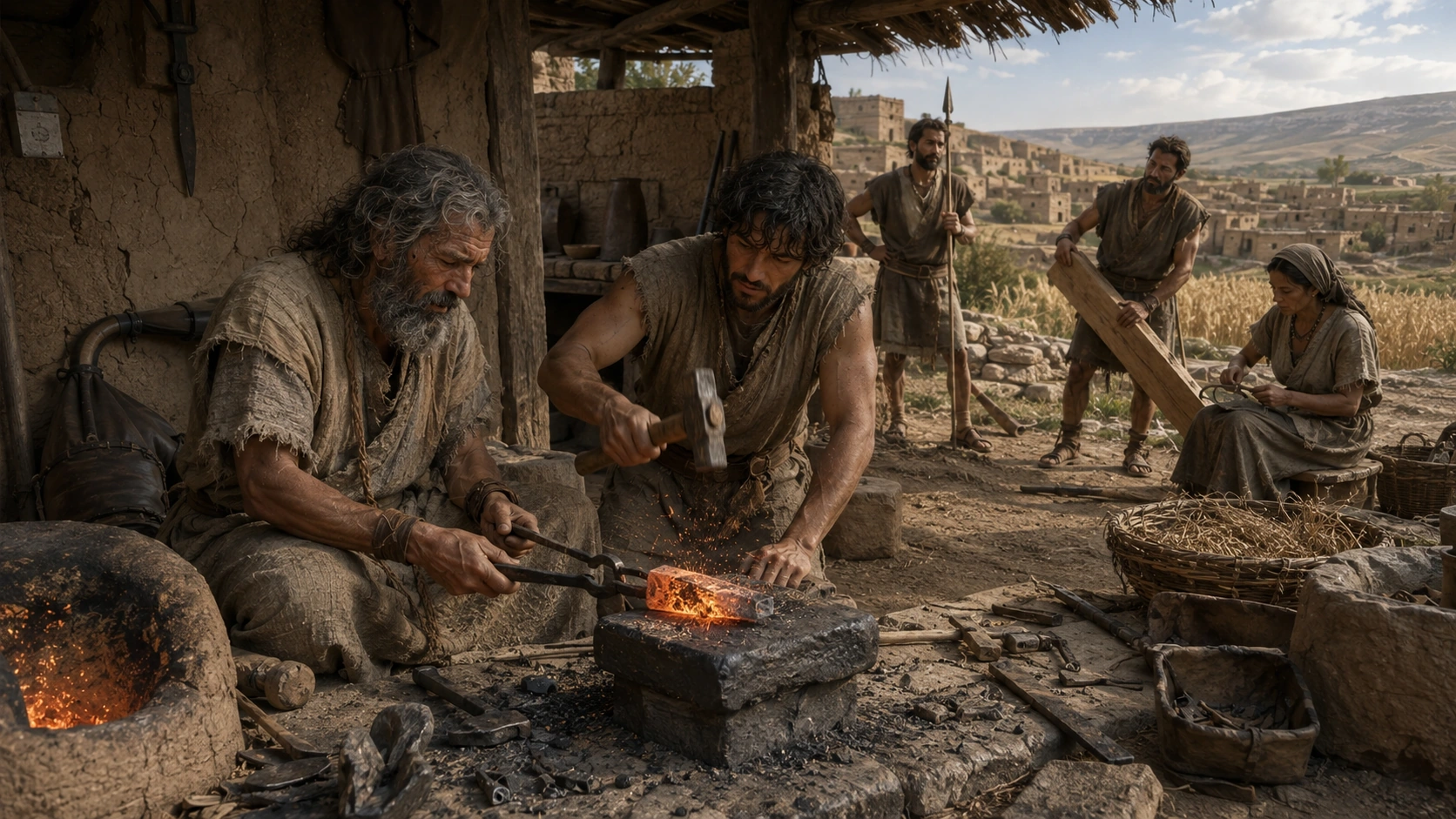
We put the black lump into the furnace three times.
Three times, it refused to melt.
Tada, the bronzesmith, pulled it out with his tongs and threw it onto the dirt floor. Charcoal dust and black grit scattered across the workshop.
“Copper melts. Bronze melts. Once they melt, I can pour them into a mold. This wretched thing swallows all that fire and still sits there like a rock.”
“It is a little flatter than before.”
“Because you got angry and hit it.”
After Ugarit fell, the copper and tin that once came through palace storehouses no longer arrived on time. Tada bought broken bronze knives and bent spearheads and melted them down. But even a village’s supply of old bronze eventually ran out.
Three customers waited outside the workshop that day. The guard captain wanted two spearheads. A carpenter needed a chisel to shape roof beams for the houses being rebuilt. A farmer had brought a sickle whose flint teeth had come loose.
Tada shook his last pouch of tin. The bottom answered with a dry whisper.
“There is enough bronze for one tool.”
“The spearheads come first,” the captain said.
The carpenter pointed at the fallen roofs.
“A house has to stand before you can store a spear in it.”
The farmer said nothing. She looked toward the ripe barley beyond the village. Each gust shook more grain from the stalks. Whatever she could not cut now would be missing from the winter jars.
I picked up the black lump and set it on the anvil.
“Let’s make the chisel from this.”
Tada caught my wrist.
“Did you miss the part where it would not melt?”
“Then we stop trying to pour it. We hammer it.”
We heated the lump again. This time we did not wait for it to melt. As soon as it glowed red, we pulled it out and struck it. Charcoal and stony waste split away. The iron trapped inside began to weld into a single piece.
Whenever it cooled, we put it back into the furnace. Tada cursed me for swinging too hard. I accused him of holding the tongs crooked. While we argued, the captain sighed three times and the farmer finally sat down to sharpen her flint blades herself.
By sunset, we had made one short, ugly chisel.
The carpenter set it against a beam and hit it with his mallet. The edge bit into the wood. On the second blow, it bent slightly to one side.
Tada snorted.
“Worse than my bronze chisels.”
“You don’t have a bronze chisel.”
The carpenter put the bent edge back on the anvil. I straightened it with two taps. He left a sack of grain inside the workshop and took the chisel with him.
No king had sent it as a gift. No merchant from a distant country had delivered the tin. Ore from nearer hills, village charcoal, and a smith’s mistakes had been exchanged for one person’s grain.
Early iron did not spread because it was always stronger than bronze. The first iron was often soft or uneven, and many pieces were worse than good bronze tools. What changed was the route to the raw material. Instead of waiting for distant sources of both copper and tin, more regions could try to turn their own ores into useful metal with local furnaces and hammers.
That day, Tada used the remaining tin to make one spearhead for the captain. He also reset the flint teeth in the farmer’s sickle. None of the three customers got everything they wanted.
But from the next morning on, we stopped trying to melt the black lumps.
We sorted the charcoal more carefully, drove air through the furnace for longer, and learned to choose the useful parts of each hot bloom. We folded and hammered them again and again. Some edges dulled almost at once. Others lasted far longer than we expected. Failed knives became chisels. Broken chisels became small awls.
After a few years, the line outside the workshop looked different. The servant of a wealthy household still brought bronze vessels for repair. Now a carpenter waiting with an iron knife and a farmer with an iron-edged tool stood beside him. Iron was becoming something made, repaired, and remade in village workshops, not merely a rare prize passed down from a palace.
The woman beneath the wall interrupted me.
“So once iron appeared, ordinary people could all get better weapons and farm tools?”
“Not that quickly. The pace differed from one region to another, and people kept using bronze and stone for a long time. Iron ore did not become metal by itself merely because it was more widely available. The work demanded charcoal, hot furnaces, smiths who could survive repeated failure, and people able to organize production year after year.”
Iron expanded more than the supply of metal. It multiplied the routes by which metal could be obtained. Dependence did not disappear, however. Societies relied less on distant tin routes and more on access to ore, forests, furnaces, skilled smiths, and the organizations that kept them working. As tools and weapons spread through different hands, production and military power shifted with them—and new rulers moved to control the workshops.
Many years later, I passed through the village again. Two old objects hung on the wall of Tada’s workshop.
One was a bronze spearhead stained green with age.
The other was our first black chisel, bent and straightened more times than I could count.
The spearhead was still sharp.
But it was the ugly chisel beside it that had rebuilt the houses.