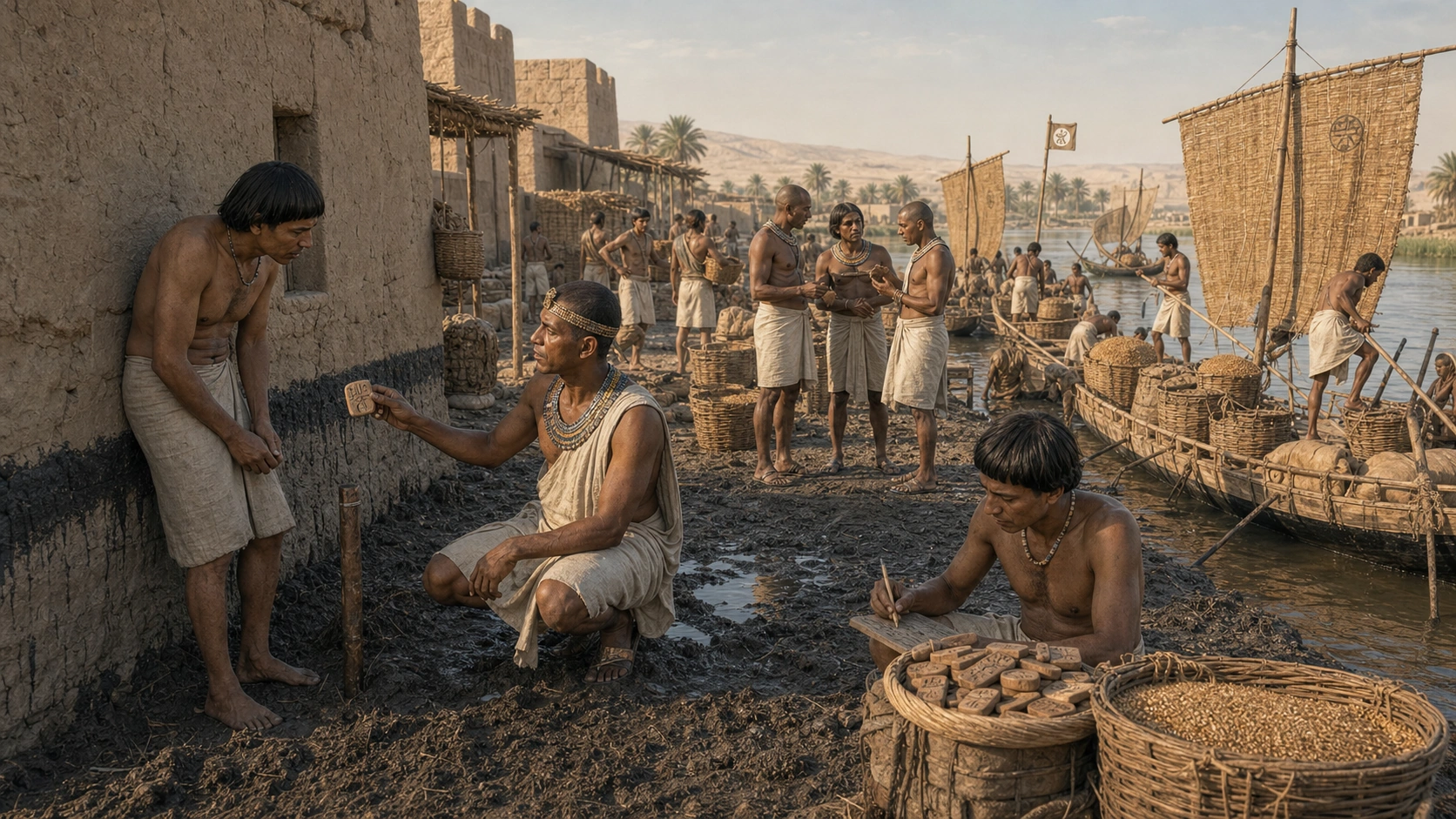
I was once caught trying to lower the Nile by a handspan.
Since I could not lower the river itself, I drove the water-level stake set up by the king's official deeper into the ground.
Floodwaters had stayed low that year. On higher ground the water had failed to reach, planting seed was unlikely to produce much of a harvest. Yet the boat that came to collect the king's share arrived as reliably in a low-flood year as it did in any other.
The officials marked the stake when the river reached its highest point. One night after the water receded, I pulled the stake out and drove it back in about a handspan deeper.
I thought that if the recorded water level was lower, they would take less grain from our village.
The next morning, a royal official looked from the stake to the freshly disturbed soil around it. Then he pointed to the mud line on the wall of a nearby granary.
“Did the stake sink into the ground as the river went down?”
“It might have.”
“Then I suppose the granary wall should have sunk with it.”
I said nothing. The mud line on the granary wall was at exactly the same height as the day before.
The official had someone return the stake to its original position. I expected him to call the guards. Instead, he first asked why I had done it.
“The water only came this far. We have less land to plant, but the king's share never gets smaller.”
“That is why we measure the height.”
“You took more in the years when the water rose higher.”
“If we take the same amount in a low year, there will be nothing left to collect next year.”
I do not know how much he truly cared about our village. But the height of the river gave the officials evidence of how large that year's harvest might be. They considered it alongside damage to the fields and the grain remaining in storage, then determined how much the village owed the king.
A lower recorded level could leave more grain in the village. A higher one could send more grain to the royal granaries.
That year, our village owed less grain than it had the year before. In exchange, the official told the village headman to put me aboard the next royal boat.
I paid for tampering with the stake not in grain, but in labor.
Measuring the river did not end with observation. The record helped determine how much grain to collect from each village and how many workers to take. Numbers describing nature began to decide how much food and labor people owed.
When the flood spread widely, there was more land to plant. When the water stayed too low, it failed to reach distant fields. When it rose too high, houses and embankments collapsed. Even the same flood could leave different damage and harvests in different villages.
That was why the officials did not look at the water level and leave. They inspected which fields had flooded, how much grain remained in each granary, where boats could land, and which embankments had failed.
They could not write all of that in long sentences. Instead, they left short marks for quantities, goods, and places. The records traveled by boat to other granaries and royal centers.
Once the information had been gathered, people could prepare the next tasks in advance. As the water began to rise, boats and workers were readied. When it receded, fields and granaries were inspected. As harvest approached, preparations were made to collect the grain.
No one had predicted the future exactly. They had watched the river's recurring changes and placed people and supplies where they would be needed before the time came.
The Nile's flood followed a seasonal cycle set by nature. Royal officials gathered workers and grain from many villages according to that cycle. As the same schedule repeated along the river, the Nile's cycle became a state schedule that moved an entire region together.
While the flood covered the fields, there was less farm work to do. During that time, royal boats traveled from village to village collecting workers. Some raised granary walls. Others unloaded stone and timber from boats or carried cargo moving between the upper and lower stretches of the river.
When the work ended, they received grain and beer from the royal granaries.
Our villagers were not the only people aboard those boats. Some workers came from upriver and others from downriver. Their speech and clothing differed, but the royal emblem carried by the official was the same.
The unification of Egypt did not make everyone wake up one morning feeling that they belonged to a single nation. Villagers still thought first of their own fields and neighbors.
But officials serving the same king arrived at similar times each year. Boats bearing the same marks carried grain and workers, and the same king's orders reached distant villages.
As officials repeatedly carried the same royal emblems and commands across conquered lands, villages far apart began moving according to one king's instructions.
The Nile was the long transport route that made this possible. Boats used the wind to travel upstream and rode the current downstream. The king could not visit every village himself, but his boats, officials, records, and commands could.
A woman seated beneath the wall asked a question.
“But what did the king actually do? The river flooded every year anyway.”
“The water would have come without a king. The king did not create the river. He made villages that had little to do with one another deliver grain and labor at the same time, according to the river's changes.”
A village headman could also inspect fields after the flood receded and gather grain after harvest. The king's power lay in repeating that work across many villages along the entire river.
Grain stored in royal granaries fed officials, guards, craftspeople, and boat crews. People who did not farm could continue working for the king. They then inspected more villages and collected more grain and labor.
The same administration could identify areas damaged by drought or flooding and send grain where it was needed. It could also discover which villages had harvested more and collect from them with greater precision.
A royal boat could avoid arriving when a village was weakest, or time its arrival for when the most grain could be taken. The same information could be used to help people or to extract more from them.
The king could not control the Nile. Instead, he recorded its changes and used those records to demand grain and labor from many villages. The grain he collected fed officials, boat crews, and guards, allowing him to repeat the same process across an even wider region the following year.
I had not really been trying to lower the river by a handspan.
I had been trying to lower the amount of grain the king could take on the strength of that water-level record.
The stake returned to its original place.
The king could not move the river. But whenever the river changed, he used that change to demand grain and labor from people.