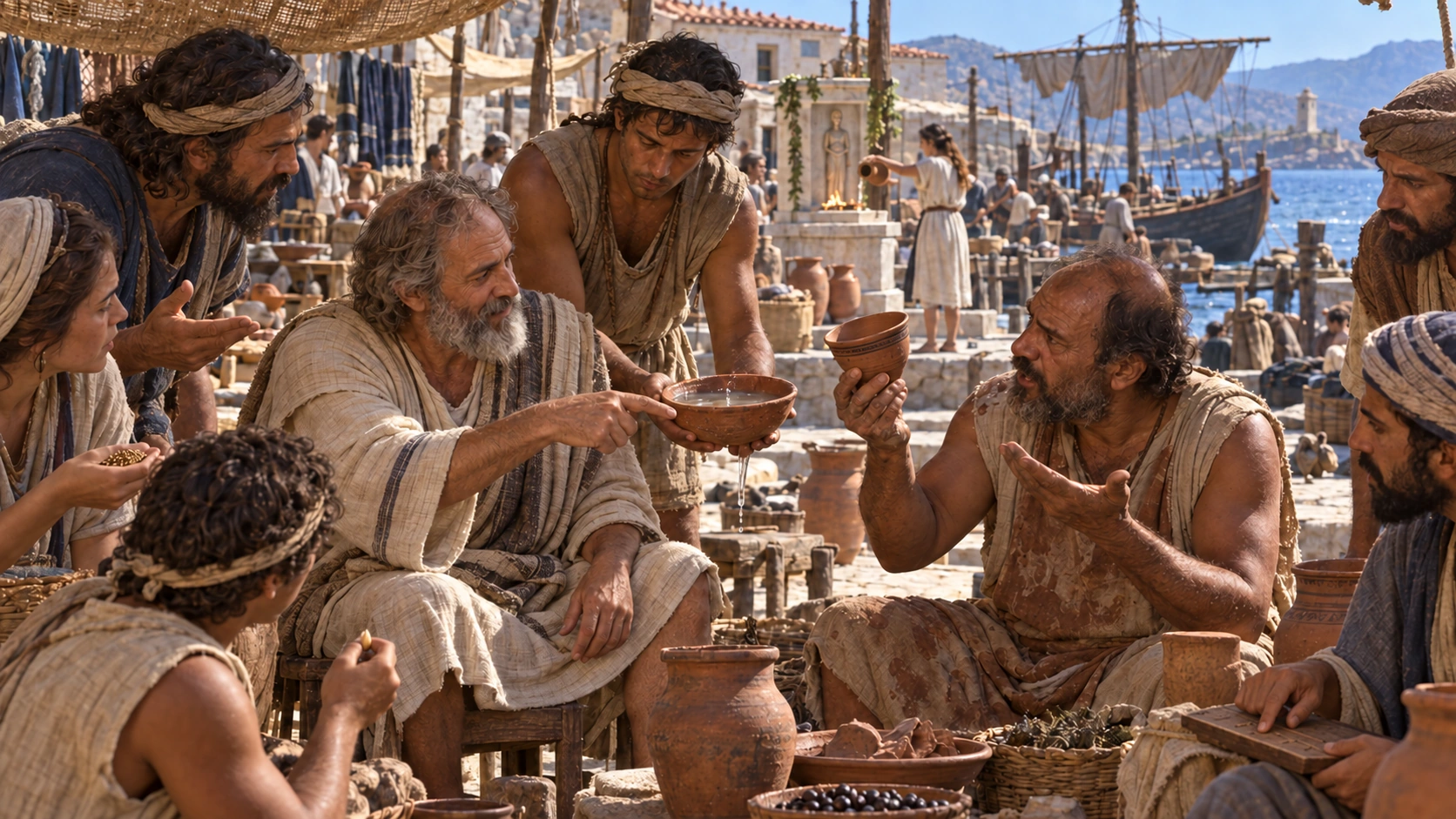
In the city where philosophy is said to have begun, I was carrying water.
A crowd had gathered in the shade near the harbor of Miletus: sailors, potters, scribes, and even men who had already finished preparing the day’s offerings. They were not there because they had nothing to do. Every ship brought this city foreign goods, foreign gods, and foreign ways of calculating. Different explanations collided here all the time.
That day, Thales stood at the center of the crowd.
“So you are saying everything in the world began with water?”
The question came from Lycon, a jar seller. He looked less interested in an answer than in finding a crack in one.
“Seeds are moist. Food carries moisture too,” Thales said, pointing to the bowl in my hands. “Dry things die. Life stirs in what is wet. I believe water is the beginning of everything.”
Lycon plucked a hair from his arm.
“Is this water too?”
The crowd laughed.
So did Thales.
“That is why the thinking is not finished.”
I liked that answer. When a singer got a divine genealogy wrong, he changed the song. Thales did something different. He pointed to water. He put forward something anyone could see and touch, then tried to explain the beginning of the world from it.
People still poured wine at the altar that day. Thales had not made the gods disappear. What changed was the direction of the question. When people asked why rain fell, they no longer had to look only at the mood of the sky. They could also look at water, wind, and the order of change.
Years later, Lycon shoved an empty jar into my arms the moment he saw me.
“Your friend said the world was water. Now this new man says it is not even water.”
“He was not my friend. I only carried the water.”
The man drawing the new crowd was Anaximander. He did not identify the beginning of everything with one visible substance such as water or fire. He spoke of the apeiron, an origin without fixed limits, from which opposites separated.
Lycon challenged him.
“Then was Thales wrong?”
“If water comes first, where does fire come from?” Anaximander asked. “A man may open a question without earning the right to lock his answer in place.”
Lycon leaned toward me.
“Wise men should never become merchants. Every few years they bring a different jar to market, but they never take back the old one.”
I set the bowl down before I spilled it laughing.
Anaximander also gave a different answer when people asked what held up the earth. The earth, he said, had no reason to fall in one direction because it stood in a balanced relation to everything around it. I looked at the ground under my feet. It did not collapse. No proof of his account appeared either.
But someone immediately asked, “How do you know the balance is equal?”
The question was neither an insult nor an act of impiety. It was simply the next burden carried by anyone who offered an explanation.
Natural philosophy did not begin when people abandoned the gods overnight. It began when they tried to explain change through the materials and order within nature, then exposed those explanations to other people’s questions. Causes now had to be sought not only in the authority of a story, but also in the world before their eyes.
More years passed.
Gray had spread through Lycon’s hair. My face had barely changed. He studied me for a long moment, then nodded toward yet another crowd.
“What is it this time?”
“Air.”
“Now they are selling what no one can even see.”
Anaximenes said air was the underlying source of everything. As air became thinner or denser, he argued, it turned into fire, wind, cloud, water, earth, and stone. He asked Lycon to purse his lips and blow across the back of his own hand.
“Cold, yes?”
Then he had Lycon open his mouth and breathe on it again.
“This feels warmer.”
Lycon tried it on his own hand several times.
“If he claims he can make stone this way, he owes me the price of a jar.”
He complained, but his eyes were smiling.
Water. The boundless. Air.
The three answers disagreed. None of them, taken literally, matches modern natural science. That disagreement was the important part. A later thinker could reject an earlier answer. The next could try to repair a weakness in both.
Scientific thinking did not start with the correct answer already in hand. It started with clear explanations that could be wrong, demands for reasons, and the possibility that a better account could displace an older one. Knowledge was beginning to shift from the property of an authority into a shared process of challenge and revision.
The woman beneath the wall asked, “Does that make them the first scientists?”
“Calling them modern scientists would go too far. They did not have modern experimental methods, mathematical verification, or scholarly institutions. Many of their explanations were wrong, and much of what we know about them comes from writers who lived centuries later.”
“Then why call this a beginning?”
“Because the rule of the question outlived the answers. Look for causes within nature, and let anyone ask where an explanation fails.”
Lycon never managed to put a price on any of the three answers.
But whenever the next gathering began in Miletus, he was always the first man in the front row.