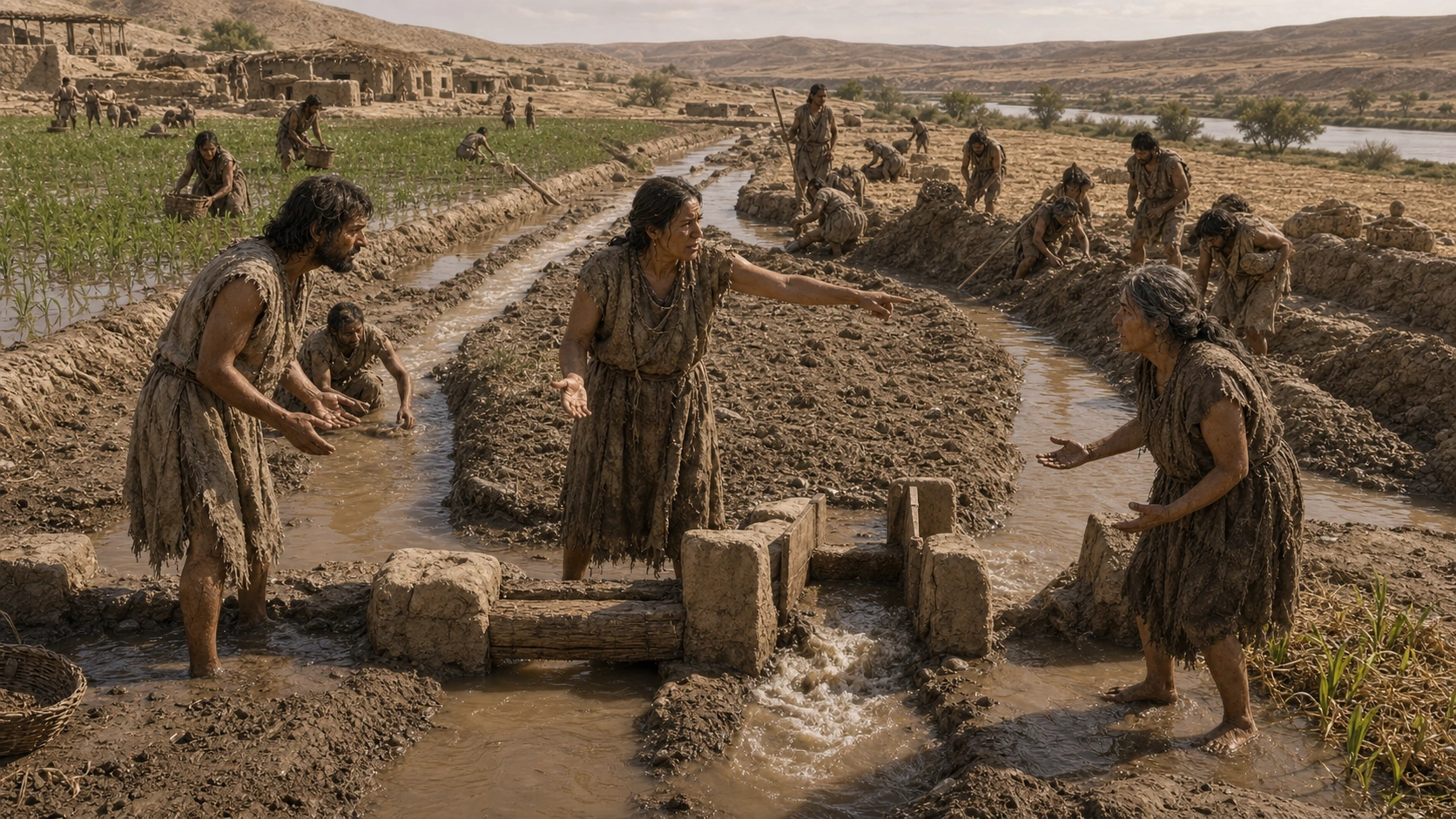
I once stole water.
More precisely, I diverted water to my field at night when it was supposed to flow to the fields below mine.
When we first began working fields, all we could do was wait for rain. If it came at the right time, the seeds grew. If the clouds passed us by, we could only stare at the cracked earth and wait. The farther a field lay from the river, the more its harvest depended on the weather.
Then people began drawing small channels from the river toward the village. The canal split into branches between the fields and carried water to ground that had once been too dry for sowing.
We could wet the fields even when it did not rain. We could farm farther from the river and open the channels when the crops needed water most.
Irrigation did not create water where none existed. People redirected water that was already flowing and sent it to the fields that needed it at the right time. This allowed them to farm more land than they could when they relied on rain alone.
My field was near the upper end of the canal. One year, the heat continued for so long that the young shoots began to dry out. My turn to receive water was the following day.
I thought the shoots would be dead by then.
That night, I went to the canal and blocked the water flowing toward the lower fields. Then I opened the branch leading to mine. I meant to wet the ground only a little before turning the water back.
But the dry soil swallowed it quickly. One side of the field grew dark with moisture while the other remained pale and dry. Each time I decided to wait just a little longer, the night grew later.
The next day, the woman who worked the field below mine came looking for me.
“You held the water too long, didn’t you?”
“My field was drying out too.”
“So you dried out mine instead?”
The water had reached only the edge of her field. Several rows of shoots in the middle were yellower than they had been the day before.
I wanted to say that no one’s name was written on flowing water. But the wet mark beside the canal spread wide in front of my field and became visibly thinner below it.
The longer I kept the water, the less reached her field. The marks in the soil made that clear.
People gathered beside the canal. Those with upstream fields argued that it was only natural for them to use water that reached them first. Those downstream answered that there had been no point in helping dig the canal if nothing reached their land.
In the end, we made a schedule. We decided in advance when each field would receive water. When one household’s time ended, it had to open the branch leading to the next field. Anyone who took another household’s turn would be moved farther back in the schedule the next time.
The rules did not stop with dividing the water. When mud collected in the canal, everyone had to help clear it. When a bank collapsed, people had to repair it even if it was not their turn to receive water. If one section became blocked or broke, every field below it went dry.
A few days later, one side of the canal collapsed just before my turn. The water spilled into low ground instead of reaching the fields.
My name could be next on the schedule, but that meant nothing if the canal was broken. The water promised to me could arrive only if other people helped maintain the entire channel.
When we depended only on rain, we could blame the weather for a failed crop. Once we had a canal, people had to decide who was responsible. Who had kept the water too long? Who had failed to appear on the day of repairs? During a drought, which fields should be saved first?
The woman from the lower field took charge of the schedule after proposing it. At first, she only remembered which household followed which. Soon, she also had to remember the days set for repairs and the people who had failed to come.
As the drought grew worse, the fixed order was no longer enough. She had to decide whether newly sprouted fields or fields close to harvest should receive water first. She also had to decide whether a household caring for a sick relative should lose its turn in the same way as one that had simply refused to help.
Whenever water became urgent, people went to her. She did not own it. But when she changed the schedule, some fields survived while others dried out.
At first, her task had been to remind people of rules they had made together. As time passed, people began waiting for her judgment when the rules did not provide an answer.
The man sitting closest to me asked a question.
“Did that woman become the leader of the village?”
“Not immediately. At first, she only remembered the agreed order and told people when their turn had come. But as the drought worsened and exceptions became more common, the decision about whose needs came first mattered more—and so did the person making it.”
One canal did not create a king or a state. But sharing a canal required people to organize labor and time, remember turns and duties, and distinguish between someone who broke a rule and someone who had been unable to follow it. When neither side would give way in a dispute, someone also had to make a decision.
Once people shared a canal, a choice made by an upstream farmer could change the harvest downstream. They created turns to divide the water, worked together to maintain the canal, and penalized those who broke the rules. When the rules alone could not settle a problem, the person who judged the exceptions gradually gained authority.
We dug canals to control water.
Then we needed rules to control what people did with it.
The person who decided when those rules should bend could change another household’s harvest.