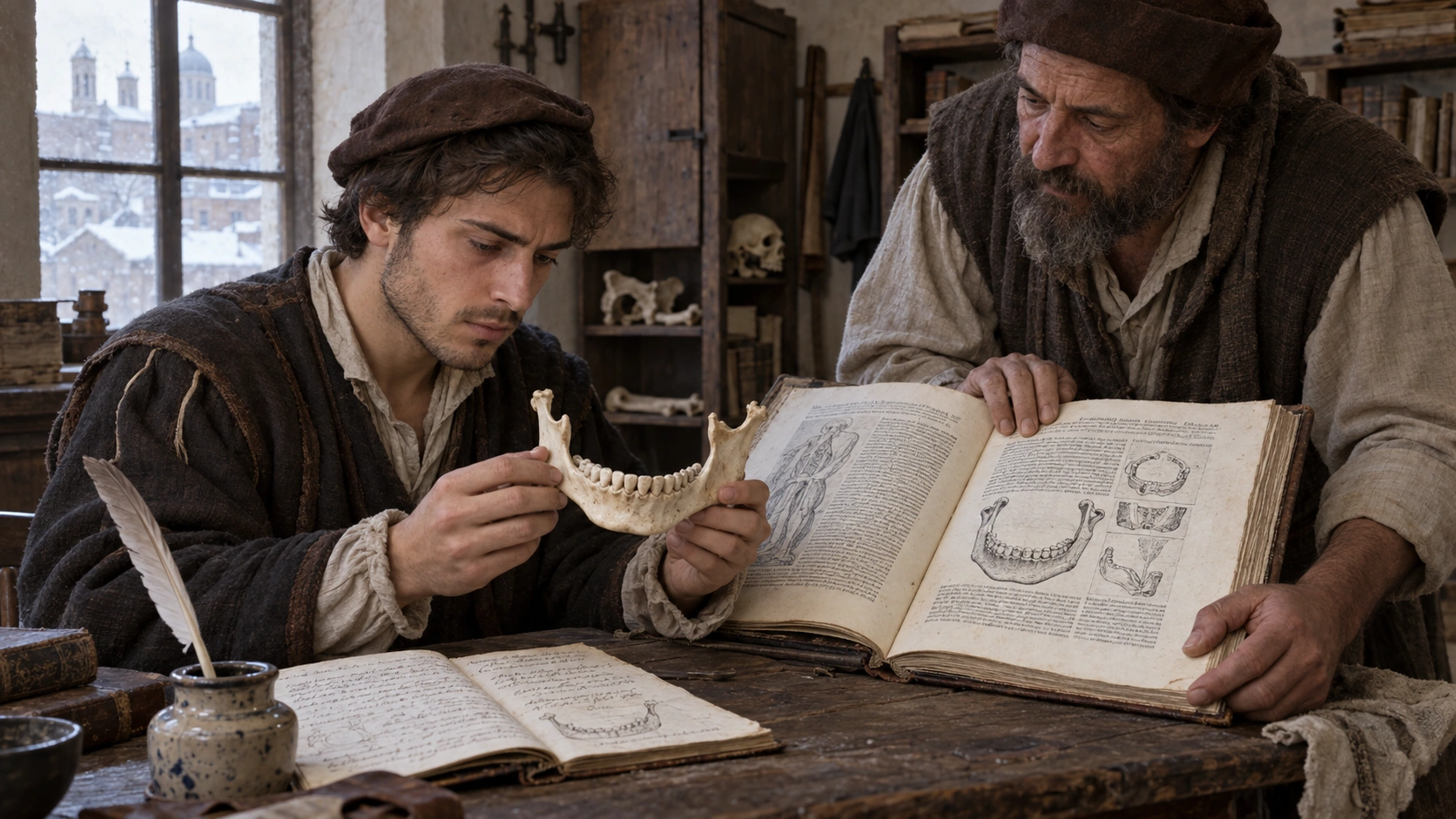
Niccolò examined a perfectly sound jawbone as though I'd handed him a faulty one.
He turned it over, ran a finger along the chin, and tried pulling the ends apart a little. When it still refused to split in two, he looked at me.
“Have you got another one?”
“What's wrong with this one?”
“It's not what I was taught.”
He opened his notebook. According to his notes, the human lower jaw consisted of two bones joined at the chin. But the adult jawbone I'd given him had no seam separating the two.
In the winter of 1543, I worked in Padua, carrying and putting away teaching materials for the university. Niccolò was a medical student. He took great care over his notes. His handwriting was so neat that anyone who didn't know better might have trusted the contents too.
I fetched another jawbone from storage.
There was no seam in that one either. This time, Niccolò spent a long while looking at his notebook.
“Did I write it down wrong?”
He hadn't come up with that explanation himself. He'd learned anatomy based on the writings of Galen, a physician who had lived long before us. His name came up endlessly in lessons. When people needed to explain some difficult part of the body, they often turned to his writings.
That year, though, Vesalius published On the Fabric of the Human Body.
Niccolò found the section on the lower jaw in a borrowed copy of the new book. It described the human lower jaw as a single bone. The illustration beside the text matched the bone in his hand too.
He set the bone next to the picture. Earlier, he'd been looking for something in the bone that agreed with his notes. Now he was checking whether the book agreed with the bone.
Galen hadn't simply made up what bodies were like. He had learned a great deal by dissecting and examining animals. The trouble lay in applying some of what he'd seen in animals to humans. No matter how long people had been taught those descriptions, human bodies weren't going to change to fit them.
Vesalius dissected human bodies himself and checked where they differed from the old accounts. He recorded what he saw in words and detailed illustrations. Even readers far away could see what he claimed to have found and compare it with a body in front of them.
Niccolò picked up his pen, but he didn't make the correction straight away.
“If I write that this is wrong, I'll have to check the rest too.”
He'd memorized plenty besides the passage about the jaw. Changing one line was easy. What he dreaded was having to go back over everything else because that one line was wrong.
I held the new book open for him. He crossed out “two bones” in his notebook.
If a human body didn't match the book, it was the explanation in the book that needed changing—not the body. Finding and correcting errors through observation would let the next person move on to a new problem instead of learning the same mistake.
Around that time, another book arrived at the university. This one said even the ground beneath our feet was moving.
It was Copernicus's On the Revolutions of the Heavenly Spheres. Niccolò borrowed it briefly from someone who taught astronomy. In its diagram, the Earth wasn't at the center. It was placed in orbit around the Sun, like the other planets.
He showed me the diagram, then glanced down at the floor.
“I could put my hands on the jawbone. How am I supposed to do that with this?”
I stamped my foot. All that told me was that the floor was solid.
We saw the Sun and stars travel across the sky. A stationary Earth and a moving sky fitted what we saw every day. Saying the Earth moved meant asking us to change that familiar explanation first.
The woman by the wall uncrossed her arms.
“I know the Earth moves because that's what I was taught. If I just looked at the sky, I'd think the Sun was moving.”
“People then were judging by what they saw too. The question was how to explain the movement they could see.”
Some planets would move one way among the stars, then seem to go backward for a while. Mars was one of them. Astronomers before Copernicus had known about this and explained it using a system of circular motions with the Earth at the center.
Copernicus treated the Earth we observed from as moving too. As the Earth caught up with and passed Mars, Mars could appear to move backward when seen from the Earth.
I remembered a time I'd traveled in a cart. As our cart overtook another, the other cart had seemed to slip backward for a moment, even though it was still going forward.
That comparison wouldn't let me calculate the movements of the heavens. But I could see why the observer's position mattered when judging what was moving.
We could bring a body closer and examine it again. We couldn't do that with the sky. We had to record the positions we saw and compare them with the calculations meant to explain them. Choosing a diagram we liked wasn't enough.
Before taking the book back, Niccolò said to me,
“The new book was right about the body. We should follow the new one about the sky too, then.”
I turned a page covered in circles and numbers. I couldn't check all those calculations. Understanding one diagram wasn't the same as checking the whole book.
“Earlier, you asked me to fetch another bone because your notes had to be right.”
For a moment, Niccolò said nothing.
Later, I saw people gather more observations and revise their calculations of how the planets moved. Copernicus's book wasn't the final answer either.
A new explanation isn't right just because a more famous person says it. We had to judge it by how well it explained what we observed and how accurately it predicted what we would see next. Knowledge can keep advancing only if new answers can be checked and corrected too.
Back in Padua that winter, Niccolò took the borrowed book away and left his notebook on the desk. Where he'd written “two bones,” it now said “one bone.”
I was about to close it when I noticed a small note underneath.
Confirmed in the two adult lower jaws examined today.
The next day, Niccolò asked to see another bone.
“Weren't yesterday's enough?”
“I want to check something else I was taught.”
He opened his notebook and pointed to a line he hadn't crossed out yet. I opened the storage cabinet again. Now that Niccolò had started checking things one by one, I had more work to do. At least I no longer had to hunt for a different bone just because the one in his hand didn't agree with a book.