“Was breaking a rock really such a big deal?”
One of the children asked.
“What mattered wasn’t that the stone broke.”
I set the stone down in front of them. It was an ordinary rock with a sharp edge where one side had broken away.
“It was that we didn’t throw the broken piece away.”
“If it was broken, wouldn’t you throw it away?”
“Maybe now. Back then, we didn’t draw the same line between broken and whole. We barely had anything we could say we had made ourselves.”
The youngest child reached for the stone. I turned it over so the sharp edge faced down.
“My memories of that time don’t come in sentences. Smell, pain, and hunger come first.”
The smell of stale blood. Wet earth. Saliva pooling in my mouth.
A dead animal, gone cold. Red meat clinging to its leg.
I pulled. It stretched. It did not tear.
I bit it. Scratched it with my nails. Blood gathered beneath them.
The children watched me in silence.
“No, I suppose I don’t have to tell it like a caveman.”
“Did you really think in fragments back then?”
“My thoughts didn’t run in words the way they do now. But that doesn’t mean I have to tell the whole story in broken sentences.”
I smiled.
“I’ll tell it with the words I have now. I just won’t add thoughts I didn’t have then.”
The food was right in front of us, but it clung to tough hide and sinew that our hands and teeth could not tear through. When a smaller companion reached for it too, I shouldered them aside, afraid they would take my share. Hunger did not make us kind.
“Who was the smaller companion?”
“Someone from my group. Not an animal. I don’t remember their name or age. I only remember that they were smaller than I was.”
“You shoved them?”
“We did worse than that over food.”
The child’s expression tightened. I did not try to excuse myself. I simply went on.
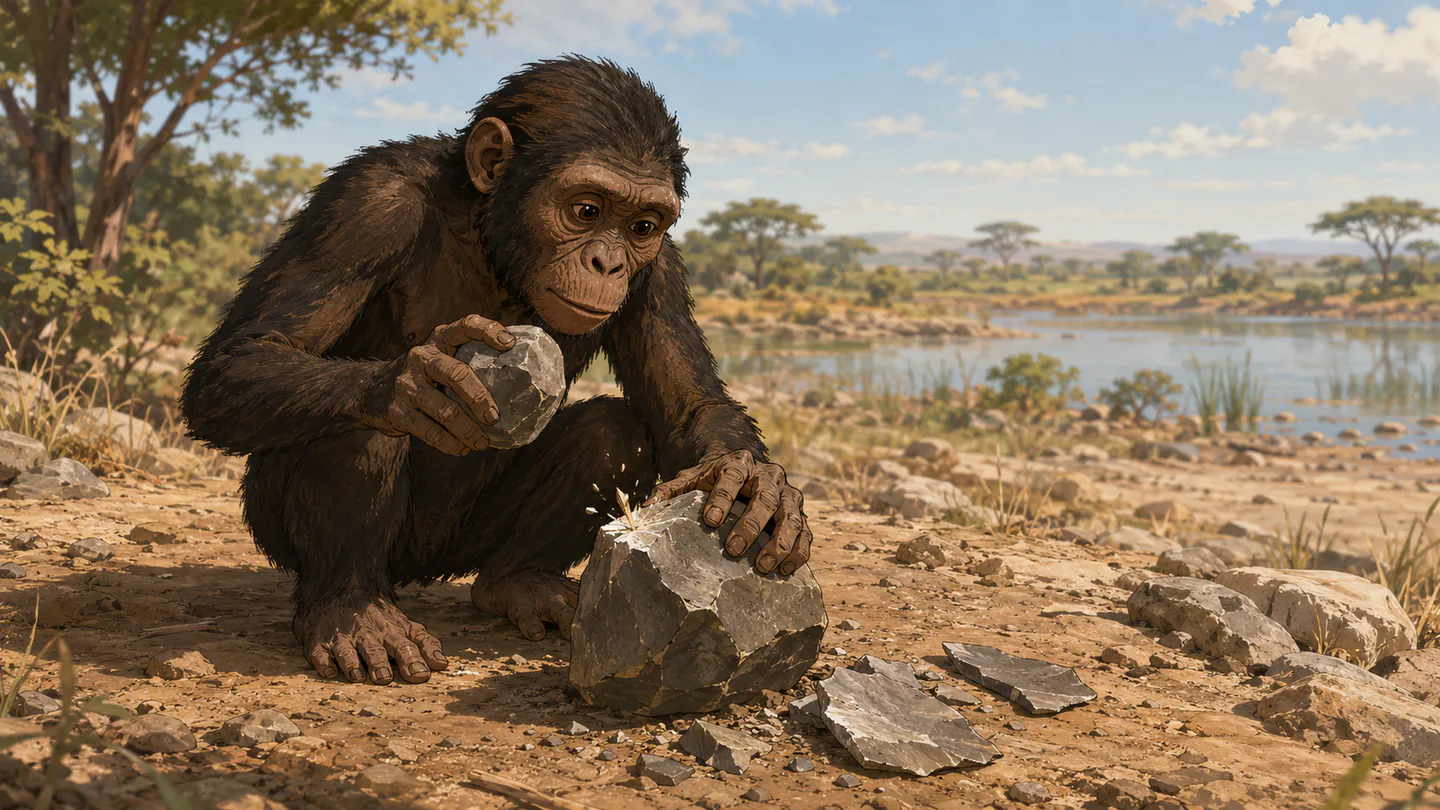
I picked up a nearby stone and brought it down, trying to crack the bone or knock the flesh loose. My first blow missed. The stone in my hand struck the one on the ground with a loud crack. A piece broke away, but the food stayed where it was.
Growing impatient, I struck again. Heat flashed across my palm, and blood began to run. The broken piece had cut me.
I almost threw it away in anger. Then I saw the edge gleaming. When I touched it, my skin split open again.
This thing bites.
If it could cut my hand, I thought it might cut through the tough hide and sinew too. I pressed the broken edge down and pulled, but it kept slipping in my bloody grip. When my companion lunged for the food again, I curled around it and bore down harder.
At last, the sinew parted, exposing the red meat beneath. I tore off as much as I could hold and swallowed it before I had even chewed. My companion clawed my arm. I started to shove them away again, then slid the sharp flake toward them instead.
They looked from me to the stone. Then they copied my hand—pressing, pulling, and pressing again. This time, we both ate.
“Was that the first knife?”
“It had no handle, and its shape was crude. It could easily cut your hand too. But it did the work of a knife. It cut open something we had never been able to open before.”
“Were you the first person to make one, mister?”
The question came from the girl in the school uniform, the youngest child’s older sister.
“There’s no way to know.”
“But you said you remember it.”
“I remember it happening to me. Someone in another group may have done something similar earlier. It was an age that left no names or records behind. I’m not claiming to be the first inventor. I’m telling you about one of the many moments when something found in nature became a tool.”
The girl thought about that, then let the matter drop.
We had no word for a tool. We had no way to preserve the name of whoever came first, or a date to mark the day. But even after we had eaten, I kept that piece in my hand for one clear reason. A rounded stone could pound. A broken stone could open what had always been closed to us.
“So it didn’t become a tool just because it broke?”
It was the child who had asked why we had not thrown it away.
“What makes you say that?”
“Rocks must have broken before. It only became a tool when you used the edge to cut, then kept it because you wanted to use it again. Right?”
I looked at the child.
“Right. Stones must have broken countless times in nature. But once we recognized what a broken edge could do and chose to keep it, our relationship with stone changed.”
“Then it wasn’t just a rock you picked up. It was a rock you had changed so you could use it.”
“Exactly. That was the difference.”
I understand it now. There is only a narrow gap between picking up what nature offers and changing it to give it a new use. That day, our hands pried that gap open for the first time. Until then, we had taken nature as it came. From that moment on, the natural world became something we could reshape with our own hands, drawing new possibilities from what was already there.
I picked up the stone again.
“The stone broke.”
“And you didn’t throw it away.”
“That’s right.”
I slowly ran my thumb along the sharp edge.
“We didn’t throw it away.”