The day the conquering army took Babylon's storehouses, the victors came closer to going hungry than the defeated city did.
Alexander had defeated Darius at Gaugamela, the gates of Babylon had opened, and new seals had replaced the old ones on the royal storehouses. The Macedonian soldiers cheered when they saw grain piled higher than a man could reach.
Breaking into a storehouse, however, was not the same as knowing how to use what was inside.
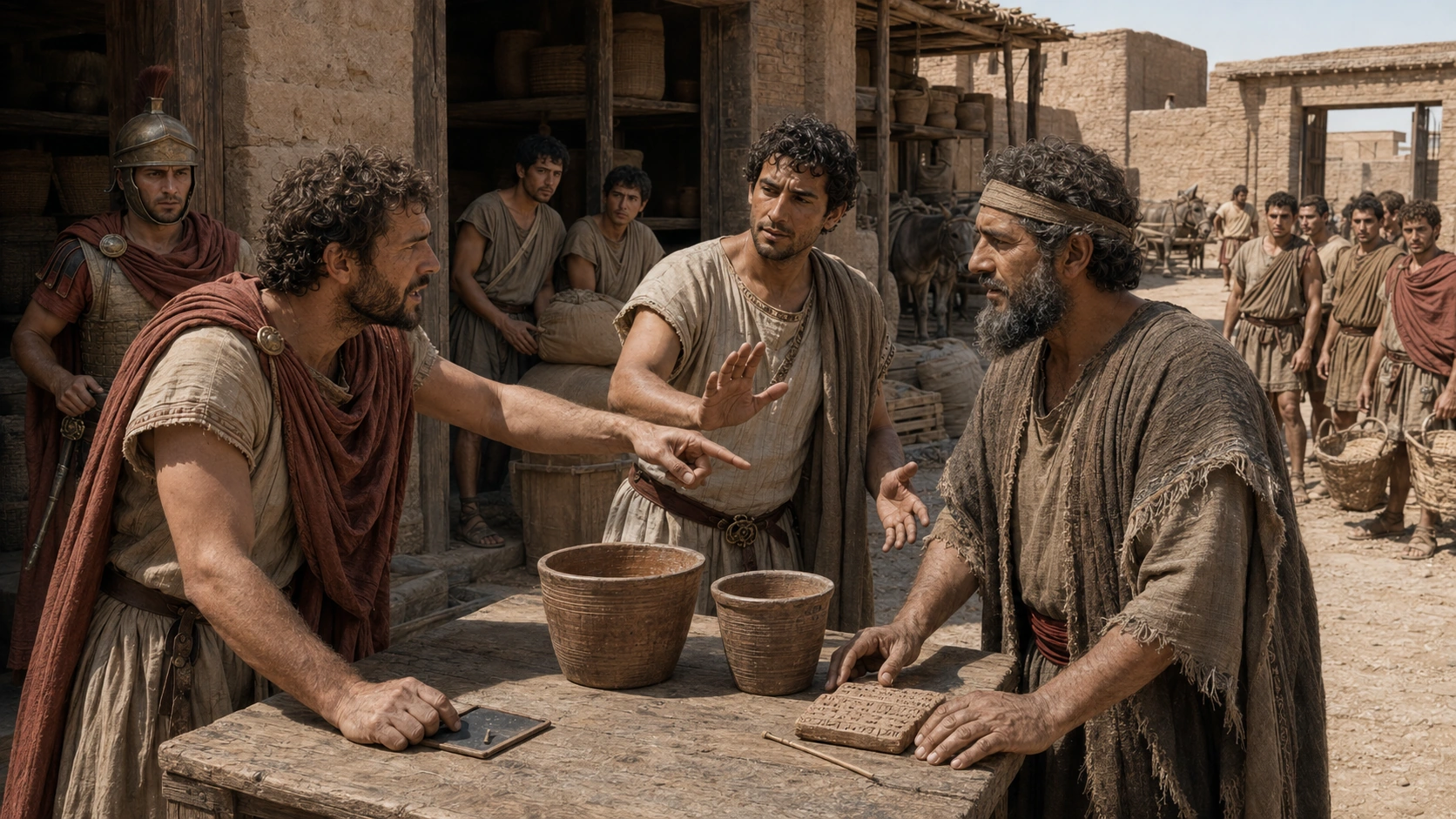
Philon, a Macedonian supply officer, dropped a clay tablet in front of Bel, one of the storehouse scribes.
“I want a thousand measures of barley issued today.”
I translated his Greek into words Bel understood. The scribe listened but made no move to open the door.
“A thousand measures by which vessel?”
Philon's expression hardened.
“Does the barley change with the bowl?”
“No. The amount your soldiers receive does.”
Bel set two measuring vessels of different sizes on the floor. Fill each one the same number of times, and the carts would carry very different loads. Philon's order gave a number. The Babylonian tablets recorded the standard unit behind such numbers.
Philon jerked his chin at the guards.
“Open the doors. We can count every sack ourselves.”
Bel snorted.
“The grain in some of those sacks is old and must be issued first. Some has been set aside for the next sowing. If you do not know which village sent the sacks, you will not even know where the empty sacks belong. You can throw me out, but you cannot throw out the knowledge you never had.”
A guard reached for his sword. I stepped between them.
“Kill him, and you keep the storehouse but lose the instructions.”
Philon glared at me.
“Then you solve it.”
That was easy for him to say.
I had Bel write down the standards used by the storehouse. Philon told us the daily ration for one soldier and one horse. We placed the two systems side by side and made a table for converting between them. Bel marked which grain had to leave first. Philon wrote each unit's ration beside it.
The new record was useless without both men. Bel knew the storehouse but not the size of the Macedonian army. Philon knew his army but could not read the storehouse records.
By late afternoon, the first loaded cart rolled out. Philon told Bel to return the next morning.
“Is that an order?” Bel asked.
“Would you come any faster if I called it a request?”
“No. But the work would go faster if you learned a few of our words.”
The next morning, Philon arrived knowing three local terms for grain measures. His pronunciation was dreadful, but for the first time, Bel opened the storehouse without an argument.
The man beneath the wall raised a hand.
“Did Alexander unite all those countries under one system?”
“The truth is not that tidy. He did not build roads and government across an empty land. The Persian Empire had already linked a vast territory through roads, storehouses, taxation, and administration. Alexander overthrew its rulers, but to move anything across a realm of similar size, he had to use its routes and depend on local officials.”
Soldiers were not the only people who moved with the conquest. Merchants, craftspeople, scribes, and families moved as well. Garrisons appeared and cities were founded. Greek spread as a shared language of administration and trade in many cities, but local languages and customs did not vanish. Different gods, clothing, artistic styles, and traditions of rule met in the same streets and royal courts. People borrowed what they needed, changed it, and made it their own.
Nor was this the first meeting between Greeks and Persians. The two worlds had been fighting, trading, and exchanging people for generations. Alexander's campaigns did not create contact from nothing. They forced existing connections across a much wider region.
Another woman spoke.
“So should we say conquest advanced culture in the end?”
“No. New markets and new art could never compensate someone who lost a city or a family. The people set in motion by conquest included not only merchants who chose to travel, but captives and soldiers sent far from home. Cultural exchange does not erase the violence that caused much of that movement.”
I remembered the guard whose hand had closed around his sword outside the Babylonian storehouse.
“But conquerors could not control everything that followed, either. The moment they claimed a vast territory, they became dependent on the people, knowledge, and institutions they had conquered.”
The greatest consequence of Alexander's conquests was not simply that one king held an enormous empire. His armies could not eat or move without using Persian roads and storehouses, local languages, and existing administration. That dependence sped up the movement of people, goods, and knowledge across a wider region and brought different ways of life together in the same cities. Alexander's empire soon broke apart, but the connections created and intensified under it did not disappear with him.
After Alexander died, his generals fought over pieces of the empire. The ruler's seal on the Babylonian storehouse changed more than once.
One day, Bel's young apprentice held up a fresh record.
“Whose name do I write this time?”
Bel looked outside at the banners carried by the soldiers.
“The king they follow today.”
“What about the grain totals written below it in both languages?”
“Leave those alone. The people working here will still need to read them when the next king arrives.”
The apprentice changed only the name at the top. Below it, the grain was still being counted in both systems.