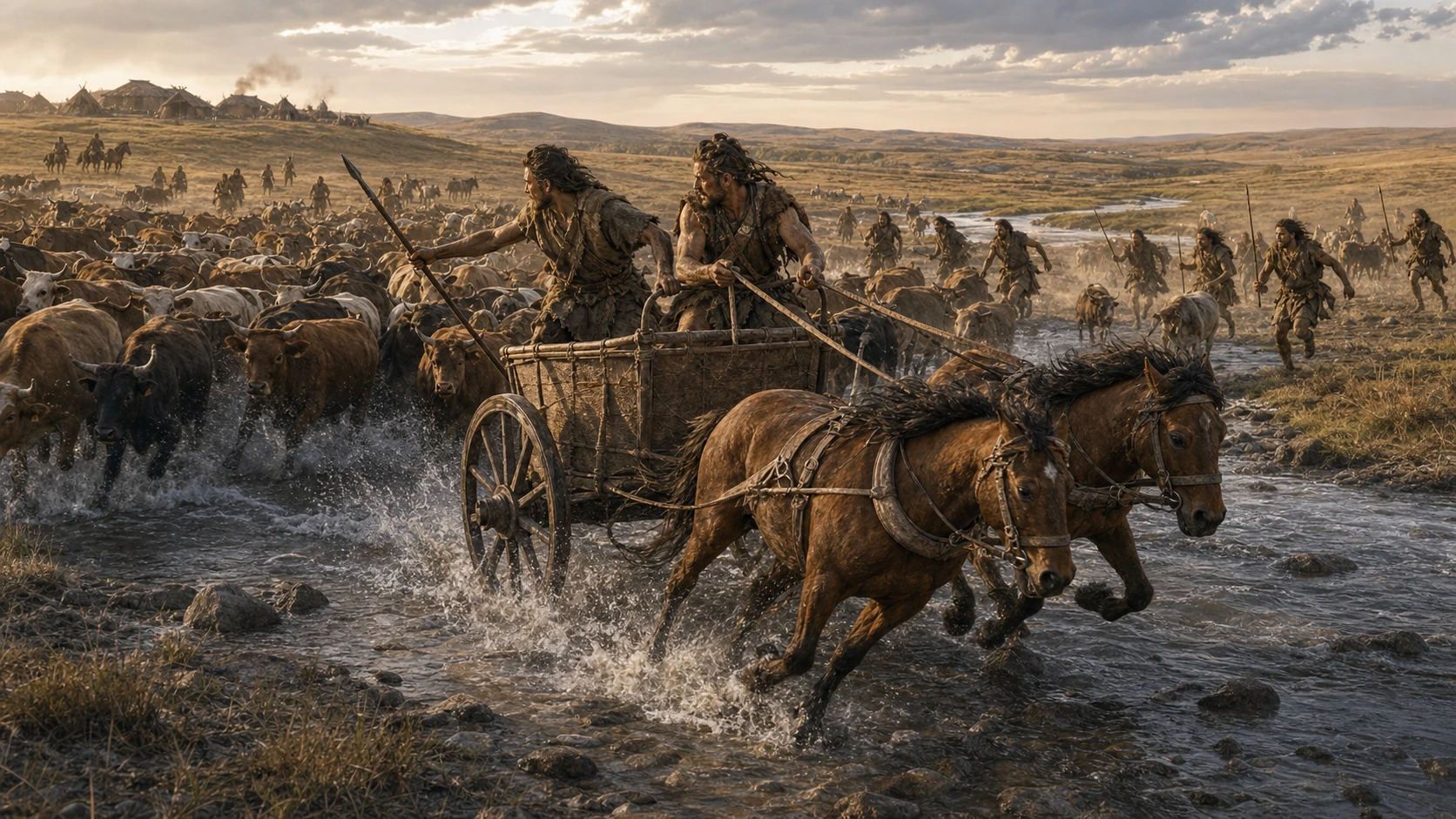
The first time I rode in a chariot, I threw up before we ever reached the enemy.
We had not even seen an enemy yet.
The man sitting at the front of the group beneath the wall laughed.
“Was it really that fast?”
“It was fast enough for someone who had only ridden in freight wagons. More importantly, there was nowhere to hide from the shaking.”
Around 2000 BCE, I lived on the open steppe east of the southern Urals, tending horses.
Every vehicle I had known before then was built to carry more. Thick wooden wheels and a broad bed held the weight while oxen pulled it slowly. Push such a wagon too hard, and an axle would snap or a wheel would sink into the ground.
The new vehicle was built for the opposite purpose. It carried almost nothing, and two people filled its narrow platform. But its wheels were supported by spokes instead of solid wooden discs, making them far lighter. A trained team of two horses pulled it instead of oxen.
The chief’s son took the finished chariot around once, then tossed me the reins. We had tended horses together since childhood, so we spoke freely when no one else was listening.
“Try it.”
I looked down at the narrow platform.
“This thing can’t even carry a proper sack of grain.”
“It isn’t meant to carry grain.”
“Then what does it carry?”
He climbed up beside me with a spear in his hand.
“The man holding the spear.”
I understood as soon as the horses began to run. The chariot crossed the steppe far faster than any freight wagon. The problem was that my body had not learned what to do with that speed.
Every small stone beneath the wheels lifted my feet off the floor. I gritted my teeth and held on to the reins. When the practice run ended, I dropped beside the chariot and emptied my breakfast onto the ground.
The chief’s son patted my back.
“We’ll go farther tomorrow.”
“You can drive tomorrow.”
“I have to throw the spear.”
Our roles had already been decided.
A few days later, smoke rose from the eastern pasture. Armed men had struck down two herders and escaped with dozens of horses and cattle.
Our people grabbed spears and shields and began to run, but the stolen herd was already far away. Even if the men caught up, they would have to fight after exhausting themselves in the chase.
The chief’s son climbed into the chariot.
“You drive.”
“I still throw up when I ride this thing.”
“You haven’t eaten today.”
He had a point. I took the reins.
We knew where the raiders were going. There were only a few shallow places where they could drive a herd across the river. Instead of following their tracks, we cut across the flat grassland toward the nearest ford.
The chariot could not move quickly through a rocky gully. Speed meant nothing if a wheel dropped into a hole. I chose level ground, even when it added distance.
We reached the ford before sunset.
The stolen animals appeared through the dust soon afterward, driven by eight men. There were only two of us. We could not defeat them, but we did not need to begin with a direct fight.
I drove across the front of the herd. The chief’s son threw his spear as we came close. It missed the raiders, but the cattle in front panicked and turned aside.
When the men ran toward us, I put more distance between us and them. When they gathered the animals again, we returned. We pulled away whenever they came close to catching us and charged back whenever they left an opening.
One of their spears struck the side of the chariot. A wheel jumped over a stone, nearly throwing both of us out. The chariot had not made us stronger. It let us enter danger quickly and escape it just as quickly. One bad choice of ground could erase that advantage.
By the time we scattered the herd for the third time, our people had reached the ford. They were tired, but now they had the numbers. The raiders abandoned the animals and fled across the river.
The chariot did not make infantry obsolete, nor did it give two men the strength to defeat eight. It let us reach the crossing first, pull away when the fight turned dangerous, and buy time for the people coming behind us. In war, the faster side could choose where the fighting began—and when.
After we recovered the herd, people shouted the chief’s son’s name. The men who had run all day had fought too, but the first thing to enter the settlement was the chariot drawn by two horses.
From then on, riding in the chariot became a special role. Harnessing any two horses together was not enough. They had to learn to run as a team, and they still had to be fed through winter. Craftsmen had to maintain the wheels and axle. The driver and the warrior beside him needed time to practice, which meant doing less of the work that fed everyone else.
The whole settlement shared that cost. The chief’s household decided which horses would be trained, who would stand in the chariot, and where it would be sent.
The chief’s son was invited to more councils. While the sons of other families learned to manage fields and livestock, his younger brothers began by learning to handle reins at speed. The horses, the chariot, and the time required to master both began passing through the same family.
A chariot’s speed came from more than horses and light wheels. It required people to feed and train the team, craftsmen to repair the vehicle, and stored grain to support warriors while they practiced. When a few households kept control of mobility built by many people’s labor, military skill and social rank accumulated in those households as well. Horses and chariots became not only transport, but a foundation for a warrior elite.
The man beneath the wall spoke again.
“So the whole settlement supported it, but the chariot belonged to the chief’s family.”
“That often happened. And the livestock they recovered—or took—with that chariot paid for more horses and more warriors.”
Not long afterward, the chief’s son drove to a neighboring settlement. He told its people that if they handed over livestock, he would protect them when enemies came.
They asked what would happen if they refused.
He did not answer. He did not need to. They knew he could return with armed men before sunset.
They surrendered the livestock.
No spear was thrown from the chariot that day.
Speed alone had brought the threat close enough.