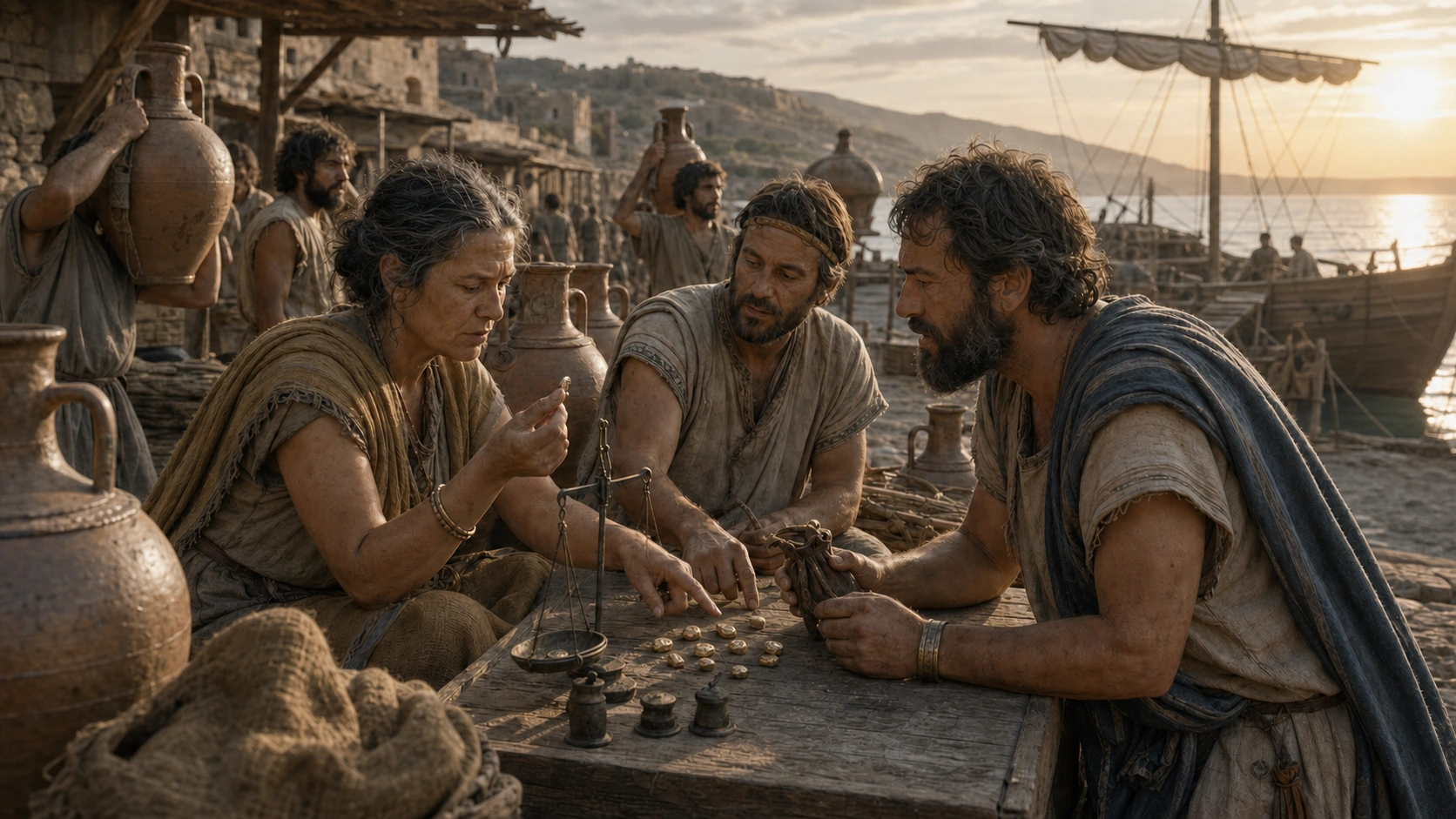
The ship had to leave before sunset.
Instead, its captain and Mira, an oil merchant, were fighting over a single balance weight.
“By this scale, that’s twelve coins’ worth of metal,” the captain said.
He emptied a pouch of yellow metal onto the table. It was electrum, a mixture of gold and silver. Some pieces looked like nuggets lifted from a river. Others had sharp edges, as if they had been cut from a bar.
Mira pressed one finger against the pan of her own scale.
“By my scale, it comes up short. And this one is too pale. How am I supposed to know how much silver is inside it?”
Thirty jars of oil stood in a row along the dock. The porters kept lifting them and setting them down again. The sailors had loosened the ropes and could do nothing but watch the sky. One unfinished payment had stopped a ship and twenty people with it.
Money already existed. People priced goods in grain, recorded debts by weight of silver, and used cut metal for large payments. The problem was that a piece of metal did not arrive with its own promise attached.
It had to be weighed.
Its surface had to be scratched to see whether the same metal continued underneath.
Then people had to argue over whether one merchant’s balance weights matched another’s.
I was standing beside a mint worker from Sardis. He opened a leather pouch and took out several small, rounded pieces. Their shapes were uneven, but each bore a lion’s head on one side and a square punch mark on the other.
“Try these,” he said.
Mira picked one up.
“This is the same electrum.”
“We weighed it before we struck it.”
“Does the lion weigh it for me?”
The mint worker handed me one of the pieces. I put it on Mira’s scale. It matched the promised weight. So did the second.
Mira reached for a third.
The captain threw up his hands.
“If you weigh every one of them again, what has changed?”
Mira stared at him.
“If my oil goes overboard, you take the loss. If your metal is underweight, I do.”
The mint worker pointed to the lion.
“Pieces with this mark are made to the same weight unit. The king’s storehouses accept that unit as well. Weigh every one today if you must. On the next trade, you will count them first.”
Mira weighed the pieces bearing the lion mark one by one. The ship waited.
The first eleven matched.
The last was light.
The captain went still. I turned it over. The lion was blurred, and the square punch was missing. Someone had hammered an ordinary lump into roughly the right shape.
Mira separated the eleven real pieces from the false one.
“The lion does not stop lies.”
“No,” the mint worker said. “It shows whose promise the liar tried to copy.”
The captain replaced the false piece with several smaller fractions. Mira weighed those too, then closed the trade. The porters lifted the jars. The sailors raised the sail.
The scale did not disappear that day.
But when the next ship arrived, Mira checked the lions and counted first. She weighed only the one piece that looked wrong.
Coins did not invent money. People had priced goods in grain and silver and made payments by weighing metal for centuries. Coinage changed the order of verification. Once an issuer weighed pieces in advance and struck them with a recognizable mark, traders no longer had to begin every payment by weighing and testing every scrap of metal from scratch.
The man beneath the wall interrupted me.
“So could a king stamp a lion on ordinary metal and make it valuable?”
“It was not that simple. Early coins still depended heavily on the gold or silver in the metal and on its weight. Electrum did not always contain the same proportion of each metal, and a foreign city might discount a mark it did not recognize. The mark worked only where merchants, storehouses, and cities were willing to accept the same unit again.”
A stamp did not place value inside metal by magic. It bound weight and responsibility into one object. People began to trust not only the metal, but also the authority that issued the piece and the market that would take it back. Coins made exchange faster, but they also turned the power to set standards—and the reach of an issuer’s mark—into political questions.
In time, cities along the western coast struck their own animals and emblems into metal. Calculation became faster within each standard. When a different mark appeared, money changers and scales returned.
Mira never threw her scale away.
But eventually, customers began placing the lion on her table before they reached for the weights.