About 70,000–50,000 years ago · Large-scale dispersal and rapid cultural diversification
I once set out along a northern route none of us had ever followed to the end, trusting only a song.
I drew the outline of Africa in the dirt in front of the children, then added several short lines leading outward. Some stretched far beyond it. Some turned back. Others stopped halfway.
“People left more than once?”
“Many times. Some groups returned. Others traveled far but left no descendants. Most people living outside Africa today—including you—trace the greater part of their ancestry to a much larger expansion that came later.”
Those people did not leave with bodies perfectly suited to every unfamiliar place. Instead, they traveled with tools, knowledge, and stories they could adapt to new surroundings.
One group I remember set out from a place in East Africa where woodland met open grass. The rains had come late for two seasons in a row, and the water holes we knew had cracked from the bottom up. We could stay and wait for the next rain, or head north in search of land where there was still water.
The problem was that no one among us had ever followed that route to its end.
A young woman traveling with us wore a small shell around her neck. It had a hole through its center, and she had received it from a traveler who came from the coast. She valued the song that traveler had taught her even more than the shell.
The verses named a ridge of black rock, two dry riverbeds, and a tree split by lightning, in that order. The final verse said that when the sun began to sink, following the shadow of the rocks would lead to water. People who had crossed the route from the other direction had sung it so they would not lose the way home.
“You want us to trust one song?” I asked.
The young woman flicked the shell at her throat with one finger.
“Whoever made that song made it here alive.”
She had a point. It was hard to argue with that.
We divided our water among hide bags and set out. On the first day, the ridge of black rock appeared. The next day, we crossed two rivers whose beds had dried white. Each time the song matched the land, our voices grew a little louder.
But on the third day, the tree split by lightning was nowhere to be seen.
We did not have enough water left to last the evening. Some said the song was wrong and wanted to turn back, but we had already come too far. The young woman sang the same verse several times, then said the tree in the song did not have to be standing.
We spread out and searched the ground. Much later, I found a black root jutting from the sand. The trunk had fallen long ago and disappeared beneath the dunes, but the scar left by the lightning was still visible near the roots.
The young woman changed the song on the spot.
The verse that told us to find a living tree became a verse about finding black roots beneath the sand.
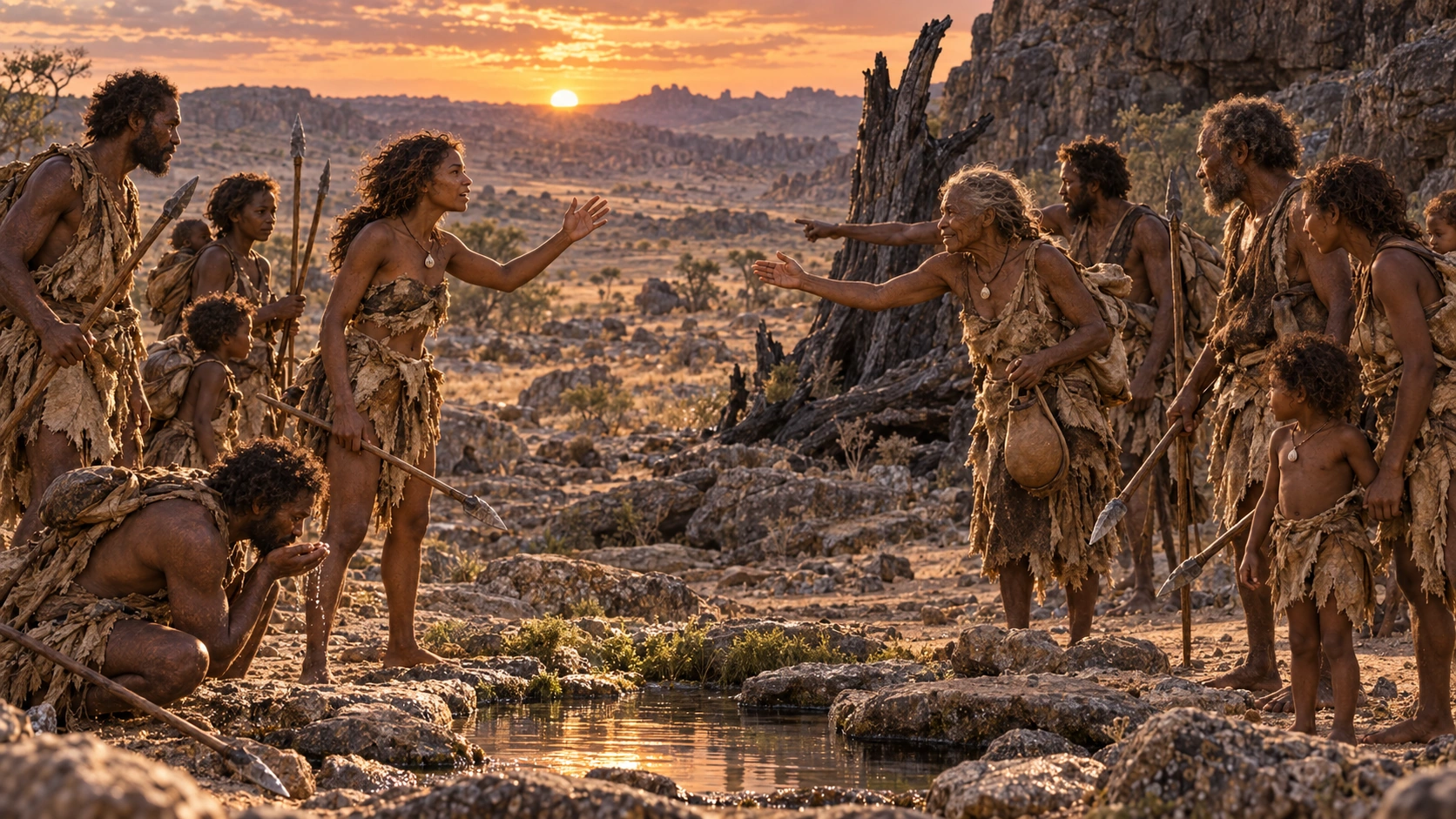
As the sun sank, we followed the long shadow cast by the rocks. At its end was a shallow spring. When we scooped away the soil with our hands, water seeped into the hollow.
Another group had reached the spring first. They shouted in words we could not understand and raised their spears. We lowered our weapons, but did not let go of them.
Then the young woman began the first verse of the song.
A woman among the strangers answered with the next verse in a different language. The tune was slightly different, and the black ridge and dry rivers came in the opposite order. Even so, we understood that they had crossed the same route from the other direction. A pierced shell hung from the stranger’s neck as well.
The spearpoints slowly came down.
That night, the two groups sat around one fire. We told them about the route south and which plants in the woodland were safe to eat. They showed us which roots were safe to eat in the north and where to find the next spring. The young woman added a new verse to the end of the song: beyond the black roots lay the strangers’ spring.
The song had changed once on its journey to us, and it changed again in our hands. Preserving every line exactly mattered less than keeping the song useful after the route itself had changed.
Most species could survive in an unfamiliar environment only after their bodies changed across many generations. Humans adapted their ways of using fire, their tools, their clothing, and their knowledge to each new environment. Because we could change how we lived without waiting for our bodies to change, people from the forest could move into deserts, along coasts, and into cold lands.
For thousands of years afterward, I heard similar songs used to remember routes and water. In one place, the black ridge became a snow-covered mountain. Some groups wore animal teeth or painted stones instead of shells. Some added new verses. Others forgot the beginning.
The original song eventually disappeared.
But the practice of carrying routes and water sources inside a story and passing them on did not.
Culture did not grow more complex so quickly because everyone suddenly became a genius. It happened because groups living in different places created their own tools, knowledge, and stories, then shared and revised them when they met again. As people and groups exchanged and combined their knowledge, humanity accumulated far more ways to survive than any one person could have discovered alone.
We did not leave Africa carrying one finished culture. Each time we reached new land, we discarded knowledge that no longer fit, accepted what other people knew, and adapted the rest to the local environment.
Human migration did not end with a single departure from Africa. Each time people reached a new place and changed how they lived, they became capable of moving farther again.