I went to the hill everyone was talking about because I heard there would be meat.
When I arrived, someone put a rope in my hands before giving me anything to eat.
“You want me to pull this?”
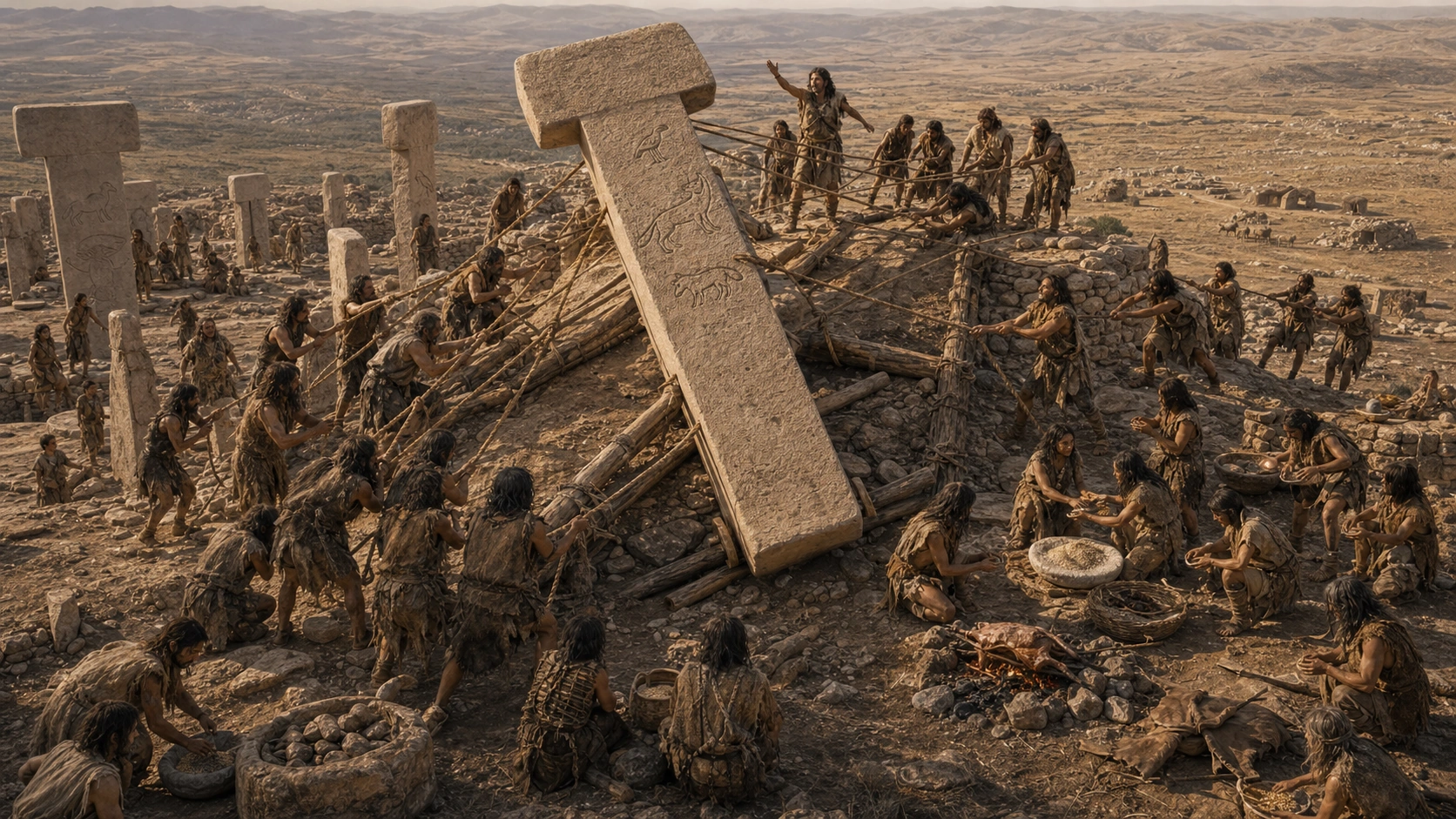
A massive stone pillar was tied to the other end. It was several times the height of a person. Snakes, foxes, boars, and birds had been carved into its surface. Some pillars also bore shapes that looked like human arms and hands.
The hill that would much later be called Göbekli Tepe had many such pillars standing in circles. To me, however, they were stones that could not cut meat, hold grain, or keep off the rain. I could not understand why anyone would struggle to raise something so heavy.
The woman organizing the work on the hill motioned for me to take hold of the rope.
“You came here to pull.”
“I came here to eat.”
“It tastes better after you pull.”
People from several valleys had gathered around us. Their stone points had different shapes, and they fastened their animal hides in different ways. If we had met at a watering place on an ordinary day, we would have checked one another’s weapons first.
That day, we took hold of the same rope.
At first, nothing worked. When the people in front pulled early, the rope went slack behind them. When those in the rear suddenly put their weight into it, the people in front fell over. The stone barely moved, and everyone shouted at everyone else.
The woman raised a hand, and the crowd fell silent.
She called out the first line of a story known by the people gathered there. The same reply came back from several parts of the crowd. I did not know which valley the story had come from, but most people knew its final lines.
The woman called one line, and the crowd answered with the next. After several rounds, the voices settled into one rhythm. People pulled when they gave their answer and caught their breath while the woman called again.
Dozens of people leaned back at the same moment.
The stone that had refused to move began sliding over the ground.
A story alone could not move a pillar. The bodies of the people and the rope did the actual work. The grain and meat they had eaten beforehand gave them the strength.
But the shared story made dozens of strangers use that strength at the same time.
When we finished moving the stone, food appeared across the hill. Some groups had brought gazelle meat. Others laid out wild grain and nuts. People grinding grain, dividing meat, dancing, and carving animals into stone all mixed together in one place.
Blood had begun to seep from my rope-burned palms. The woman handed me a piece of meat.
“Tastes better after pulling, doesn’t it?”
“I’m just hungrier now.”
“And you will still come back next time.”
I meant to tell her no. My mouth was already busy with the meat.
She laughed.
As I chewed, I asked her a question.
“Don’t people come here because they want to eat this?”
“Then why carry everything they hunted all the way here instead of eating it at home?”
I had no answer ready.
If filling their bellies were the only goal, people would not have carried meat and grain up a high hill. They could have shared it comfortably with their own families.
Instead, they brought food here because they believed there was something they had to do together on this hill. The animals carved into the pillars and the story everyone recited told people when to gather, where to go, and whom they would meet.
Food gave people the strength to work. A shared story brought them to the same place and directed that strength toward the same task. Great symbolic structures did not necessarily appear only after people had produced plenty of food. Shared beliefs could gather people, food, and labor in one place—and that gathering could create a need for greater production and cooperation.
The question from the man sitting closest to me brought me back to the present.
“But hungry people still cannot raise stone pillars.”
“Of course not. Starving people cannot raise pillars. But if food were all they needed, they could have eaten in their own homes. What brought scattered groups back to the same hill the following season was the belief and the story they had shared here.”
Food fueled the work that day. The story brought them back the following season.
When the right time came, people remembered the hill with the pillars. No one needed to visit every valley and invite them one by one. Those who remembered the place and the story set out on their own.
Families and small groups had hunted and shared food together before. At Göbekli Tepe, however, people who did not know one another’s names and might never meet again did the same work. A shared symbol and story allowed people with no blood ties to cooperate.
People who believed the same story could work together even when they barely knew one another. As the number of people cooperating grew, they could begin projects beyond the strength of any single village. A shared story expanded the meaning of “us” beyond family and neighbors.
That did not mean stories only united people.
Once believers in a story began calling themselves “us,” those who did not share it could be placed outside that group.
Stories brought more people together, but they also created boundaries that decided who belonged and who did not. Unity and exclusion began in the same place.
As the sun sank, the pillar that had been lying on the ground finally stood upright.
People cheered in different languages. Even so, they were all looking up at the same stone.
The greatest thing raised on that hill was not the pillar.
It was a far larger sense of “us,” one that joined strangers together.