“What did you do if you lost a sharp stone?”
One of the children asked.
“At first, it was a serious problem.”
“Couldn’t you just break another rock?”
“It took a very long time for that to become the obvious answer.”
The child still looked unconvinced. These days, if something is lost or broken, we can find another object that does the same job. Lose a pencil and you get another. Break your phone and you replace it with a similar model. Back then, a sharp piece of stone was less an object than a stroke of luck.
When I first found one, I thought I had to keep it for as long as possible. I had no way to be sure I could ever get another. But an edge lost its usefulness sooner than you might think. Scrape through flesh and sinew a few times and it would go dull. Step on it the wrong way and it would snap. Drop it while moving, and it would be hard to find among the grass and dirt.
“So you kept looking for new sharp stones?”
“For a while, I spent more time searching for lost flakes. One good flake was worth more to me than knowing how to make one.”
I picked up a stone and turned it in my hand.
“The real change began when we stopped searching for every piece we lost.”
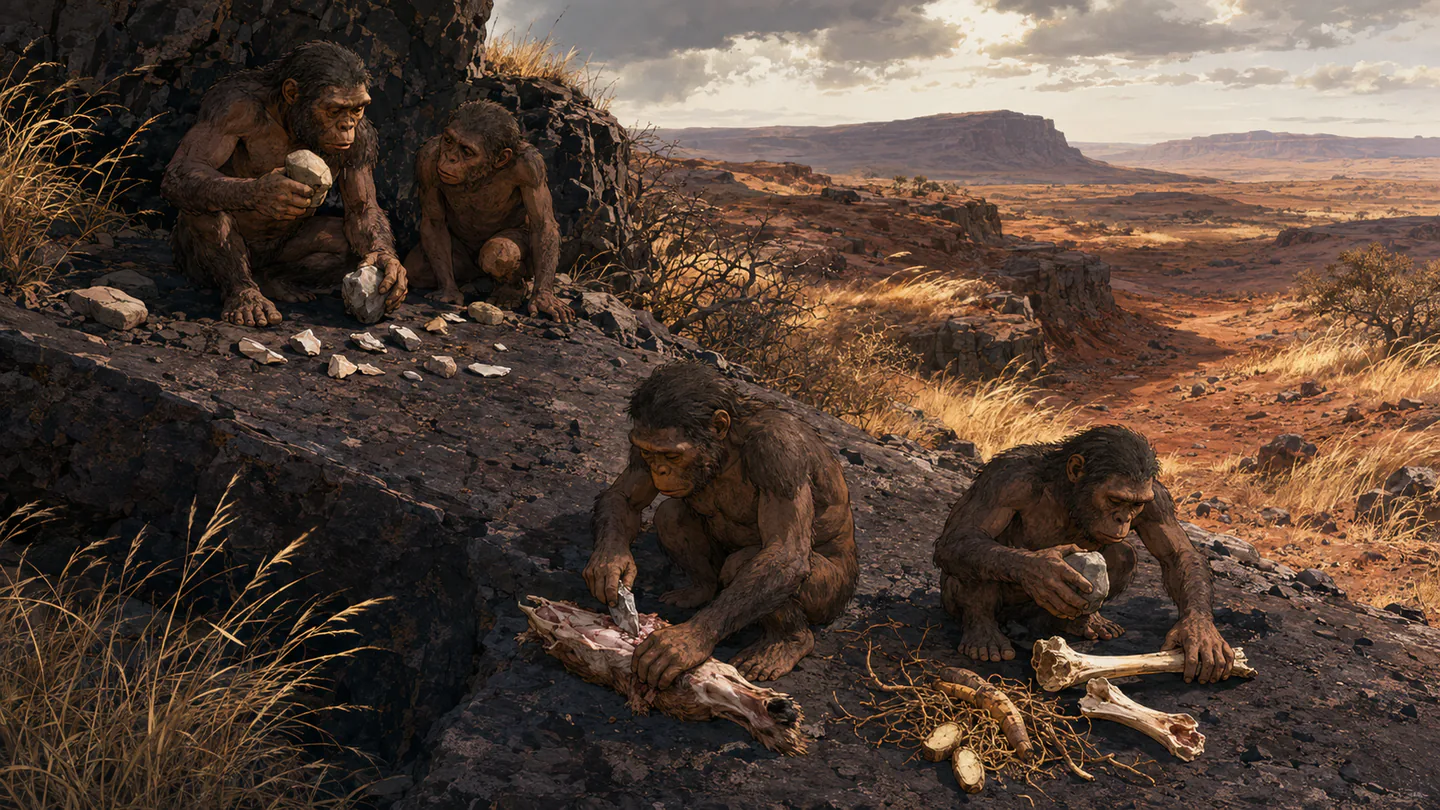
One dry season, we found an animal that had died only recently. My stone edge was already dull and left no more than faint scratches on the hide. Other animals had caught the scent and were circling at a distance. We did not have long.
The companion in our group who was best at breaking stone gripped a heavy rock and struck along its edge. The first flakes to come off were too thick or too short. But my companion did not stop to stare at the failed pieces. They turned the stone slightly and struck a different spot. A flake the size of my palm broke free, with a long, sharp edge along one side.
They pushed it toward me. The new edge opened the hide and sliced quickly through the sinew. While the others kept watch, we stripped away the meat, smashed the bones with rounded stones, and scraped out the marrow. It was far faster than trying to do everything with teeth and fingernails.
After we ate, I picked up the battered stone the flakes had come from. I copied the sequence I had seen. The first flake was too thick to use. On the second attempt, I hit my finger instead of the stone. My companion shifted my hand into a better position. I turned the stone and tried again. Only on the third strike did a flake I could hold and use come free.
“Only three tries? That sounds pretty good.”
The youngest child asked.
“In that one scene, sure.”
“Did it actually take longer?”
“Much longer. I’ve condensed countless days of failure into the scene I just told you. Some days I couldn’t find the right stone. Some days I struck at the wrong angle. Some days I ended with nothing but aching fingers.”
The girl in the school uniform, the youngest child’s older sister, tilted her head.
“So you didn’t learn the skill just by watching once.”
“Hands learn more slowly than eyes. I had to watch, fail, adjust my grip, and try again. Over and over.”
Once we learned the method, it proved useful in other seasons too. We scraped the skins from tough roots and pounded the hard parts until they broke. Things we once could not eat—or had abandoned because they took too long—now ended up in our mouths.
“Is that what you mean when you say there was more to eat?”
“Exactly.”
Tools did not create food. They expanded the range of things we could use as food.
Of course, not every stone broke the way we wanted. Without the right kind of rock, we could fail for a long time, and bruised fingers never disappeared entirely. But failure no longer meant waiting for chance to give us a useful flake. We could turn the stone, strike somewhere else, and try again.
Once, while we were moving, I dropped a sharp stone flake into the water. It flashed beneath the current a few times, then vanished into the mud.
“You didn’t look for it?”
“Before, I would have spent a long time feeling along the bottom.”
“What did you do that time?”
“I watched for a moment, then turned away and began looking for a suitable stone.”
“Weren’t you upset?”
“I was. Making another still took time and effort. But now, if I lost one stone, I could make another tool that did the same job.”
By then, several people in the group knew the sequence. Some made better flakes than I did. Some still failed often. But the method no longer belonged to only one person.
“Then the important part wasn’t the stone. It was knowing how to make one.”
“We still needed both. But a stone could break, go dull, or be lost.”
I put down the one in my hand.
“The method could pass from hand to hand.”
One stone could be lost. But the knowledge of how to make another remained in many hands. From then on, a tool was no longer a lucky find. It was a survival skill we could repeat whenever we needed it.