I laughed at the first cart I ever saw.
They had built something heavier than the load it was supposed to carry.
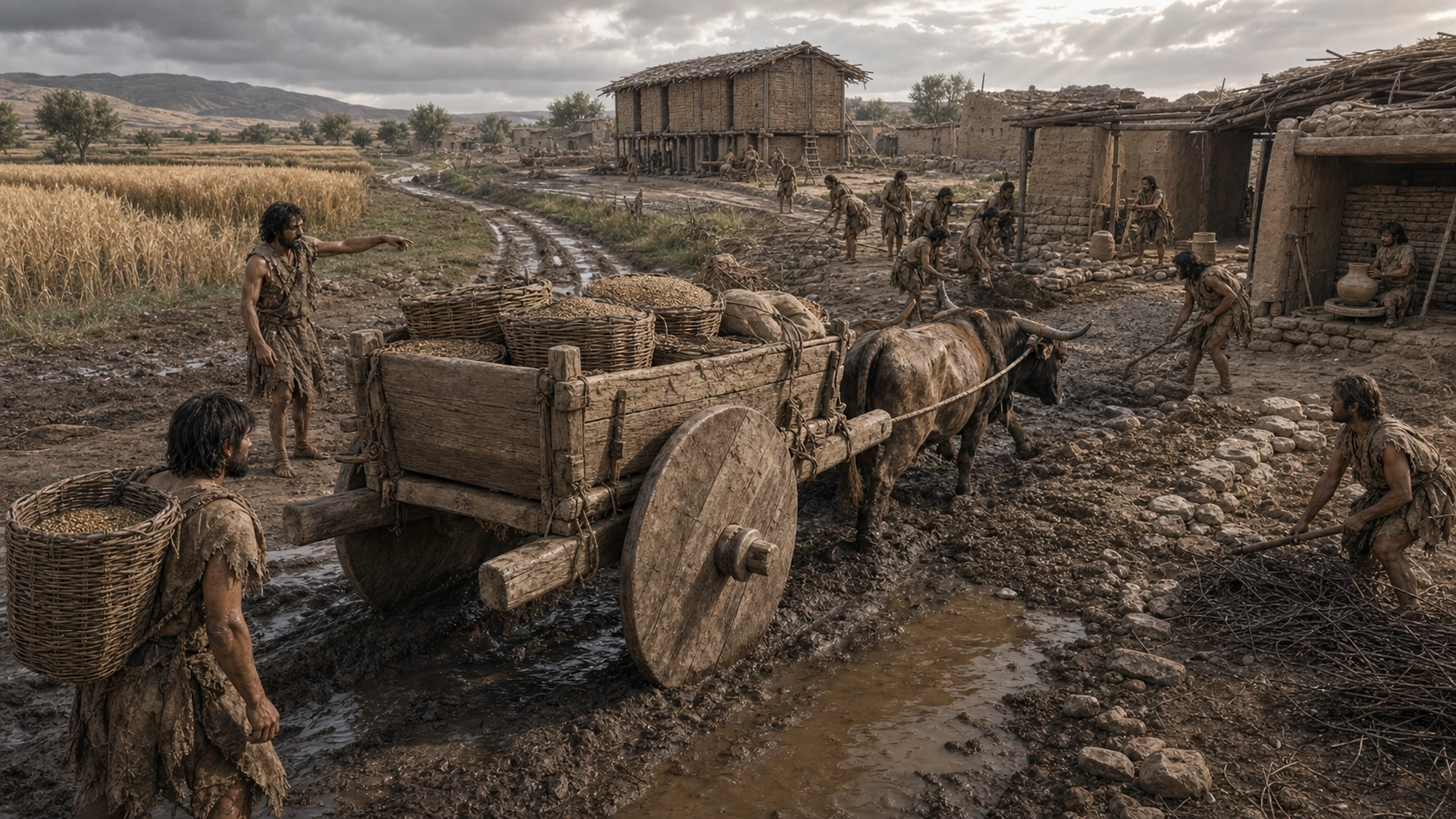
The thick wooden wheels, axle, and cargo bed were already heavy enough that several people had to work together to lift them. The man who had made the cart began loading our harvested grain onto it.
“Carrying that grain on our backs would be faster.”
“This was not made to be carried.”
“Something for carrying loads that no one can carry?”
He harnessed two oxen to the front of the cart.
“You roll it.”
At first, I pushed from behind. The oxen leaned forward, the wooden axle made a harsh grinding sound, and the wheels slowly began to turn.
Once the cart was moving, I barely had to push at all.
Grain that would have taken us several trips to carry on our backs moved toward the granary in a single load.
The grain had not become lighter. The cart added even more weight. But when people carried grain on their backs, their shoulders and legs had to support it with every step. On the cart, the wheels and axle supported the load while the oxen pulled it forward.
The entire bottom of a sled dragged across the ground. A cart moved forward as its wheels turned. On firm, level ground, the same amount of effort could therefore move much more cargo.
The wheel did not make a load lighter. It meant that people no longer had to bear the weight with every step. The wheels and axle supported the cargo while animals pulled the cart, allowing the same number of people to move larger loads over longer distances.
I thought we would have an easy trip to the granary.
The cart became stuck in mud soon after leaving the field.
One wheel sank almost halfway, tilting the cargo bed. The oxen lowered their heads and pulled, but the wheel only pushed mud around without moving forward.
In the end, we unloaded the grain baskets and put them back on our shoulders. Only after the cart was empty could we push it free.
“So people still have to carry everything in the end.”
The cartmaker pointed not at the wheel, but at the muddy path ahead.
“The cart does not need fixing. The road does.”
People objected at first. Using one cart meant repairing the entire path between the fields and the granary. Widening the village entrance required moving a wall. Every low spot where rainwater collected had to be filled with earth and stone.
Then the cartmaker said something that changed their minds.
“Fix it once, and the next cart can use it too.”
One person could build a cart, but several households had to work together to keep a road usable. People widened the route between the fields and the granary and hardened the places where the wheels had sunk.
A cart was not useful simply because it had wheels. Animals had to be able to pull it, and it needed a road firm enough to keep the wheels from sinking. To make carts work, people began changing the village roads and entrances around them.
From the next harvest onward, grain reached the granary faster and before the rain could soak it. Crops from fields farther from the village could be brought in more easily. People also hauled in timber and stone that had once been too heavy to move and used them to build larger houses and storage buildings.
Fewer carts returned empty. After delivering grain, they carried copper, good stone, salt, and pottery on the way back. People no longer depended only on what could be found nearby. Goods made in distant regions changed hands more often.
Round platforms also appeared in workshops. A potter placed clay on a turntable and spun it. Instead of walking around the vessel, the potter could bring each side around to the same pair of hands.
Keeping the hands in one place made it easier to work the entire vessel quickly and produce more pots with similar shapes.
On a cart, wheels moved cargo forward. In a workshop, a turntable moved the material past the worker’s hands. Rotation allowed the same motion to continue without stopping and starting again.
The man sitting closest to me asked a question.
“Does that mean the road was more important than the wheel?”
“It is difficult to choose one. A cart became stuck if the road was poor. But without carts, several households would have had less reason to widen and harden the road together. Carts needed better roads, and better roads made carts more useful.”
Once a road was repaired, the next cart used it too. Grain and goods accumulated along routes used by many carts. People built granaries and workshops near those roads so loads could be moved in and out easily.
As more goods gathered there, people had more reason to repair the road again. Routes that had been difficult for carts from the beginning were used less and less.
A well-built road did more than make carts easier to use. People kept choosing the routes that were easier to travel and built granaries and workshops beside them. More traffic gave people more reason to repair those roads again, so the routes that gained an early advantage continued to pull ahead of the others.
Once heavy loads could travel farther, the distance between fields and villages could grow. Stone from quarries moved to places with large building projects, and goods from different regions gathered at trading sites.
Much later, armies used carts too. Sending soldiers over a long distance was not enough to keep a war going. Carts carrying grain, water, weapons, and tents had to follow if large numbers of soldiers were to remain far from home.
The earliest heavy wooden carts did not immediately become fast chariots. In mud, on steep slopes, and across rough ground, carrying goods or using sleds could still work better. Even so, on level roads, carts moved far more cargo over longer distances than before.
By the end of the harvest, two wheel tracks ran between the fields and the granary.
The next cart followed the existing tracks because the ground there was firmer and easier to cross.
At first, we repaired the road for the cart.
After that, people drove their carts there because the road had already been repaired.
Once one route became easier, people and goods kept gathering along it.