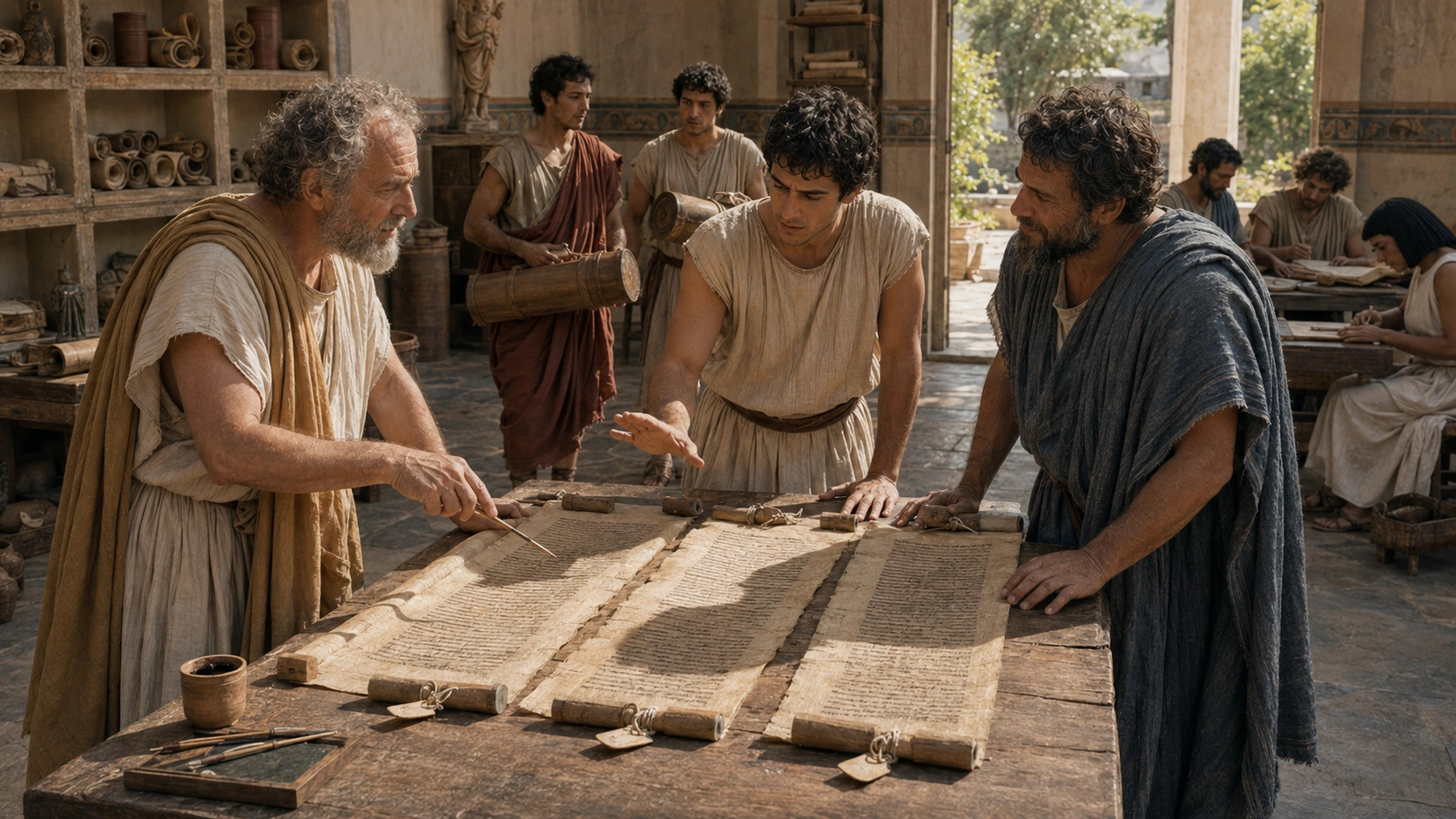
I thought I had caught a fraud in Alexandria.
The scroll of Homer's Iliad he was trying to sell contained a line that did not appear in our copy.
“This is wrong.”
I handed the scroll back. Teles, a traveling performer from Chios, narrowed his eyes at me.
“You mean it is different from yours.”
“If two copies of the same work disagree, one of them was copied incorrectly.”
“My father recited that line. So did his teacher. Is every line missing from your shelves a forgery?”
Instead of answering, I fetched the Library's copy. I untied its label and placed the disputed passages side by side. Teles's scroll had one extra line and two different words below it.
To me, that looked like even more evidence of fraud.
Then Zenodotus, who oversaw the Library, joined us. He read both versions and turned to Teles.
“Where did you get this scroll?”
“It belonged to my family on Chios.”
“Do you know who copied it?”
“My father said he received it from his teacher. I know nothing before that.”
Zenodotus looked at me.
“Bring the copies from Athens and Rhodes as well.”
I sighed to myself. Unrolling four copies to expose one fake seemed like pouring water into a cracked jar four times to prove that it leaked.
But the four scrolls did not match.
One lacked Teles's line. Another included it but used a different word. Two lines appeared in reverse order in a third. Even the newest and cleanest copy was missing a line elsewhere.
Zenodotus did not immediately declare one version authentic. He recorded where each scroll had come from and marked every disagreement in the passage. We separated lines shared by several copies from lines found in only one. We considered the language and the sense of the surrounding verses.
Teles folded his arms.
“So was the line my father learned a fake?”
“I cannot say that. We must study it further before placing it in the main text, but we will preserve the line and record where it was recited.”
“And what about the price of my scroll?”
“Its differences make it worth buying.”
Teles gave me a broad smile.
“Generous pay for a fraud.”
That was the first time I apologized to a man while counting out the money for his scroll.
The man sitting beneath the wall raised a question.
“Could collecting many copies always reveal the correct text?”
“Not always. But while the copies remained scattered, the one each person owned was the whole work as far as that person knew. Once versions from different regions were placed side by side, missing lines, added lines, and altered words became visible. Scholars could begin asking which language was older and what might have changed in transmission.”
When books existed only as scattered individual copies, people could read and memorize them. Gathering different versions in one place made it possible to compare and correct them. A library could do more than preserve large quantities of knowledge. It could expose differences and help scholars build texts they had better reason to trust.
Books were not the only things gathering in Alexandria. Scholars supported by the royal court lived and worked at the Mouseion. A scholar of poetry might eat beside a physician, while mathematicians and astronomers argued at the same table. People who knew other languages helped scholars study foreign texts, and some of those works were translated into Greek. As the scrolls multiplied, scholars also compiled catalogs that recorded authors, subjects, opening words, and lengths to help identify and locate works.
This time, a woman in the audience spoke.
“Why would kings spend so much on that? Did they simply love learning?”
“Curiosity was only part of it. After Alexander's death, his successor kingdoms competed for scholars and books as well as territory and armies. Filling a capital with celebrated thinkers and ancient works displayed the power and prestige of its ruling dynasty.”
Royal funding allowed scholars to study without constantly worrying about their next meal. It also gave a royal institution influence over which works were purchased, which were translated, and which versions became standard. Some differences, like the line in Teles's copy, were recorded. Many words that no one chose to preserve may have disappeared.
An institution that gathers knowledge can expand it, but it also decides what deserves to be copied, translated, and treated as standard. As collections grew, the power to improve knowledge and the power to define its boundaries gathered in the same place. In Alexandria, knowledge became a shared resource for scholars—and an asset that states wanted to possess.
The next morning, I reopened the box of scrolls I had labeled as duplicates. It held twelve copies bearing the same title.
Zenodotus glanced over.
“How many are truly identical?”
“I haven't yet confirmed that any two are identical.”
He nodded with satisfaction.
“Now you are ready to work in a library.”