Today, I was back beneath the same wall, telling another story.
The difference was that the people sitting in front of me were much older than yesterday’s audience.
They were parents who had come to complain that I was telling their children strange stories. At first, they had all remained standing, and several had interrupted me. Now the ones who were not interested had gone home. Four remained, seated on chairs beneath the wall.
The man who had challenged me first had somehow pulled his chair closest.
“From what I’ve heard so far, I don’t think you’ve told the children anything harmful. Please, go on.”
I saw no reason to remind him why he had come.
“Yesterday, I told the children about people experimenting with sowing a few seeds. Today, I’ll tell you about when people began getting a whole year’s food from their fields.”
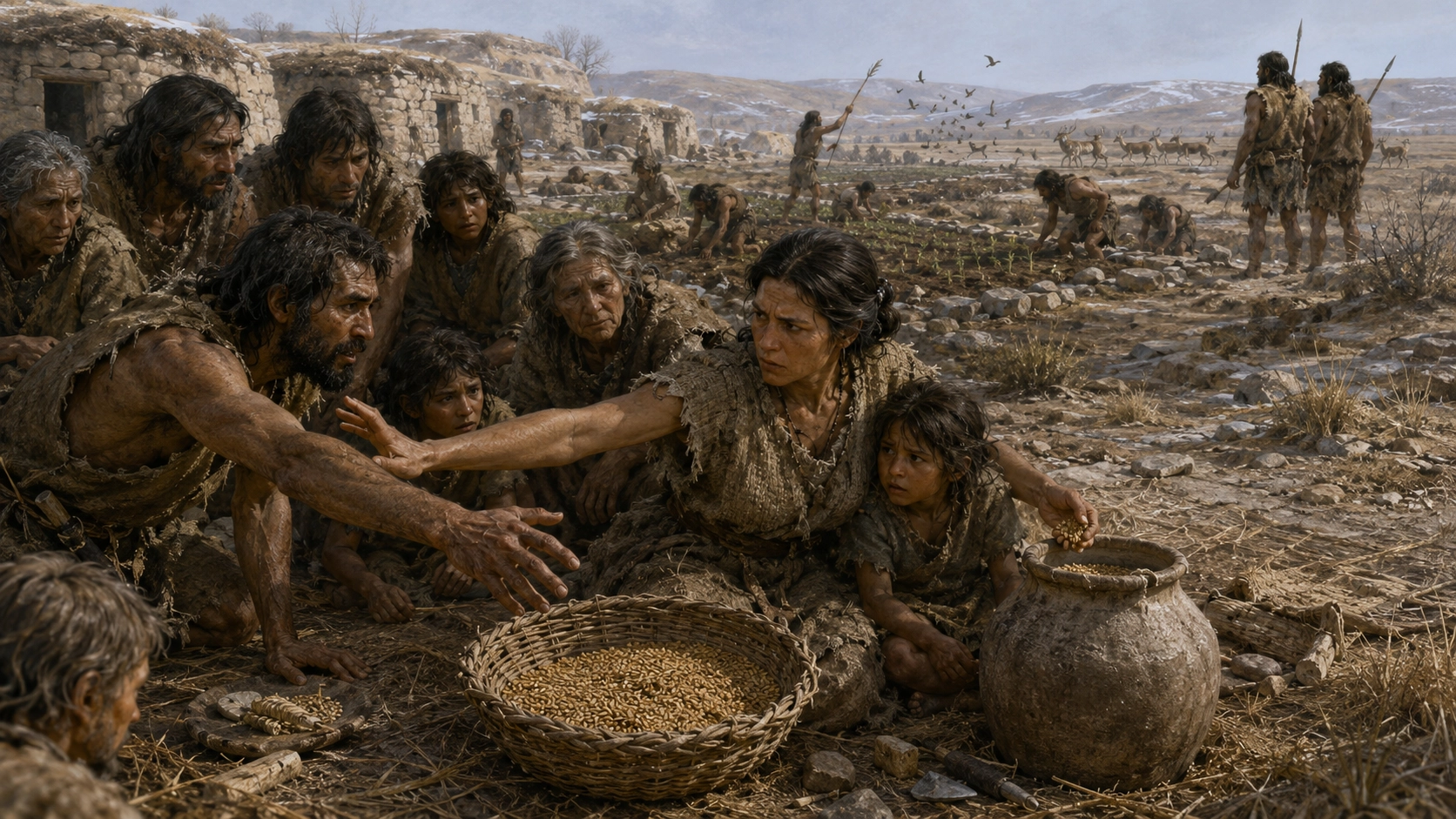
That spring, a single basket of grain divided us into two sides.
Some wanted to eat it now. Others wanted to save a share for planting.
The cold season had dragged on, and our stored food was nearly gone. Emptying the basket would have kept our bellies full for several days. But the woman in charge of the grain stopped me when I reached for it.
“That grain isn’t for eating.”
“It’s grain.”
“It’s for next year.”
Her own child was hungry too. Even so, she would not give up the basket. If we ate the grain now, we would certainly be full. If we buried it, birds might eat it or the rain might fail, leaving us with nothing.
We already knew that seeds produced shoots and that shoots produced more grain. We did not hesitate because we lacked that knowledge. The problem was giving up grain we could eat today and waiting for a harvest that did not yet exist.
In the end, we ate some of the grain and sowed the rest.
Life in the village changed after that. Before, people moved to places where food could be found. Now we chose where the field would be and had to keep tending it so food would grow there.
Clearing stones and pulling other plants from the ground took days. Once the shoots appeared, someone had to keep birds and other animals away. When a herd of gazelles passed, the hunters wanted to follow for several days. But if everyone left, we could lose the grain we had spent so long growing.
A field did not run into the distance like a gazelle. Instead, it kept people in one place until the grain ripened.
Before agriculture, people mainly moved to places where food was growing. After they began farming, people chose where and when to sow seed and worked in advance for a larger harvest. Food could now be produced close to the village, but people had to follow the schedule set by their fields and crops.
On the day of the harvest, the ground produced more grain than we had planted.
People laughed as they poured grain into baskets. The seed we had saved instead of eating in spring had not been wasted. Neither had the months spent clearing stones and chasing birds. There was enough grain to eat immediately and still set some aside.
Then, before the joy had even settled, a new problem appeared.
“Who gets how much?”
The person who had cleared the most stones said their share should be larger. So did the person who had guarded the field at night. The hunter whose meat had fed the workers argued that their labor counted even though they had not worked in the field. The person whose house stood closest insisted that no one else should be allowed to claim the ground in front of it.
Every eye turned to the woman who had guarded the basket. The person who had protected the seed in spring was now expected to divide the harvest as well.
The man sitting in front of me broke in.
“Is that when rulers first appeared?”
“No. A single harvest did not suddenly create a king.”
I remembered the people arguing over their shares and continued.
“But someone had to store the seed, decide who used the fields and when, and divide the harvest. At first, it was simply a job that needed doing. If the same person kept doing it, however, they could gain the power to decide how much others ate and what the village would do the following year.”
Hunter-gatherers had fought over good places and stored food too. Agriculture did not invent ownership or conflict.
But once many people worked the same land and the harvested grain remained piled in one place until the following season, the problem changed. Every year, people had to decide who could use the land, who would guard the grain store, and how the harvest would be divided.
Agriculture did not create kings and cities on the day it began. But fields needed boundaries, and stored grain needed guards and rules for distribution. A larger harvest could feed more people, but it could also give more power to whoever managed the grain and decided how it was shared. Agriculture increased the food supply while also creating conditions in which power could concentrate in the hands of those who managed land and stored food.
The woman listened to everyone for a long time. Before dividing the harvest, she selected some of the finest grain and placed it in an empty jar.
“Whose share is that?”
I asked.
“No one gets to eat it.”
“Why?”
The woman sealed the mouth of the jar.
“Because it’s for next year.”
As soon as the first harvest ended, the work for the following year began.
We had gained more food. In return, we had to leave part of every harvest uneaten and repeat the same work on the same land the next year.