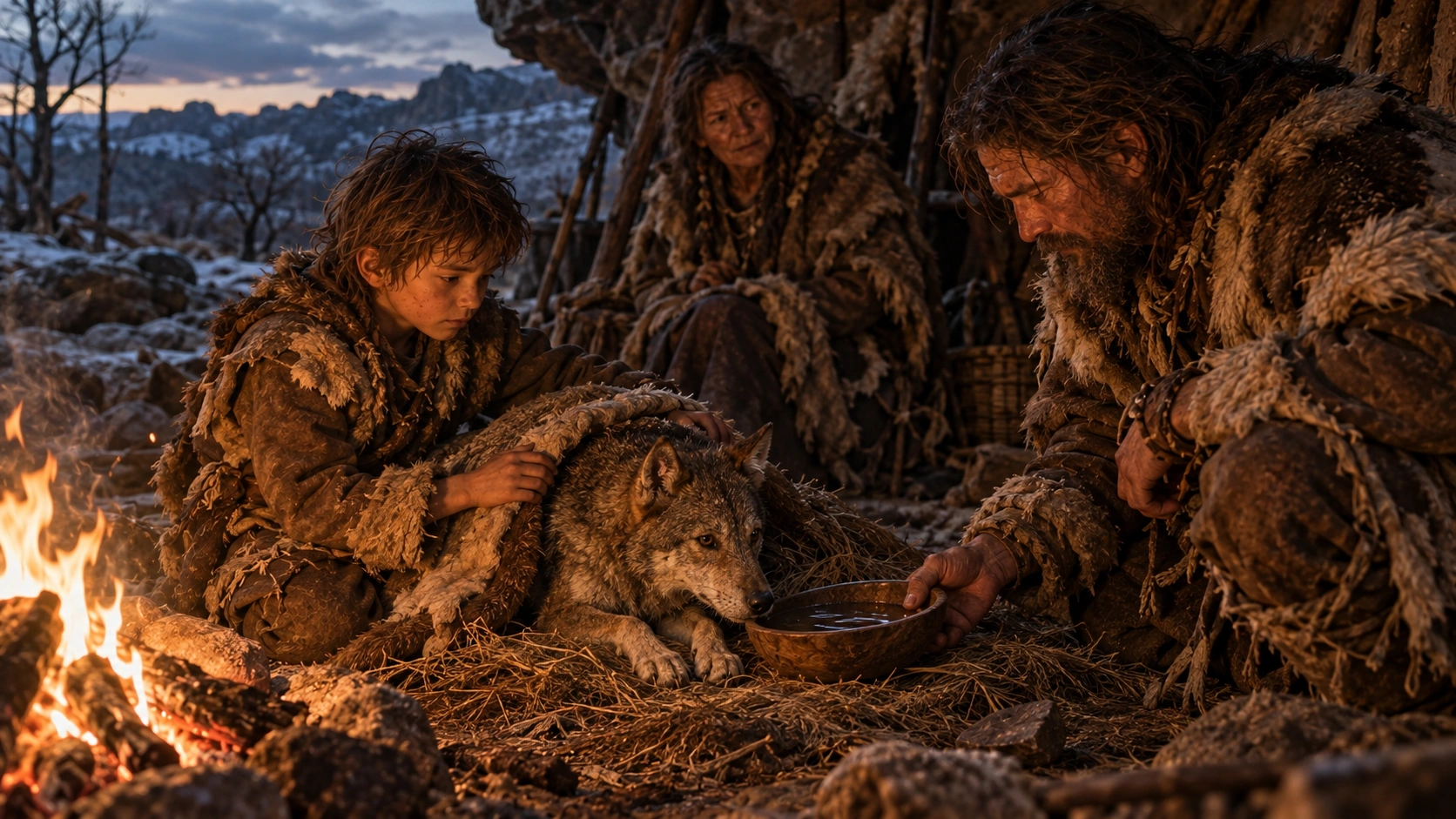
I was not the one who first let that dog near the fire.
“What about you, mister?”
“I kept trying to drive her back out.”
The youngest child stared at me in disbelief.
“Why? She was a dog.”
“To you, yes. To us, she was closer to a thief with teeth.”
In those days, wolf-like animals often appeared around our camp. Most ran when they saw a person, but a few circled beyond the firelight all night, waiting for the bones we threw away.
When they came close, we threw stones. When they retreated far enough, we sometimes left the bones where they were. We had not quite decided whether we were driving the animals away or feeding them.
One female had an ear torn nearly in half. A young boy called her Half-Ear.
Half-Ear was less afraid of the fire than the others. She took the bones the boy tossed her, but if an adult approached, she bared her teeth at once.
I did not like her either. It annoyed me that she avoided human hands while still taking food people left behind.
Then one night, Half-Ear began growling low at something beyond the firelight. We could hear nothing but the wind.
A moment later, we smelled a bear in the darkness. People rose with torches, and the bear changed direction before it reached the camp.
A few days later, Half-Ear followed the scent of a wounded deer the hunters had lost. She stopped several times in the woods to look back at us. We followed her and found the deer before sunset.
After that, I stopped throwing leftover bones wherever they happened to land. I placed them near where Half-Ear stayed.
“So you started liking her.”
“Not yet. She helped us, so I gave her food in return.”
I truly changed my mind only after Half-Ear could no longer help us at all.
As the cold deepened, she stopped eating and shivered for days. She no longer watched the darkness at night or followed the hunters when they left. When the boy brought her water, she barely lifted her head.
Hunting had not gone well that year. We could not afford to reduce people’s shares to feed an animal that could not even stand.
“Starting tomorrow, don’t set aside a share for Half-Ear.”
The boy split the meat in front of him in two.
“I didn’t set it aside. It’s mine.”
“If you go hungry, you won’t have the strength to walk.”
“Before Half-Ear got sick, she found food for us.”
“She can’t do that now.”
The boy looked me straight in the eye.
“You couldn’t hunt when you were sick either. We still fed you.”
I could not answer at once. I thought people and animals should be treated completely differently. But the boy already saw Half-Ear as part of our group and therefore ours to care for.
That night, he pulled Half-Ear closer to the fire and covered her with his own hide. I complained once about the smell, then warned him that she would bring fleas. Still, I did not drag her back outside.
After the boy fell asleep, I gave Half-Ear water one sip at a time so she would not vomit. I never told him. He would have been unbearably smug about it.
After several days, Half-Ear began drinking on her own. Much later, she managed to stand, though her legs still shook.
By the time she had recovered enough to follow the hunters again, we no longer sent her beyond the firelight. Half-Ear stopped snatching a bone and running. She curled up at the boy’s feet instead.
When Half-Ear heard something in the night and lifted her head, we listened too. On the hunt, she followed scents we could not detect. At camp, she noticed movement around us while people slept.
Humans gave Half-Ear food, fire, a safe place to sleep, and care when she was sick. Half-Ear used her sharper hearing and sense of smell to find food and danger before we could. By living together, humans noticed threats sooner and found prey more easily than they could on their own.
“Was Half-Ear the first dog?”
“No. One wolf did not suddenly turn into a dog one day.”
Among Half-Ear’s pups, those that were less afraid of people remained near the camp longer. Children gave them names, and adults took the ones that understood human signals on hunts.
Those that continued to avoid people returned to the forest. Those that stayed received food and warmth, and human voices and travel routes became part of their lives.
The same thing happened over many generations. People kept close the animals that were helpful and easier to live with. The ancestors of dogs stayed longer with humans who shared food and faced dangerous nights beside them.
“Didn’t humans domesticate dogs?”
“Humans weren’t the only ones who changed.”
Living with dogs changed human life as well. People set aside a share for the dogs when they divided food and listened when the dogs gave an early warning at night. Before a hunt or a move, they also checked whether the dogs were with them.
Domestication did not change only wolves’ bodies and temperaments. Humans also began sharing food, caring for dogs, and relying on their help in hunting and guarding the camp. Over many generations, people and dogs each changed in ways that made living together easier.
At first, Half-Ear came to the firelight by following the smell of leftover food.
In time, before we put out the fire and moved on, the first thing we did was check whether the dogs were following.