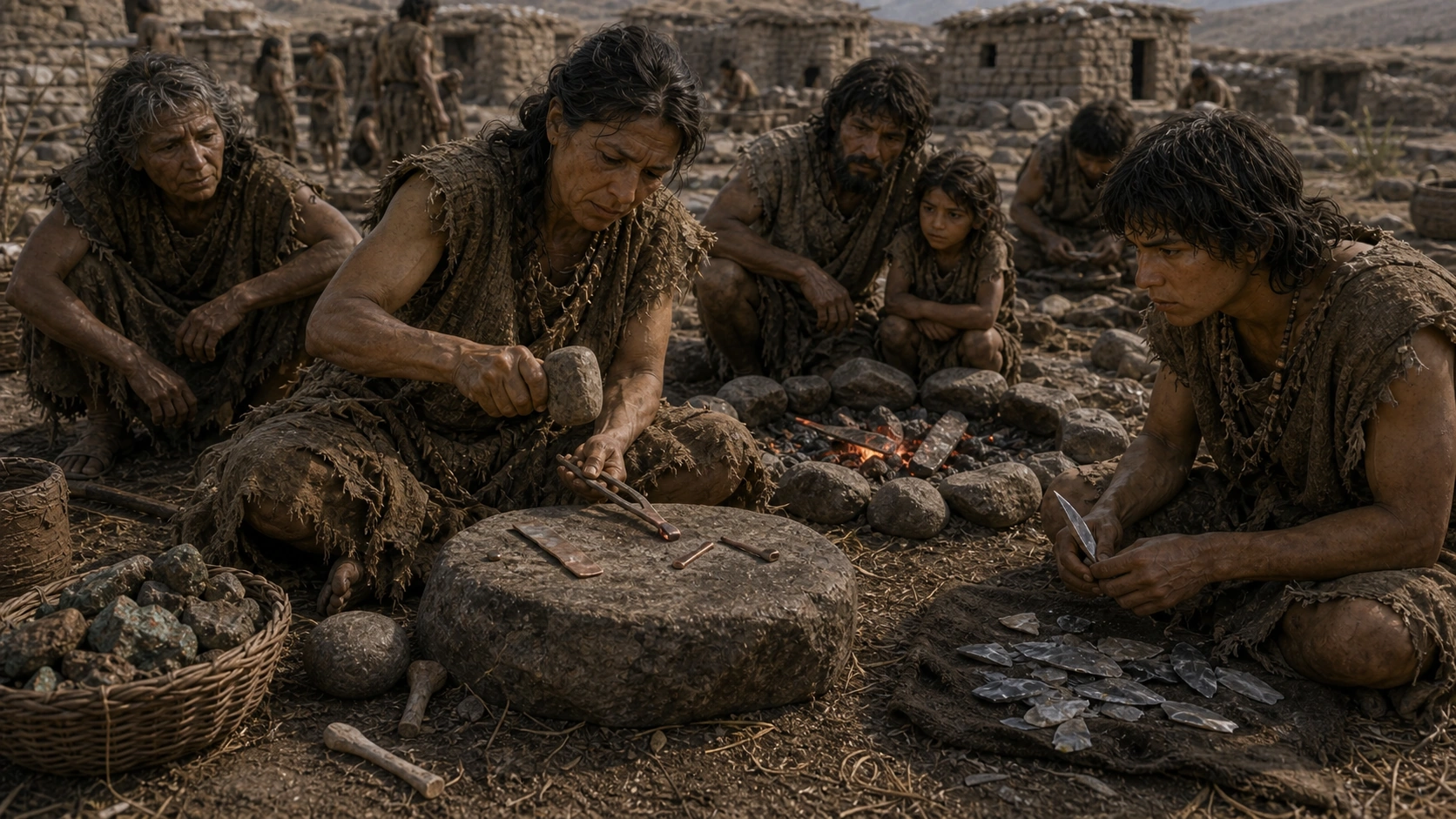
The first time I saw copper, I thought it was a bad kind of stone.
I placed the small reddish lump on an anvil stone and struck it. I expected a sharp flake to break away as it would from flint, but nothing fell off. Only the spot beneath my hammer became flatter.
I hit it again.
This time, it spread sideways.
“I can’t get an edge on this.”
I pushed the red piece away. A woman who made ornaments picked it up.
“It didn’t break.”
“That’s why it’s useless.”
She stared at me for a long moment, then laughed.
“It is the opposite. Not breaking is what makes it useful.”
I knew how to work stone. By striking a hard stone and removing small pieces from the outside, I could leave behind the shape I wanted. If I struck the wrong place, the piece fell to the ground and could not be put back.
The red material behaved differently. The part struck by the hammer did not break away. It spread outward. Thick areas grew thinner, and a round lump grew longer. I could bend it far enough that stone would have snapped, yet it remained in one piece.
The woman hammered it into a slender awl. It was not as sharp as a stone blade, but it could pierce hide. It did not break when dropped, and if the tip bent, she could hammer it straight again.
Working stone meant removing what was not needed and leaving the useful part behind. Copper could be hammered and bent into a new shape without throwing away much of the material. If the shape came out wrong, it could be straightened and corrected. Stone did not allow that.
A few days later, the tip of the awl no longer flattened as easily as it had before. Repeated hammering had made the copper harder, and it resisted each blow. When more force was applied, a small crack began to form along the edge.
“So this breaks in the end too.”
The woman took the awl and placed it in the fire.
“To make it harder?”
“The opposite. To make it easy to shape again.”
After the fire burned down and the awl cooled, she placed it on the anvil stone. The same blow flattened it more easily than before. The bent tip slowly straightened as well.
She had not brought new copper or mixed in another material. The same piece grew harder when it was hammered again and again. After it had been heated in the fire, it became easier to reshape.
We did not know words such as heat treatment or annealing. But we could remember the sequence. Hammering copper for long enough made it harder. Heating it before it grew so hard that it cracked made it easier to work again.
The same piece of copper could have different properties depending on how it was treated. Humans no longer only searched for materials that already had the qualities they needed. They had begun changing the properties of the materials in their hands.
Of course, one small copper awl did not replace stone axes and blades. Copper was rare, and large pieces were difficult to find. Stone still made a sharper cutting edge. For felling large trees or butchering animals, people continued using far more stone tools for a long time.
The woman sitting beneath the wall asked a question.
“So metal was not a better material than stone at the time?”
“It was not better for every task. Stone was easier to find and easier to turn into a sharp blade. Copper, however, could be straightened after it bent and reshaped several times.”
Humans were already hardening clay in fire to make pottery. But once a pot had been fired, it could not return to wet clay. Copper behaved differently. It could be made harder by hammering, softened by heating, and then changed into another shape again.
What mattered was not whether copper was always stronger than stone. What mattered was that the same material could be repaired repeatedly and shifted between harder and softer states.
Much later, people would extract metal from ore, melt it and pour it into molds, and mix different metals together. Those techniques did not all appear at once in this period. But the questions people asked about materials had already begun to change.
Which material is best?
People who had once asked only that question began asking another.
How can we treat the same material to give it the properties we want?
The Stone Age did not end that day.
But humans had begun moving beyond the search for better materials. They were learning how to make the material already in their hands better suited to the task.