I had to learn hundreds of signs before I could write.
The mine guide drew a house and told me, “This isn’t a house. It’s a sound.”
There were turquoise mines at Serabit el-Khadim in the Sinai Peninsula. Egyptians came with officials, quarrymen, and soldiers. People from lands farther east and north worked among them. I understood both groups’ languages, so I helped coordinate the expedition’s people and supplies as an interpreter.
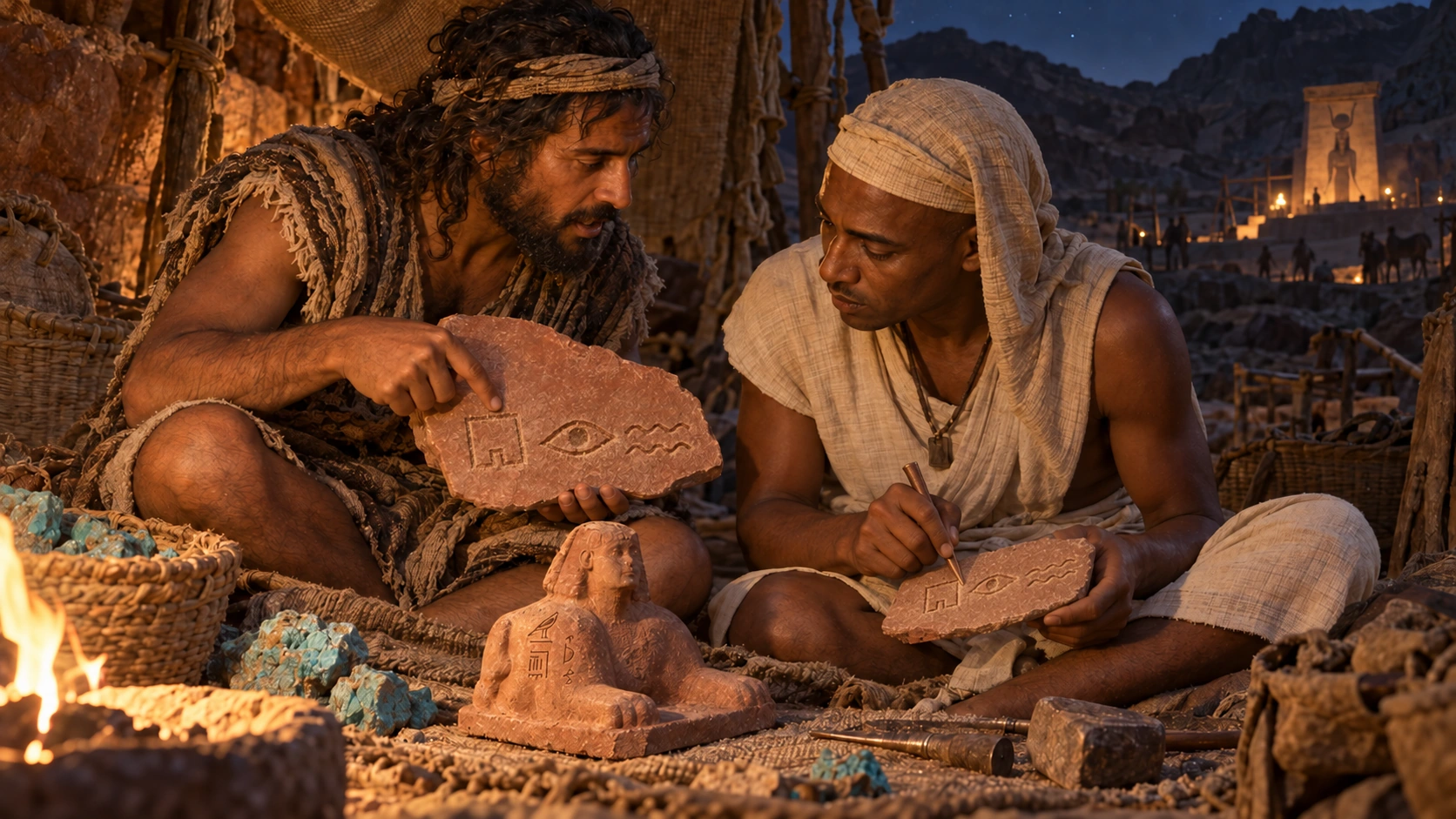
Above the mines stood a temple filled with offerings to Hathor, Mistress of Turquoise. That year, the leader of the expedition dedicated a small sphinx carved from reddish sandstone. An Egyptian scribe cut a neat hieroglyphic inscription into its right shoulder.
Beloved of Hathor, Mistress of Turquoise.
Even people who could not read knew those signs mattered. The scribe had smoothed their patch of stone more carefully than the rest, and the expedition leader’s name stood close to the king’s.
The guide stared at the sphinx for a long time. He had shown the Egyptians where to find springs and which valleys would lead them safely through the desert. When merchants tried to bargain in our language, he was the one who made them stop and listen. Yet the offering carried neither his words nor his name.
He approached the scribe.
“Write the name of our Lady on the other side. Baalat.”
The scribe did not lower his chisel.
“The expedition leader is dedicating this stone. There is no room for your prayer.”
“Then I’ll carve it myself.”
Everyone nearby laughed. Egyptian writing looked like pictures, but copying a few pictures did not make a readable sentence. The same sign could represent an object or a sound. Other signs could be added to clarify its meaning. Becoming a skilled scribe took years of training.
That night, the guide placed a broken stone chip on the floor of my shelter. He scratched a square house onto it.
“In our language, a house is bet.”
“Yes.”
“Then this is the b sound.”
I reached over to make the house more precise. He caught my wrist.
“It doesn’t need a roof. We aren’t drawing a house.”
He drew an eye and took only the first sound of our word for it. He drew water and did the same. From a picture of an open hand, he kept the first sound and threw away the rest of the word. Instead of reading what each picture meant, he used the sound that came first when we named it in our own language.
I asked him to say a name I had never seen written. He pronounced it slowly, and I placed his signs in a row. We did not mark the vowels separately, but because we spoke the same language, we could supply the sounds between the consonants.
He read the chip.
This time, I had it right.
After years of learning to write, I had just been shown a shorter road into writing by a man I had assumed was illiterate.
The great change in early alphabetic writing was not that people drew simpler pictures. Each sign was detached from a whole word and its many possible readings, then assigned to a single sound at the beginning of a word in their own language. Instead of mastering hundreds of signs, a writer could combine a few dozen signs, each tied to a sound, to spell words no one had written before.
Before dawn, we climbed to the temple. The guide carved a short line into the sphinx’s left shoulder. His strokes were rougher than the Egyptian inscription, and no two signs were quite the same size. Still, he read them without stopping.
Beloved of Baalat.
The scribe arrived late and went rigid.
“Who gave you permission?”
The guide set down the chisel.
“Your writing calls her Hathor. Mine calls her Baalat. Both are the Lady of this mountain.”
The scribe could not read the new line. He could order it erased, but first he would have to explain what insult it contained. He studied the sphinx for a long moment and checked only that the expedition leader’s name had not been damaged.
Then he walked away.
At that point, the man beneath the wall interrupted me.
“So from that day on, anyone could write?”
“No. Fewer signs did not remove the need for time, teachers, and writing materials. The power to decide who had a reason—or permission—to write remained as well.”
The alphabet did not hand the power of writing to everyone at once. It did, however, sharply reduce the number of signs and the training needed to begin. The threshold that only palace and temple specialists had crossed began to fall within reach of more people. Lowering the threshold did not open the door by itself, but far more hands could now push against it.
The scribe’s orderly sentence remained on the sphinx’s right shoulder.
The guide’s crooked sounds remained on the left.
He never carved his own name in large signs.
But when he called to his goddess in his own language, he no longer needed to borrow a scribe’s hand.