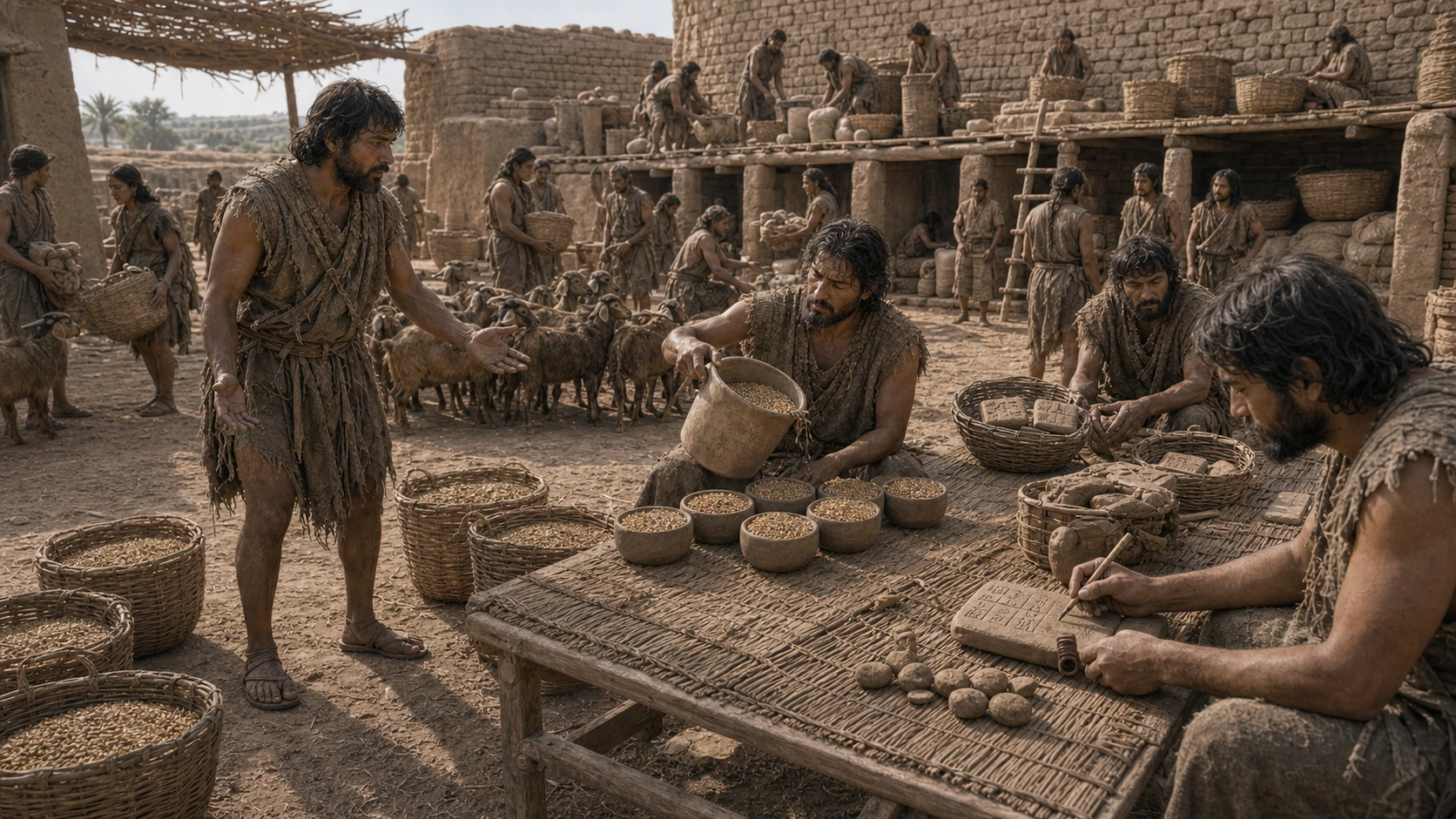
I carried seven baskets of grain.
The clay tablet recorded six measures.
A large measuring vessel stood in front of the granary. The baskets people brought came in every shape and size, but before grain went into storage, all of it was measured again with that one vessel.
Some of my baskets held more than the standard measure, and some held less. Once I had emptied all seven, they came to exactly six standard measures.
The man keeping the granary records drew the sign for grain on a wet clay tablet. Beside it, he pressed marks for the number six and a sign identifying my work group.
“I carried it here seven times.”
He looked at my empty baskets.
“I am not counting how many trips you made. I am counting how much grain came in.”
“It is seven by my baskets.”
“And how is anyone else supposed to know how large your baskets are?”
He rolled the granary seal along the edge of the tablet, leaving a long, repeated pattern in the wet clay.
“On this tablet, it will remain six.”
At first, I felt as though one basket of grain had been stolen from me. I had walked seven times, and my shoulders had borne the weight seven times. Yet a tablet no larger than my palm said I had brought only six measures.
But dozens of people were waiting outside the granary, each holding baskets of different sizes. If the record keeper simply trusted every person's baskets and claims, there was no way to add up how much grain the granary actually held.
The next person had brought a basket larger than mine. The record keeper did not throw away the grain that rose above the measuring line. He added it to the next measure. He had not singled me out.
Once everyone's grain was measured with the same vessel, the amounts could be compared.
Accounting began by measuring different things against the same standard. Seven baskets and five baskets could not be compared if the baskets were different sizes. Six standard measures and six standard measures could. Before people could record grain, livestock, and labor, they first had to convert them into units that could be counted.
A few months later, the record keeper left for another place. His replacement had never seen me deliver grain and did not know my name.
Even so, he found the mark of our work group and the granary seal on the dried tablet. He confirmed the six measures we had deposited.
The man who remembered the event was gone, but the calculation continued.
Soon the tablets held more than grain. Signs and numbers recorded how many goats had come in or gone out, how many days a work group had spent repairing a canal, and how much grain should be distributed to the people carrying bricks.
The person overseeing a large project no longer had to remember every worker's face. A tablet showed how much grain each work group had received and how much work it still owed.
The record remained even when the person in charge changed. The amount of grain and the unfinished labor passed to the next official with it.
Records lasted longer than one person's memory and could hold more numerical information than one person could remember. When officials changed, they could read the same tablets and continue distributing rations and assigning labor. A shared organizational record began to take over work that had once depended on individual memory.
Cave paintings had also preserved memories and stories. But different people could look at the same painted bison and understand it differently. An accounting sign could not work that way. If every official read the number beside the grain sign differently, the granary could not function.
Accounting records had to mean the same thing to every person who read them.
And records did more than preserve what had already happened. The amount of grain written on a tablet determined the next distribution. The labor already recorded determined who had to return and how much longer they had to work.
Numbers written in the past began to demand action in the future.
Of course, a clay tablet was not always right.
Once, I saw the share owed to a neighboring work group recorded incorrectly. The clay was still wet, so the record keeper rubbed out the marks with his hand and pressed them again. If no one had noticed before the tablet dried, the wrong number would have passed to the next official bearing the granary's official seal.
A woman seated beneath the wall asked a question.
“What did you do when a record was wrong?”
“When memories disagreed, we argued with people. Once a wrong record had dried, we had to argue with the tablet. The tablet was usually the more difficult opponent.”
A person might listen and change their mind. A dried tablet silently showed the same number over and over. Once it carried the granary seal, more people trusted it than trusted my memory.
Even if someone had delivered grain or completed the work, an official left it out of the calculation if it was not in the record. And if an incorrect number entered the official record, it affected the next distribution of grain and labor.
Records did not merely preserve reality. They determined what would be officially recognized and served as the basis for distributing grain and assigning labor. Accurate records allowed a large organization to keep running. Incorrect records allowed mistakes to survive long after the officials who made them were gone.
As cities, granaries, herds, canals, and work groups grew, no single mind could manage them all. Someone had to add the quantities, find shortages and surpluses, and calculate how much to collect and distribute in the next season.
Much later, records came to hold taxes, debts, contracts, land, orders, and laws. A ruler did not need to know every person's face. He could issue commands based on recorded quantities of grain and counts of livestock, workers, and fields.
The larger the state became, the more it depended on records that many officials could read rather than on any one person's memory.
My shoulders remembered carrying grain seven times.
The clay tablet recorded six measures.
And the people running the granary trusted the tablet more than my shoulders.