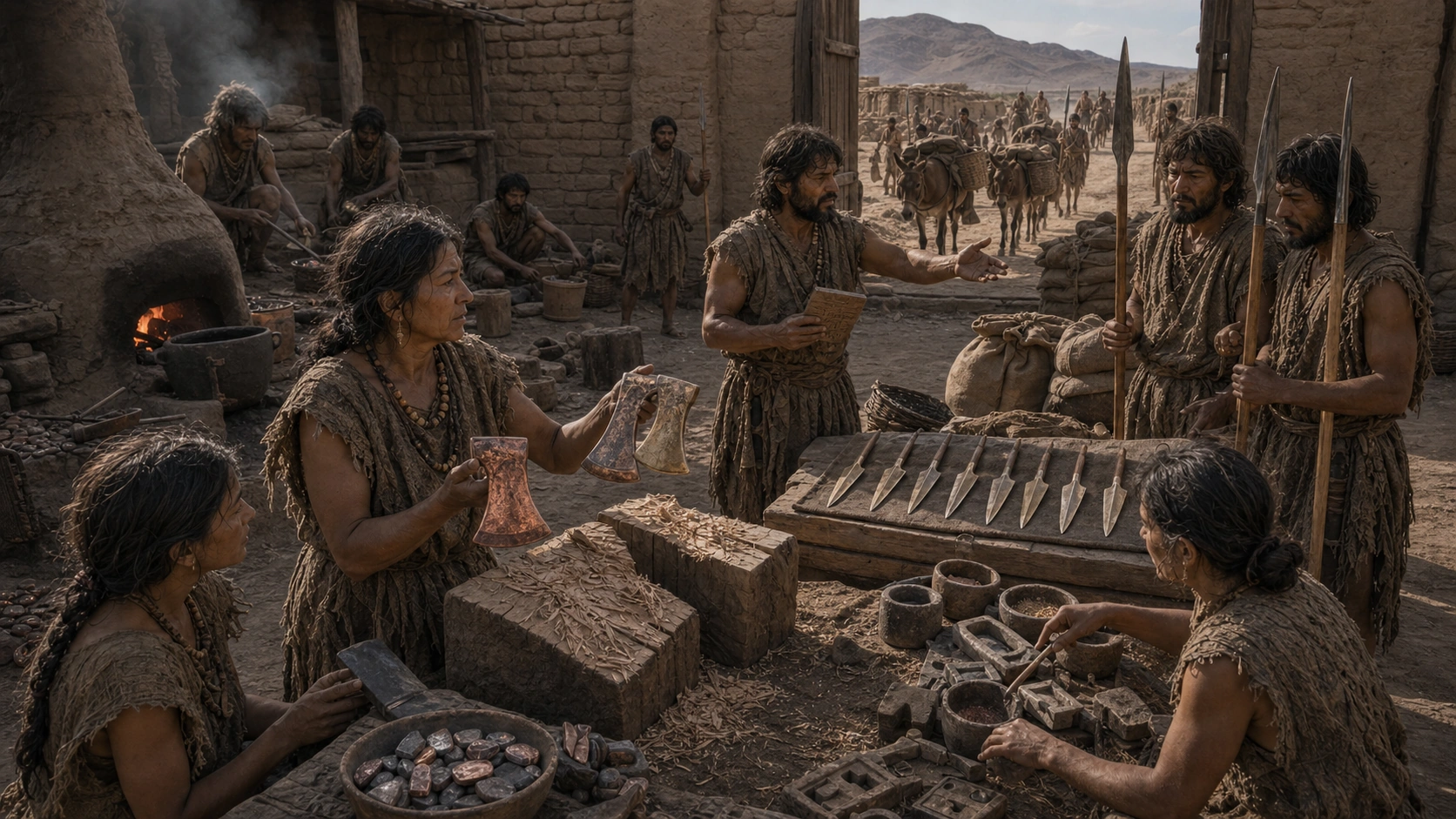
The first person to receive a bronze spear was not the craftsperson who made its point.
It was a guard at the granary door.
At the time, I was assisting a metalworker. One day, he placed two axe heads of similar shape in front of me. One was the familiar red of copper. The other was slightly paler.
“Strike that tree with both of them.”
I chopped at the dry wood several times with the copper axe. Its edge slowly flattened and soon became rounded.
The other axe head kept its edge longer after the same number of blows. It also cut more deeply into the wood.
“What kind of copper is this?”
“It is not only copper.”
The metalworker pointed to a small pouch in the corner of the workshop. It held pieces of grayish metal brought from far away. Mixing another metal into the copper had produced an alloy that was harder and kept a sharp edge longer.
I picked up the new axe head.
“We should make axes first. We could cut wood much faster with these.”
“The first batch is supposed to be spearheads.”
“Who decided that?”
Instead of answering, he looked outside the workshop. The man responsible for the granary seal was entering with two guards. He held out a clay tablet listing what we were to make next.
“Make ten spearheads first.”
“The woodcutters are waiting for this metal too,” I said.
He answered calmly.
“If we cannot defend the granary, there will be no grain to give the woodcutters.”
He was not wrong. That made him harder to argue with.
Bronze was not a metal we could make whenever we wanted. Copper had to come from the mountains, and the metal mixed with it came from even farther away. The people and pack animals carrying those materials had to cross several villages and long stretches of dry road.
If the mine produced nothing, we could make no bronze. If raiders took the cargo along the trade route, we could make no bronze. Even after the materials reached the workshop, we still needed a craftsperson who knew which metals to combine and in what proportions.
If even one part was missing, lighting the workshop fire changed nothing.
Making bronze required metals from different regions, secure trade routes, and craftspeople who knew how to combine and work the materials. Behind one strong tool stood mines, carriers, guards, and skilled metalworkers. Bronze drew its power not only from the metal's properties, but also from the ability to keep that entire network working.
The man in charge of the granary posted a guard beside the pouch of rare metal. Before long, the metalworker had to ask permission before accepting orders from another village.
He received more grain and a better room than before. But he could no longer decide for himself what to make first or who would receive it. His valuable skill earned him better treatment, yet it also kept him from freely accepting orders from other groups.
The first ten spearheads went to the guards as promised. The woodcutters continued using stone and copper axes, and the farmers did not receive tools made from the new metal right away either.
A new technology did not benefit everyone at the same time. The people controlling the materials and the workshop decided who received its first products.
Soon afterward, the traders who were supposed to bring us more alloying metal returned empty-handed. They said their cargo had been stolen on the road.
The man in charge of the granary sent four guards carrying new bronze spears with the next trading party.
The second group returned with the metal.
The workshop made more spearheads. Some of those went once again to the guards protecting the trade route. The people who had received the new weapons first protected the route that supplied the raw materials, and those materials were then used to make more weapons for their own side.
A man listening beneath the wall asked a question.
“Still, is it not too much to say that a single spear created power?”
“It is. If there had been only one spear, the advantage would have lasted only until someone stole or broke it. What mattered was whether a group could make the next spear, repair damaged ones, and keep arming its own people.”
The difference between a group with one bronze weapon and a group with ten was already large. If the group with ten also controlled the mines, trade routes, and craftspeople, it could make twenty next time. The other group kept falling behind if it could not gain access to the same materials and skills.
One powerful weapon could provide an advantage in a single fight. A group that could keep making and repairing the same weapons—and arm its own people first—could preserve that advantage. Bronze weapons protected the routes that supplied raw materials. Those materials produced more bronze weapons, and the technological gap grew wider.
The first axe head I tested never reached a woodcutter.
It was melted down, remade as a spearhead, and placed at the granary door.
The first person to benefit from the new metal was not the person who needed it most.
It was the person who could decide who received it first.