I drew one large circle in the dirt, then scattered small dots around it.
“What is that?”
The youngest child asked.
“The circle is a herd of bison. The dots are us.”
“Why did you need so many people?”
“Because bringing down one bison is easier than making an entire herd change direction.”
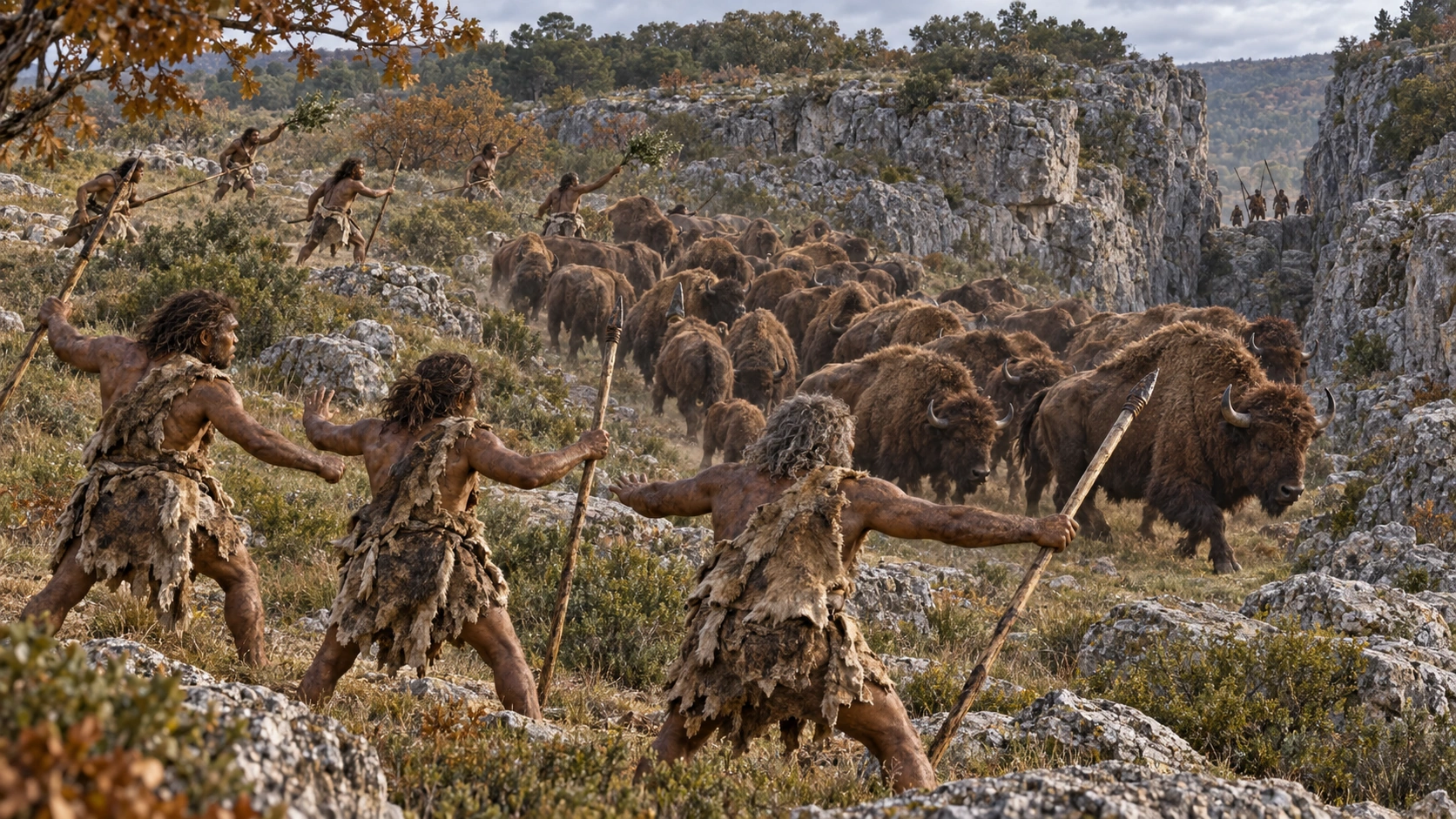
That year, we watched the bison for a long time before we tried to hunt them. The people who read tracks well studied the places where the herd passed most often. Those who read the wind watched where our scent would travel. Those who knew the land chose ground the bison would have trouble escaping from.
No one was best at every part of the hunt, so we brought together what each person had learned. An older woman who read tracks better than anyone drew lines in the earth and used stones to mark our positions. Some people would move the herd from behind. Others would block the side paths. Another group would wait where the ground narrowed.
My place was below the slope on the left. I was not there to drive a spear into a bison. I was there to keep the herd from escaping into the trees. I had a new spear and wanted to use it, so I did not like my assignment.
Once the hunt began, I could not see the people on the other side. All I knew was that when the distant calls reached me, I had to show myself—and if the bison came my way, I had to hold my position.
Not long after the calls began, the herd moved toward me. A young bison broke away and ran for the trees. I left my position to chase the animal in front of me.
The companion beside me caught my shoulder.
The rest of the herd was following behind the young bison. If I opened the path, I might gain one animal and lose all the others. I returned and stood beside the others.
That was almost the whole of what I did.
The bison searched for open ground, changed direction, and entered the narrowing terrain we had chosen. The people waiting at the far end used their spears. The hunt ended before anyone had time to count who brought down which animal.
Our roles did not disappear when the hunt ended. Some kept watch. Some worked on the hides and meat. Others carried what was too heavy for one person. If the people with spears had been the only ones doing any work, predators would have taken the meat—or we would never have brought it home.
“Which bison did you kill?”
The youngest child asked.
“I didn’t deal the final blow to any of them with my spear.”
“So you just stood there?”
“I held my place. If I had chased that one young bison, the larger herd might have escaped through the gap.”
The youngest child looked unimpressed.
“That’s not very heroic.”
“That day, we needed a great many people to do unheroic work well.”
“Did you still get meat?”
“I did.”
“Even though you didn’t kill one?”
“If meat went only to the people who used their spears, everyone would crowd the front with a weapon on the next hunt. No one would block the side paths, keep watch, or carry the meat home.”
The children looked again at the dots scattered across the dirt.
Division of labor did not mean everyone doing the same job. Some people read tracks. Some watched the wind. Some blocked escape routes, while others used their spears at the end. Each person could do only part of the work, but when those parts followed one another, a hunt no one could even attempt alone became possible.
Today, we might call that collective intelligence. It did not mean everyone understood the entire hunt. Because each person shared what they had seen and took responsibility for a different task, the hunt could continue even without one person directing the whole thing.
That structure made us stronger while also creating a new weakness. When I hunted alone, if I made a mistake, I was the only one who failed. Once our roles were connected, just one person I could not even see could abandon their position and make everyone fail. Cooperation required more than combining our abilities. We also had to trust that people beyond our sight would do their part.
Collective intelligence did not mean that many people all thought alike. It was the ability to connect different people’s knowledge and actions through signals, roles, and rewards. By joining their separate parts, people could complete work that no one person could understand or accomplish alone.
As the sun dropped, we hung one great bison leg from a pole. A weight no one could lift alone rose from the ground on several shoulders.
Our places had been different during the hunt.
On the way home, we shared the weight. Once home, we shared the meat.