“Was there fire back then?”
The youngest child asked.
“Fire had been around far longer than humans. Lightning could start it, and once it caught in a dry forest, the wind carried it from tree to tree.”
“Then you didn’t discover fire?”
This came from the girl in the school uniform, the youngest child’s older sister. She had been listening as if she meant to catch me in a lie.
“There probably was no first person to see fire. What mattered wasn’t the day we saw it, but whether that fire was still beside us the next day.”
I picked up one of the stones in front of the children, then set it down again.
“Keeping a fire was harder than finding one.”
“You just had to keep adding wood.”
“Easy to say now.”
“You didn’t know that, mister?”
“Not always.”
The children laughed. Even the girl let that answer pass.
At least at that point, we did not know how to kindle fire from scratch. We could only get a burning branch after lightning had swept through dry woodland. Even on the way back to the cave, we had to feed it dry grass and slender twigs. If we looked away for a moment, the flame shrank. If the wind picked up, the fire spread where we did not want it.
“So you didn’t start the fire. You brought it home?”
“At first, that was closer to the truth. Even in our hands, it was like an animal that did not belong to us. Stop feeding it, and it would run away.”
“Fire eats?”
“Dry grass, branches, fallen trees. It ate far more than we did.”
Once fire stayed inside the cave, much of our lives changed. When the night air turned cold, we no longer shivered for as long. Animals approaching through the dark often stopped beyond the edge of the light. Meat and hard roots changed in smell and texture when left nearby. Tough flesh tore more easily, and roots could be swallowed without so much chewing.
“Did you roast meat?”
“We didn’t know from the beginning how to cook the way people do now. We saw food change near the fire, then tried placing it a little closer. That is how I remember it, at least.”
“Did it taste good?”
I thought for a moment.
“Not having to tear at it with my teeth for as long was flavor enough.”
The children nodded. Apparently, the value of good teeth needed no explanation in any age.
The problem was that every one of those comforts could vanish with the flame.
During a stretch of rain, we ran out of dry branches inside the cave. In a hurry, I piled wet wood from outside onto the fire. Acrid smoke billowed up, and the flames sank lower, unable to catch.
“Wet wood puts a fire out.”
The girl caught the mistake at once.
“I know that now.”
“What did you think then?”
“I thought a thicker piece of wood would make the fire grow.”
The youngest child put a hand to their forehead.
“That’s bad.”
An accurate assessment.
The more pieces of thick wood I added, the weaker the flame became. Before long, the light that had filled the cave was gone. Only a few red embers remained among the ash. Animals’ eyes gleamed beyond the edge of the dying firelight, and the people inside the cave pressed closer as the warmth faded.
Then a young companion who often sat near the fire pushed my arm aside. They sifted slowly through the ash until they found a patch that still glowed red. They laid a little dry grass over it, shielded it from the wind with their body, and blew a short breath into it.
“They were better at it than you.”
“That day, in front of that fire, certainly.”
“Didn’t that hurt your pride?”
“Not as much as losing the fire would have.”
In my haste, I blew too hard and sent ash flying. My companion gathered more dry grass. This time, I used my body to block the wind. A thin thread of smoke rose from the tips of the grass.
We did not rush. First came dry grass, then twigs thinner than a finger. Only after the flame caught did we add anything thicker. The ember caught in the grass, and the flame spread from thin twigs to thicker branches. When our shadows returned to the cave wall, the people who had scattered came back one by one.
“Did you never let it go out after that?”
“It went out plenty of times.”
“Again?”
“A fire wasn’t something that stayed forever because you got it right once. But more people learned what to feed it before it died and what to offer first when it had almost disappeared.”
One person watching the flames all night was not enough to keep a fire alive. Someone had to gather dry fuel. Someone had to find the embers beneath the ash. Someone had to block the wind. Once several people knew the sequence, one person’s mistake no longer meant the end of the fire. Someone else could save it. Fire stopped being something we happened to get after lightning and became something we managed at the center of daily life.
“Looking back now, I think of it as humanity’s first energy revolution.”
“Why call it an energy revolution?”
The girl asked.
I pointed to the phone in her hand.
“That goes dark without electricity, doesn’t it?”
“Of course.”
“Until then, most of the power we used came from our own bodies—the power to walk, lift, break, and chew. Once we learned to keep fire, we could burn wood for heat and light and use that power to change the space around us.”
Fire was the first technology that let us draw on energy outside our own bodies again and again. By burning wood, we gained heat and light. With them, we pushed back cold and darkness and changed food itself. Stone sharpened the power of the hand; fire transformed the entire space in which people lived.
“So you kept working after dark?”
“It wasn’t all work.”
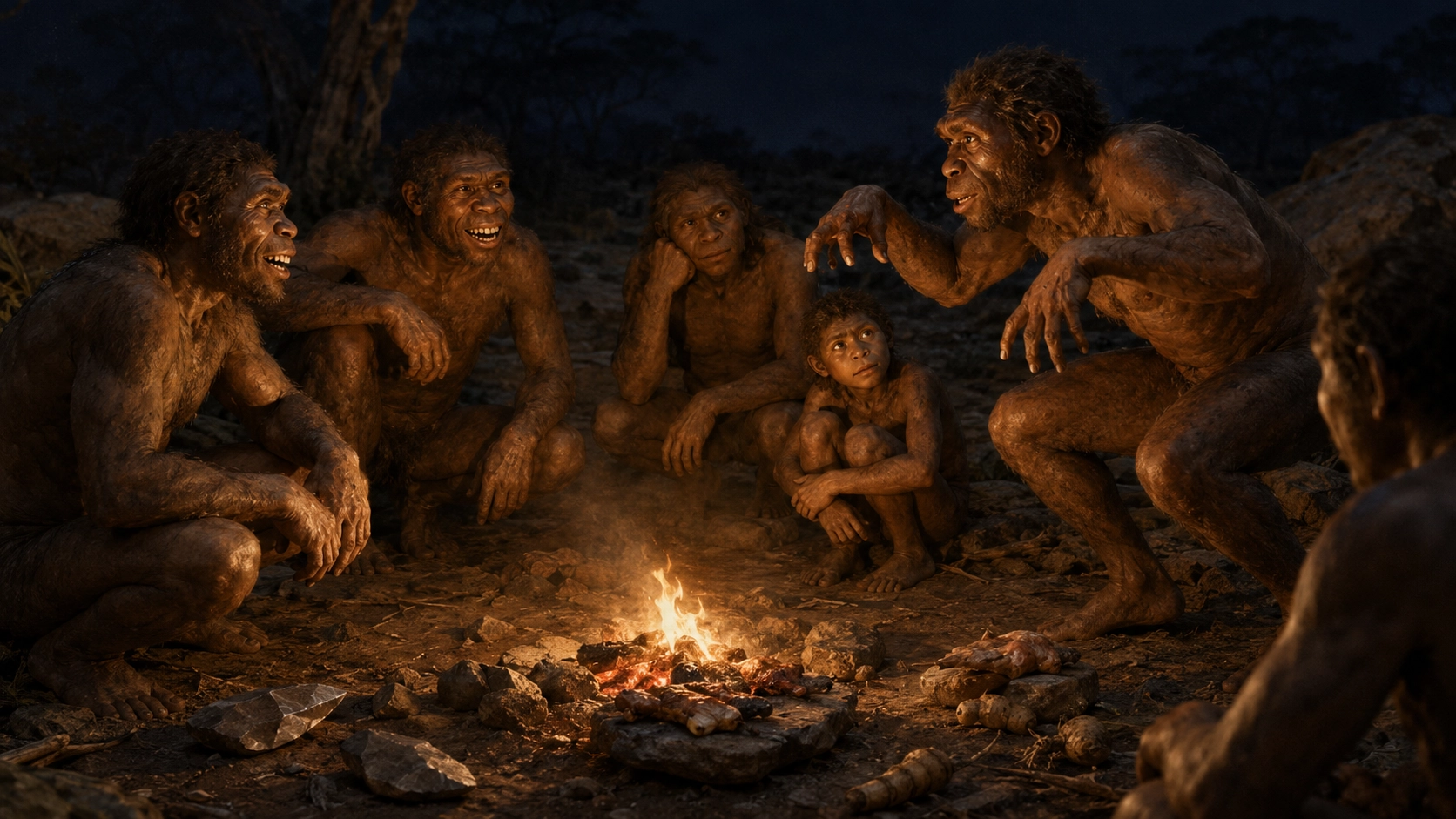
Even after the animals’ eyes had vanished beyond the firelight and our bellies were full, we did not immediately curl up to sleep. Someone mimicked an animal we had failed to catch that day. Those who recognized it bared their teeth and laughed. We traded short sounds and gestures around the fire.
“You could tell stories when you could barely talk?”
“Our words were short, but we could still see faces and hands. Darkness hides a gesture. Fire gives it back.”
The youngest child thought about this.
“Then you didn’t just get fire. You got the night.”
I smiled.
“That is one way to put it.”
Without fire, night was a time to curl up and wait for the darkness to pass. Once we could keep fire alive, we could eat together after dark, see one another’s faces and gestures, and laugh together. Daylight had not grown longer, but night had become shared time for the first time.