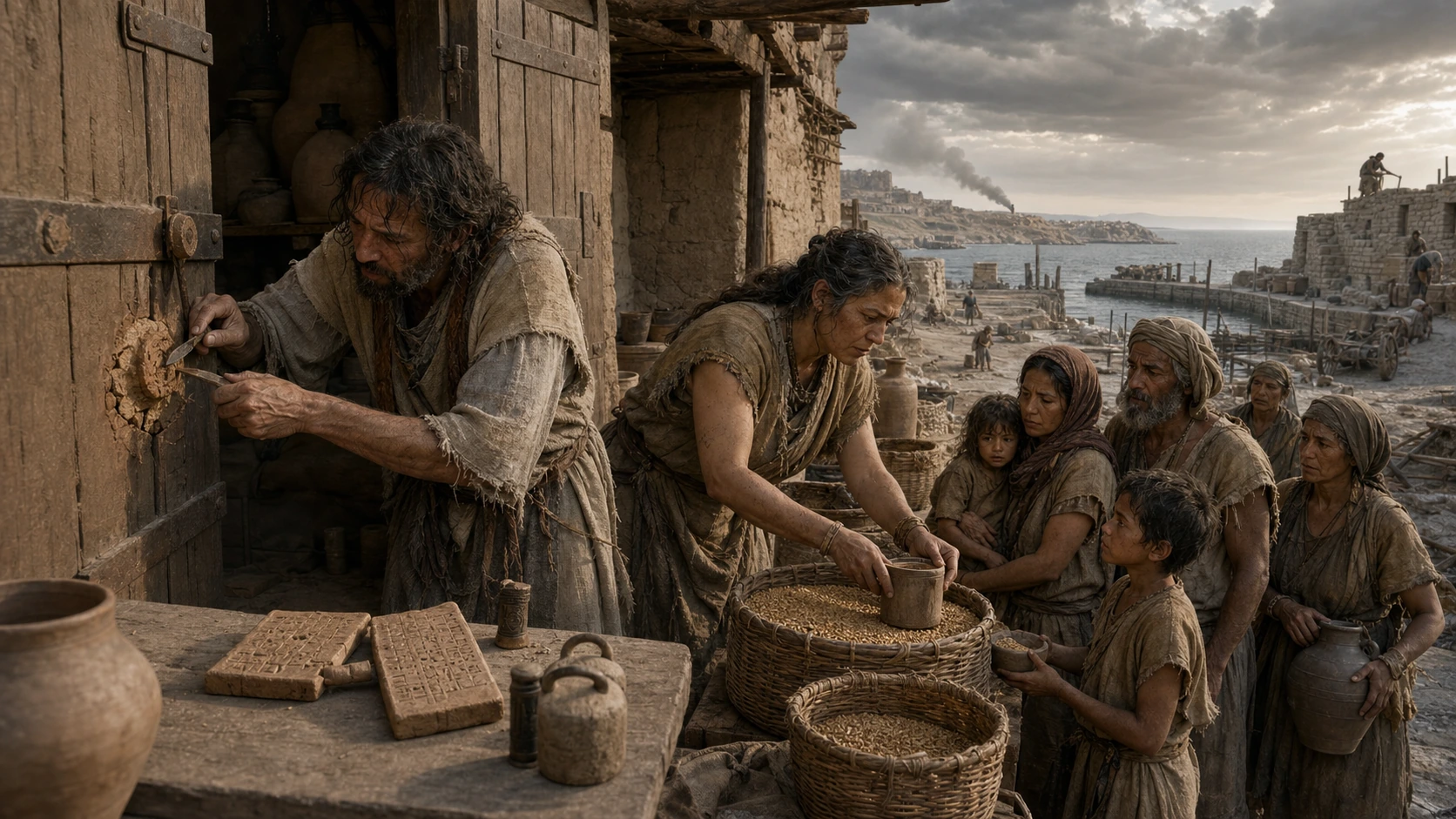
Two ships and a train of cargo carts were due at Ugarit’s harbor that day.
None of them arrived.
The woman who ran the harbor warehouse stared at the empty quay.
“Copper comes from Alashiya. Tin passes through half a dozen countries. Grain comes from inland. If any one of them is late, the palace blames us.”
“Today, all three are late.”
“Then I suppose we’ll be blamed three times.”
She did not smile. Neither did I.
Ugarit’s harbor and palace storerooms gathered goods from far beyond the kingdom: copper from Cyprus, tin carried across several frontiers, grain from inland fields, pottery and oil from other shores. Merchants speaking different languages checked weights and seals. Scribes recorded which king, temple, or storeroom owned every load.
A generation earlier, that scene had looked like strength itself. No city had to find every material or master every skill on its own. A bronzesmith did not need a copper mine. A king did not have to rule every field that fed his court. Roads, ports, and promises connected people who could each do one part well.
The trouble was that all three had begun to fail at once.
A tablet arrived from the palace ordering us to release the grain promised to Ugarit’s northern overlord. Almost at the same time came another demand: find workers to reinforce the wall and provide spearheads for the men guarding it.
The warehouse keeper pushed an empty grain jar toward me.
“If we send the grain, the harbor families go hungry. If we keep it, we defy the king.”
I wrote three messages. I asked the inland storehouses where the grain carts had stopped. I asked a merchant from Alashiya what had happened to the copper ship. I told the palace that without tin, I could promise no new bronze spearheads.
The first answer arrived near sunset. Villages along the road were refusing to release their grain, and the carts could not move. The villagers did not have enough to reach the next harvest either.
The second message was not written on clay. It came in the form of people fleeing a port to the south. Raiders from the sea, they said, had emptied the warehouses and set ships alight.
The third tablet said only that the troops and chariots were deployed on another front. Hold the gates. Endure.
The warehouse keeper looked at me.
“Who is coming to help us?”
I looked down at the tablets and considered the three reports together. The villages with grain, the merchants with ships, and the king with soldiers were all trapped inside emergencies of their own.
“No one can.”
We went to the sealed palace granary. There was enough grain inside to last a few days, but it belonged to the king. She wanted to send the dockworkers’ families beyond the walls while the roads were still open. I was the scribe responsible for protecting the seal. She was the one who knew the names of the people who would starve because of it.
“They will punish you if you open it,” she said.
“If I don’t, children you know will be the first to go hungry.”
I broke the king’s seal. Then I pressed my own into wet clay beside the door, marking that I had opened the storehouse and would answer for it.
We did not divide the grain equally. We gave food first to the children and older people leaving the city. Then we counted shares for the people carrying water and for those staying to repair the wall. It was not a fair distribution. It was one meant to keep people alive and moving.
At that point, the man beneath the wall interrupted me.
“If so many kingdoms were connected, couldn’t the others help whenever one of them was in trouble?”
“Usually, they did. But a network changes when every road carries a plea for help. The villages that should have sent grain were hungry. The ports that should have sent ships were under attack. The king who should have sent soldiers was fighting somewhere else. When every end of the network pulls at once, nothing remains loose in the middle.”
A complex civilization does not need every city to be destroyed before it stops working. Farmers can wait for a safe road, smiths for tin, soldiers for grain, and ports for soldiers. The people and materials may still exist, yet the whole system can stall when every part begins waiting for another part to move first.
A few days later, the warehouse keeper left for the interior with her family. I gave her a final sack of grain and a palace token that opened official gates. I believed it would still be honored in other cities.
It was not honored for long.
Ugarit’s palace and harbor were destroyed, and much of the city burned. It never rose again in the same form. That did not mean everyone vanished. Survivors planted fields in smaller settlements, repaired boats in other ports, and made new routes. The great net tied by kings had torn. People took its broken cords and knotted them into smaller lives.
The lesson of the Late Bronze Age collapse is not that connection makes a society weak. Connection gives people power that none of them could produce alone. But when too many resources are concentrated under a single palace’s control and too much depends on one distant supplier, the same routes that carry wealth can also carry disruption. The network was a source of strength. Once the slack that sustained it disappeared, it became a road along which shocks traveled together.
Years later, I found one of my tablets in the ruins of the warehouse, still bearing the mark of my seal.
The record showed where the grain had gone.
It did not record the people who had lived because they ate it.