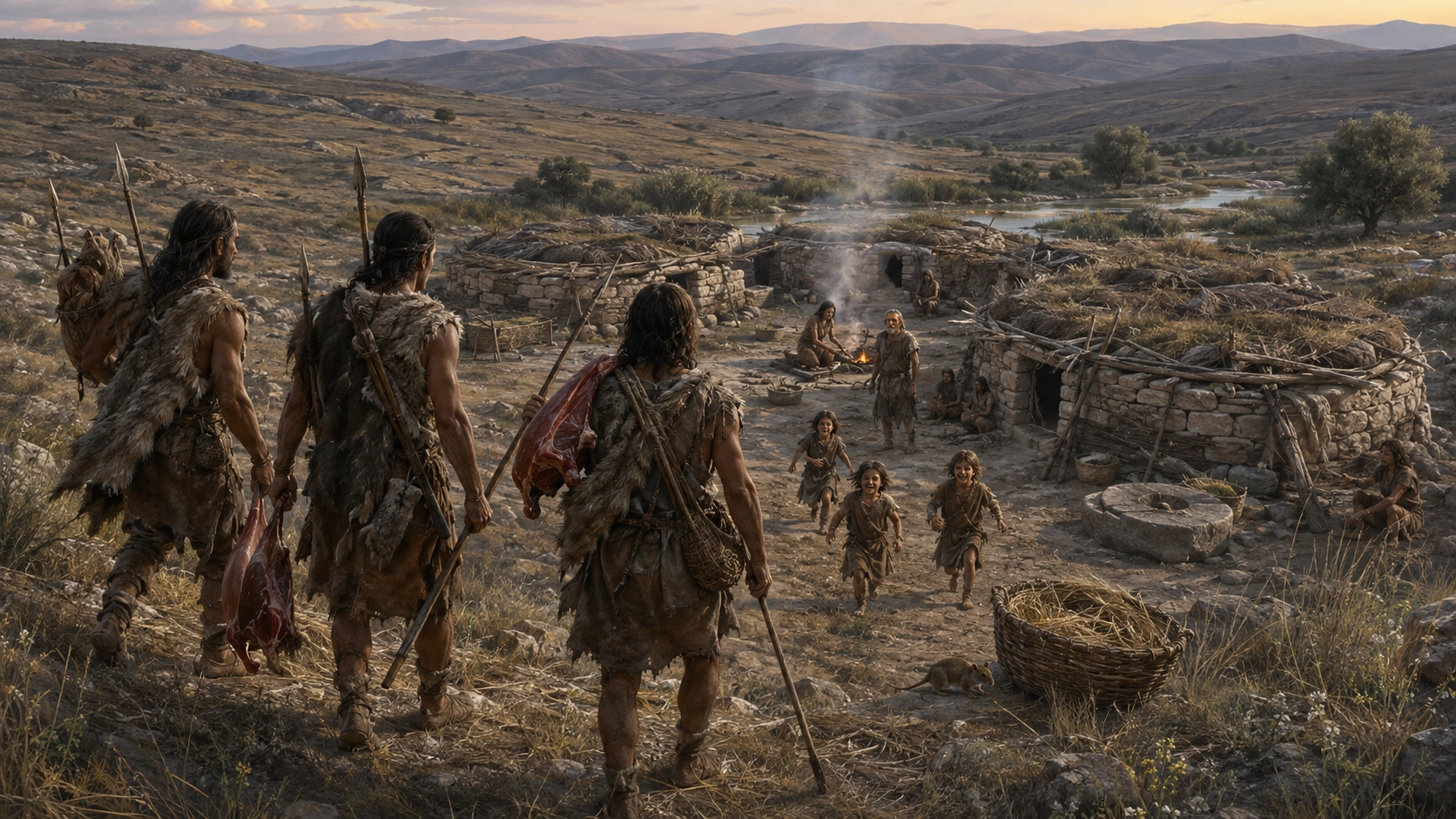
The first to notice that we had begun staying in one place for longer was a mouse.
“A mouse? Not people?”
The youngest child asked.
“People still thought we could leave whenever food ran low. The mice had already realized that food kept being left there.”
That night, another rustle woke me. A mouse leaped from a basket of dried wild barley and vanished into a gap in the low stone wall. I reached inside, but it fled deeper and left me with nothing but a scratch across the back of my hand.
“This is why you shouldn’t build houses out of stone.”
An old friend laughed at my grumbling.
“Mice got into hide tents too.”
“You can pick up a tent and leave.”
“There you go again.”
A spring lay close to where we were staying, and wild barley and other grass seeds ripened there each season. A route used by migrating gazelles was not far away. We had stayed there for long stretches before, whenever food was plentiful. When fruit and game grew scarce, we rolled up the hides and moved to another place.
But more remained each time we returned. A pile of stones once used as a windbreak became a round wall. As people rebuilt the fallen sections, the wall grew thicker. Layers of ash from many fires accumulated on the floor. People even brought in heavy stone mortars that could not be carried from place to place. More graves for people who had died there appeared along the edge of the camp.
We could still leave. But now leaving meant more than rolling up the hides and putting out the fire. We had to abandon the houses, tools, and graves as well.
On the day the gazelle herds began moving north, I packed my hides and spear. My friend, however, was repairing the roof of his house.
“You’re not coming?”
“Only the hunters need to go.”
“If the gazelles move away, the food moves with them.”
My friend laid another handful of dry grass across the new roof.
“Just because the food moves doesn’t mean the house has to.”
Until then, people had lived wherever food could be found. When food moved, people moved. Once the group left, nothing remained but cold ashes and broken things.
This time was different. Only a few hunters followed the gazelles. Children and elders stayed in the stone houses near the spring, while others gathered nearby seeds and fruit and ground them with heavy mortars. We walked for days in search of game, but we did not take the whole group with us. There was a village to return to when the hunt was over.
Five days later, we crossed the ridge carrying meat. Smoke was rising from the same place as before. Children ran to meet us, and my friend had cleared a space beside the fire where we could butcher the meat. I put down my load and fell asleep in the same place where I had slept a few days earlier.
We had often returned to the same places in the past. Back then, we rebuilt the camp whenever we came back. This time, the houses, the fires, and the people waiting for us were still there.
Semi-sedentary life did not mean that people stopped moving altogether. In the past, the whole group had followed the food. Now, only some people went out to hunt and gather before returning to the village. Children and elders, houses and fires, and heavy tools remained in one place, turning it into the starting point and destination of every journey.
Staying in one place did not make life easier in every way. As more people remained for longer, nearby firewood and food disappeared faster. The path to the spring became deeply worn with footprints, and mice swarmed around discarded bones and scraps.
In the past, we could leave when an area became dirty or food grew scarce. Now, if we wanted to keep living there, we had to clear the waste, block mouse holes, and carry firewood from farther away.
As the next season approached, my friend set aside ripe ears of wild barley whose grains did not fall away easily.
“Why aren’t you eating those?”
“When the rain comes, I’m going to sow them near the house.”
“Do you think grass will grow wherever you want it to?”
“That’s why I’m trying.”
Even on hungry days, my friend did not touch the bundle. We still hunted gazelles and gathered wild fruit and grass seeds. When food became too scarce, we sometimes left for other places for a while. We did not yet get all our food from fields.
But the more people stayed in the village, the more food they needed to find nearby. Moving the entire group whenever food ran low was no longer enough. People paid closer attention to when wild cereals ripened. They saved good seed instead of eating it and began sowing it in the ground near their homes.
“Did villages cause farming?”
The teenage girl asked.
“Not one village by itself. But when people kept moving, they could leave for a place with more food. Once they stayed, they had to keep finding food close to home.”
People did not always begin farming first and settle down afterward. Some groups stayed in one place for longer before agriculture. They needed to obtain more food near their villages again and again, which gave them a reason to manage wild cereals and sow more seed. Settlement could be a result of agriculture, but it could also help drive people toward farming in the first place.
That night, I heard another rustle beneath the basket. I brought over a stone and blocked the mouse hole.
I was not preparing to leave.
I was preparing to stay.