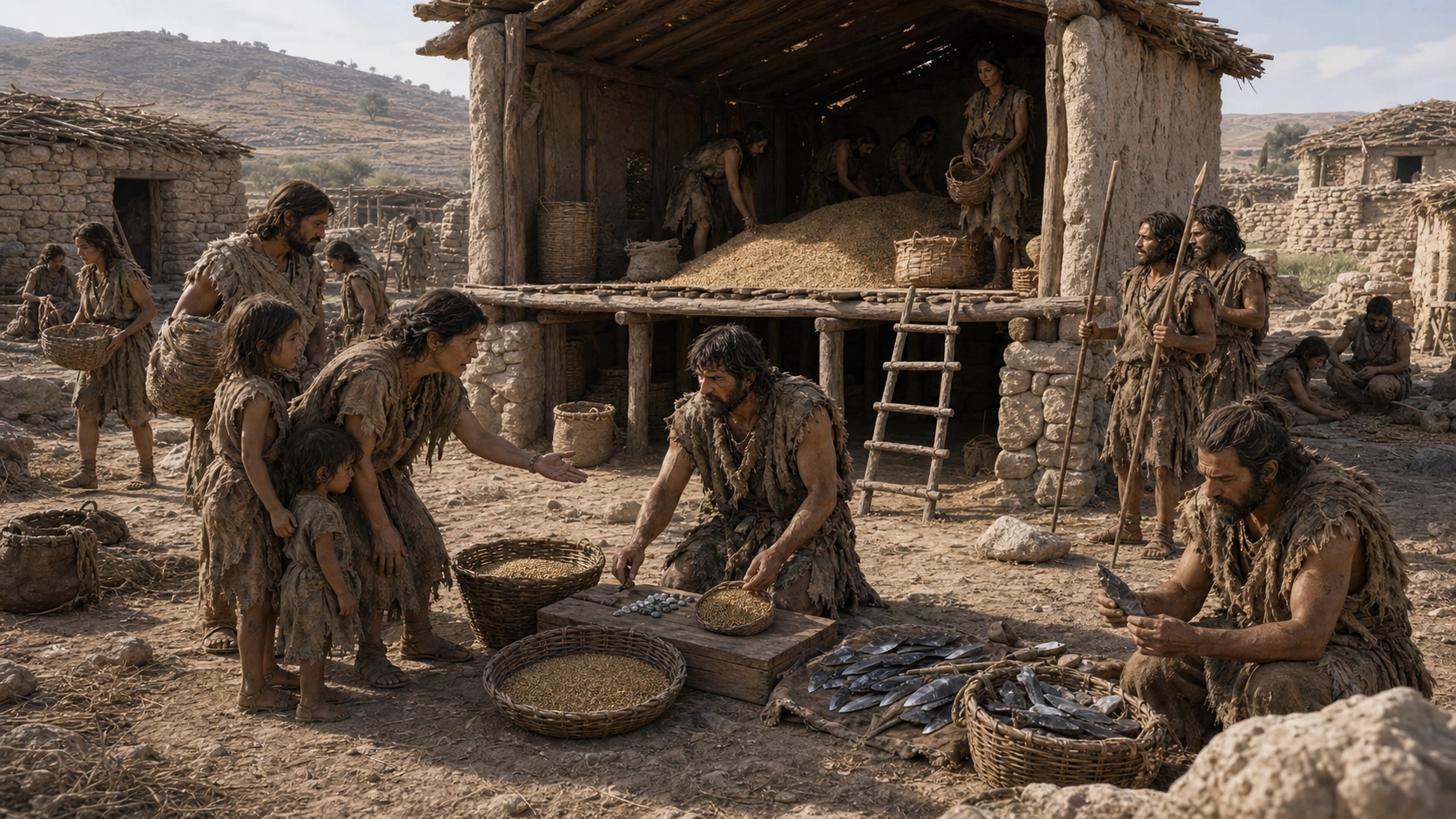
In the year when we had more grain than ever, abundance—not hunger—kept us awake at night.
The harvest was too large for the baskets in each house. We built a communal granary in the middle of the village and filled its raised storage compartments with well-dried grain.
Everyone laughed when we emptied the last basket. Even if winter lasted longer than expected or the hunters returned empty-handed for days, it seemed that no one would have to go hungry at once.
The problems began after we stored the grain.
At night, mice scratched at the walls. Whenever it rained, someone had to check the roof for leaks. Any grain that smelled damp had to be moved to another compartment. People thought the work ended with the harvest, but keeping grain for a long time meant maintaining the granary every day.
The man in charge of it had hunted with me many times. He remembered how much grain each household had brought and checked how much remained after people took their shares. At first, I thought we had simply given an annoying job to the most reliable person in the village.
When winter came, more people stayed in the village than before. Relatives arrived from other places. Children and elders could remain there through a season when food was scarce. The following year, there were also more people available to work the fields.
One man was exceptionally good at making stone blades. He began spending fewer days hunting and harvesting. Instead, he sharpened dull blades for several households and replaced the ones that had broken.
“Why give grain from the granary to someone who did not help with the harvest?”
The man in charge pointed to the stone blade in my hand.
“You harvested faster because you used the blade he made.”
He was right. The toolmaker no longer had to spend every day looking for food. He could use that time to make more tools and improve his craft. The people who received better blades could finish their harvest faster.
Once grain could be stored, not everyone had to spend every day finding food. Some people focused on making tools or building houses. Others cared for children or guarded the granary. Stored food allowed people doing different kinds of work to live together in one village.
But the next harvest was poor.
The rain did not come at the right time, and the new harvest was less than half the size of the previous one. Some old grain remained, but the daily shares had to be reduced if they were to last until spring.
People gathered in front of the granary. One man demanded the grain he had brought the year before.
“When you poured it in here, you said we would eat it together,” the granary keeper said.
The other man answered at once.
“That was when there was enough to share. Why should I protect someone else’s portion while my child goes hungry?”
The keeper remembered how many baskets each household had contributed. But he could not divide exactly how much each household had eaten during the previous winter. Nor could anyone separate the grain in the granary and identify which field each kernel had come from.
In a good year, the communal granary made everyone feel safe. When a bad year came, the same people stood before it and demanded that their own families be fed first.
From the next good harvest onward, people placed only part of their grain in the communal granary. Seed for the next sowing and a reserve that could help the whole village survive stayed there. The rest was stored inside each household.
After several years, the differences between households grew. Families with many healthy adults filled their storage compartments high. Households with sick members or smaller fields ran out of grain before winter ended.
One day, a young couple went to a household with plenty of grain. The head of that household offered them a basket.
“At the next harvest, work in our field first.”
“Our own grain will be ready then too.”
“Then why are you taking mine now?”
The couple finally nodded. In return for one basket of grain that day, they would work in the other household’s field before harvesting their own.
A household with grain to spare could feed someone now and make that person work its field first at the next harvest.
The toolmaker also traded tools from house to house for the grain he needed. Surplus grain allowed him to specialize in one kind of work. But because he did not harvest his own food, he had to sell his tools to people who controlled grain.
The man sitting in front of me with his legs apart asked a question.
“Did the communal granary make the village grow, or did it divide people?”
“It did both. Grain stored together allowed more people to survive in one place. But once households began keeping grain for themselves, the difference between those with plenty and those with little could last much longer.”
Moving the grain into houses did not remove the danger. After another group that had lost its harvest appeared nearby, someone broke into one household’s storage compartment during the night.
From the next day onward, people barred their doors more securely. They also took turns guarding the edge of the village and the houses with the most grain. Guards could not farm while they were on watch, so their shares also came from the stored grain.
The more grain people accumulated, the more work it took to count, divide, lend, and protect it. Even those guarding grain inside their own homes needed the help of the village as a whole.
Grain could be stored for a long time, and its amount could be counted. That allowed people to divide it, lend it, accumulate it over several years, or take it from others. Storage reduced hunger, but it also created lasting differences between households, debts, and the need for guards against theft.
At first, everyone had pooled grain in one granary so the village could survive the winter.
A few years later, people piled grain inside their own homes and barred the doors.
Everyone faced the same winter, but each household’s grain would last for a different length of time.