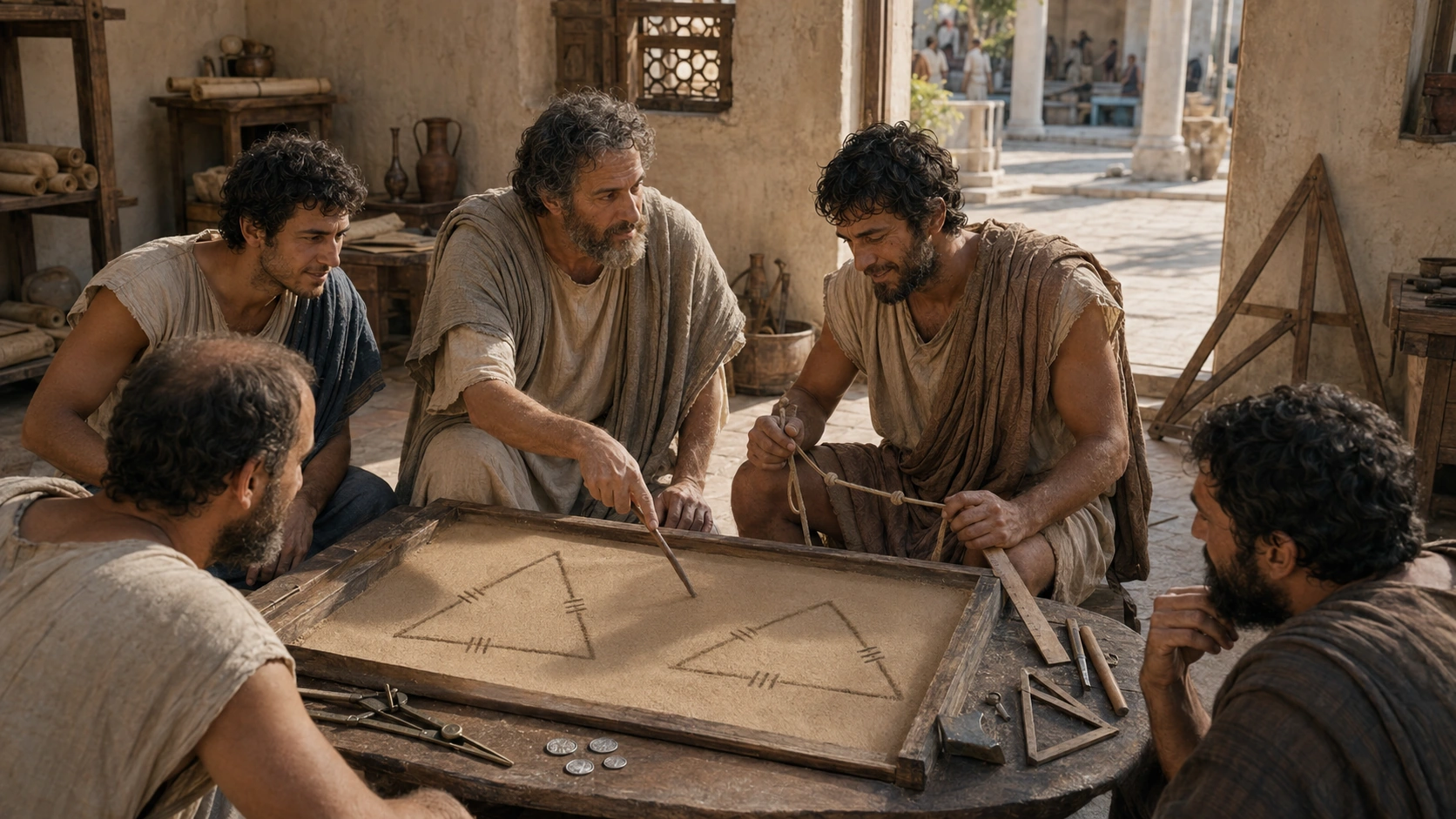
Euclid once paid me to study geometry in Alexandria.
More precisely, he paid me when I came close to being thrown out of his class on the first day.
At the time, I worked on construction sites near the harbor. I held the measuring cord, marked the spacing between columns, and checked the wooden frames that would support roofs. I had a quick eye and considered myself good at the job.
Then two triangular frames nearly cost me my wages. The carpenter swore that the three sides of one matched the three sides of the other, but one frame looked badly distorted. The foreman accused him of cheating. The carpenter blamed my cord. I measured both frames again and again, yet I could not explain who was wrong.
I had heard of a man named Euclid who taught the study of shapes in Alexandria. I assumed he could give me a few calculations that would settle arguments at work.
During the first lesson, Euclid drew a line and showed us how to use it as one side of a triangle with three equal sides. I waited until he finished, then raised my hand.
“What do I gain from learning this?”
Euclid studied me for a moment and spoke to the man beside him.
“Give this student three coins. He seems to require a profit from everything he learns.”
The room laughed. I considered taking the money and leaving, but three coins were too little to buy my pride as well. I sat back down.
Euclid drew two more triangles. We were told that the three sides of one matched the three sides of the other. One drawing looked balanced; the other looked crooked enough that I could not believe the figures were equal.
“They are not the same,” I said.
“Why not?”
“Anyone can see the difference.”
He slid the writing board toward me.
“Then draw them better.”
I straightened the lines and made the two figures look as similar as I could. This time they appeared identical.
“What have you established?” Euclid asked.
“That the triangles are equal.”
“No. Only that you draw more neatly than I do.”
The room laughed again. This time, so did I.
Euclid made us begin with what we had already agreed to accept. We started with the common principle that things equal to the same thing are equal to one another. Then we added the propositions established earlier and the given lengths of the three sides. Whenever someone offered the next conclusion, he asked the same question.
“Where did that come from?”
If the student could not answer, we stopped at that step. Guessing the right conclusion in advance was useless. The path from the starting point to the result had to remain unbroken.
By the time we reached the end, the ugly drawing no longer mattered. A diagram could guide the eye, but the conclusion rested on reasons that someone else could inspect and follow again.
The man sitting beneath the wall spoke up.
“Wouldn't measuring still be faster on an actual construction site?”
“For checking one piece of timber, yes. But cords stretch, and people do not pull them with exactly the same force every time. Measurement tells you about the object in front of you. Proof tells you what must follow in figures of any size whenever the relevant conditions are met.”
I returned to the construction site the next morning and examined the two frames once more. Geometry had not failed. Part of the measuring cord had stretched after getting soaked in the rain, and the carpenter had marked one side while pulling it tight and another while holding it loosely. The first condition—that the corresponding sides were equal—had never been satisfied.
The carpenter received his pay. The foreman issued a new cord. I kept my wages as well.
Measurement tests the object in front of us. Proof shows that the same result follows wherever the same conditions hold. It turned practical calculations and hard-won experience into knowledge that could travel beyond one person's judgment and be checked and used by others.
Euclid's greater achievement was not discovering every geometric result himself. It was arranging earlier knowledge so that definitions, postulates, and common notions led into a sequence of propositions. What had already been proved could support the next result. When someone objected, people could look for the precise step where the reasoning failed.
This time, the woman in the audience asked a question.
“Why didn't he prove the postulates too?”
“Because every proof has to begin somewhere. The important change was making the starting points visible. If people know what was assumed, they do not have to reject everything when they dispute a conclusion. They can ask whether the starting point is the problem, whether a step in the reasoning failed, or whether someone applied the result where its conditions did not hold.”
The power of proof does not come from having no assumptions. It comes from stating those assumptions and showing every step that leads to the conclusion. Disagreement could then become a search for the broken step instead of a contest over who spoke with greater authority.
I placed Euclid's three coins on his table and added a fourth.
“I gave you three,” he said. “Why return four?”
“The extra coin is interest. Geometry saved my wages today.”
Euclid picked up one coin and handed it back to me.
“Remove what the proof does not require.”