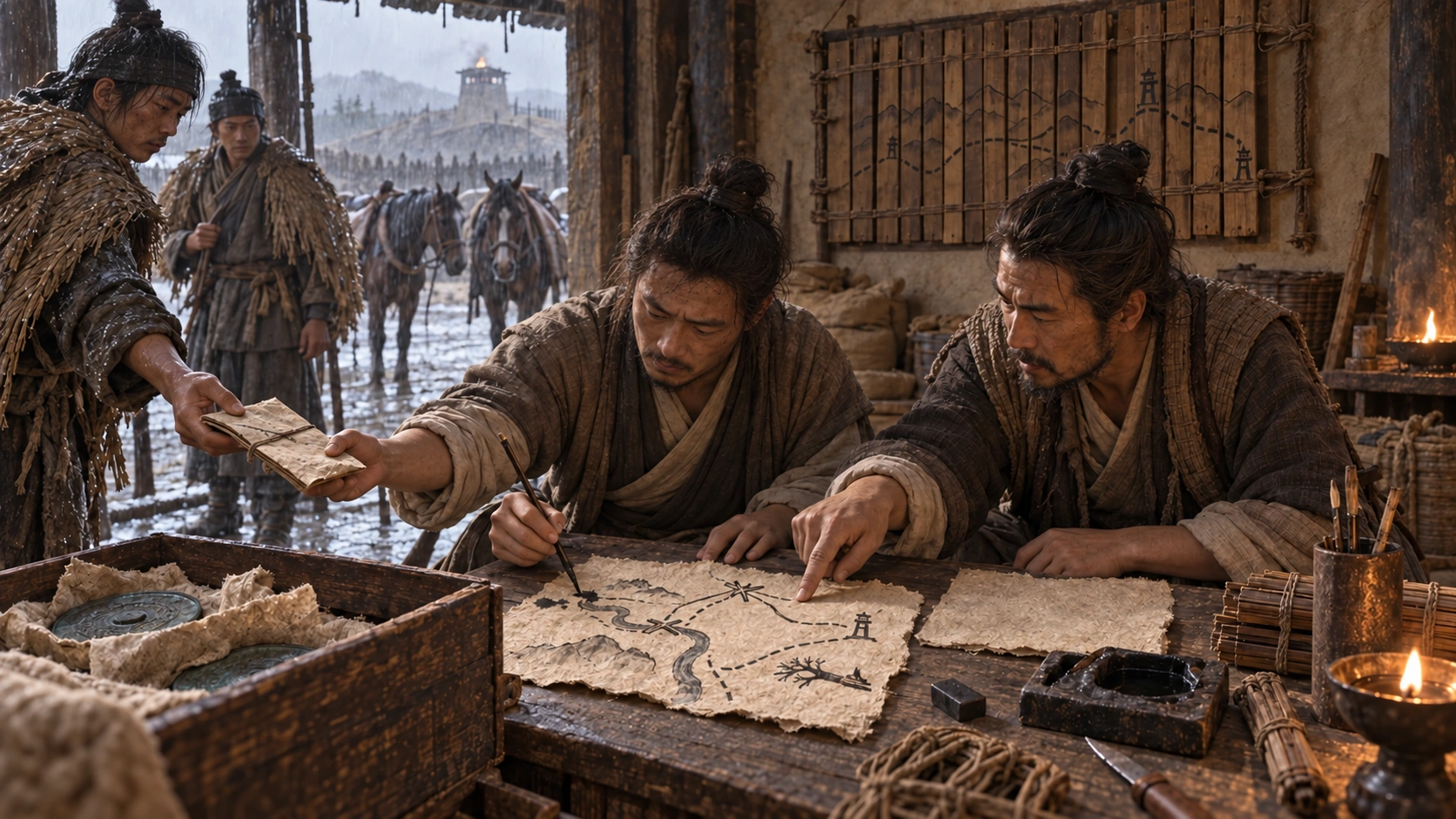
On the third day of rain, a soldier we had sent to inspect the western road stumbled back into the relay station covered in mud.
“The river has swallowed the stone crossing. Every cart coming that way has to stop.”
At the time, I was responsible for documents and supplies at a small Han relay station on the western frontier. Two grain convoys were due in two days. Neither knew the crossing was underwater.
There was another route. It climbed the northern slope, passed below an old beacon tower, then descended toward our station. The trouble was explaining it. The road split three times, and two dry gullies looked like streams after heavy rain. Verbal directions could easily send the drivers down the wrong path.
A map of the surrounding roads hung on the station wall. It had been drawn across several thin wooden boards tied together with cord. It was useful for checking a route, but we could not send the same map to both convoys at once.
The clerk took out a writing slip.
“We can send written directions.”
“Then we need to describe what they will see at every fork.”
He looked down at the narrow piece of wood. It could hold only a few lines. We could bind several slips together, but then we would have to make the same bundle twice. The two riders heading west were already waiting in the yard with their horses.
I ran to the storeroom in search of a spare board. Instead, I noticed a crate of bronze mirrors that had arrived that morning. Thin sheets made from coarse plant fiber had been packed between them to keep the metal surfaces from scraping against one another.
I carried the cleanest pieces back to the clerk.
“Can we draw on these?”
He rubbed the surface between his fingers.
“You want to put an official map on packing material?”
“If the grain cannot find the road, it will never reach an official storehouse.”
He picked up his brush with a doubtful look. His first line spread into a dark blot. He wiped some ink from the brush and tried again. This time the river and hillside remained clear enough to recognize.
We drew the same route on two rough sheets of paper. We crossed out the flooded stone crossing, marked a fallen pine beside the third fork, and added a short note explaining that the path rejoined the main road below the beacon tower.
Each rider tucked one map inside his clothes and galloped away by a different road.
The station chief emerged from the storeroom only after they had left.
“Did you send an official document on that stuff?”
“It wasn't an official record. It was a route to keep the convoy alive.”
He looked from the wooden map on the wall to the empty mirror crate. He did not get angry. He merely said that if the plan worked, he would report it—and if it failed, I would answer for it. That was a common arrangement in government service.
The next afternoon, twelve grain carts appeared first. Their wheels were caked in mud, but the sacks were dry. The lead driver handed my folded map back to me. One corner was torn and rain had stained the sheet, yet the forks and beacon tower were still legible.
The second convoy arrived before sunset.
Grain was not the only thing that reached our station that day. A road that had once been fixed to a wall had become two maps, traveled in two directions, and come home again.
Paper did not begin as a material reserved for books and imperial decrees. But as a writing material cheaper than silk and lighter than bundles of wood or bamboo came into use, more records could be sent where they were needed with far less weight and expense.
A few days later, the chief ordered us to save the paper used to wrap incoming mirrors. Records meant for permanent storage still went onto wooden slips, but paper was convenient for short messages, lists of supplies, and quick copies of routes. A mistake was cheaper to replace as well.
The clerk warmed to it faster than anyone. When the same message had to reach two people, he no longer needed to select and prepare another set of wooden boards. A sheet of paper did not create valuable knowledge. It simply lowered the cost of putting existing knowledge into one more person's hands.
The woman seated near the mouth of the alley set her market basket beside her knees.
“If it was that useful, did everyone start reading books as soon as paper appeared?”
“No. Early paper was rough and inconsistent, and wood and bamboo remained the main writing materials during the Han dynasty. You still needed people who could copy texts and schools that could teach others to read. Paper did not erase illiteracy overnight.”
She pulled a receipt from her basket and unfolded it.
“So there was a time when people couldn't casually use even one sheet like this.”
“More precisely, it took a very long time to build a world where people could use a sheet like that once and throw it away without a thought.”
Good ideas alone are not enough to spread information. The price of making one more copy, the weight of carrying it, and the cost of teaching someone to read must all come down. Early paper began lowering one of those barriers, laying part of the foundation on which larger systems of administration and education could later grow.
Several months later, a rider from another relay station handed me a thin sheet of paper. The front listed quantities of horse fodder. On the back, the clerk there had added one short message.
“The new road you sent us is still usable.”
I did not cut the words away. I tucked the whole sheet between the station records.
Paper entered our station wrapped around a mirror. When it left, it carried a route people could follow.