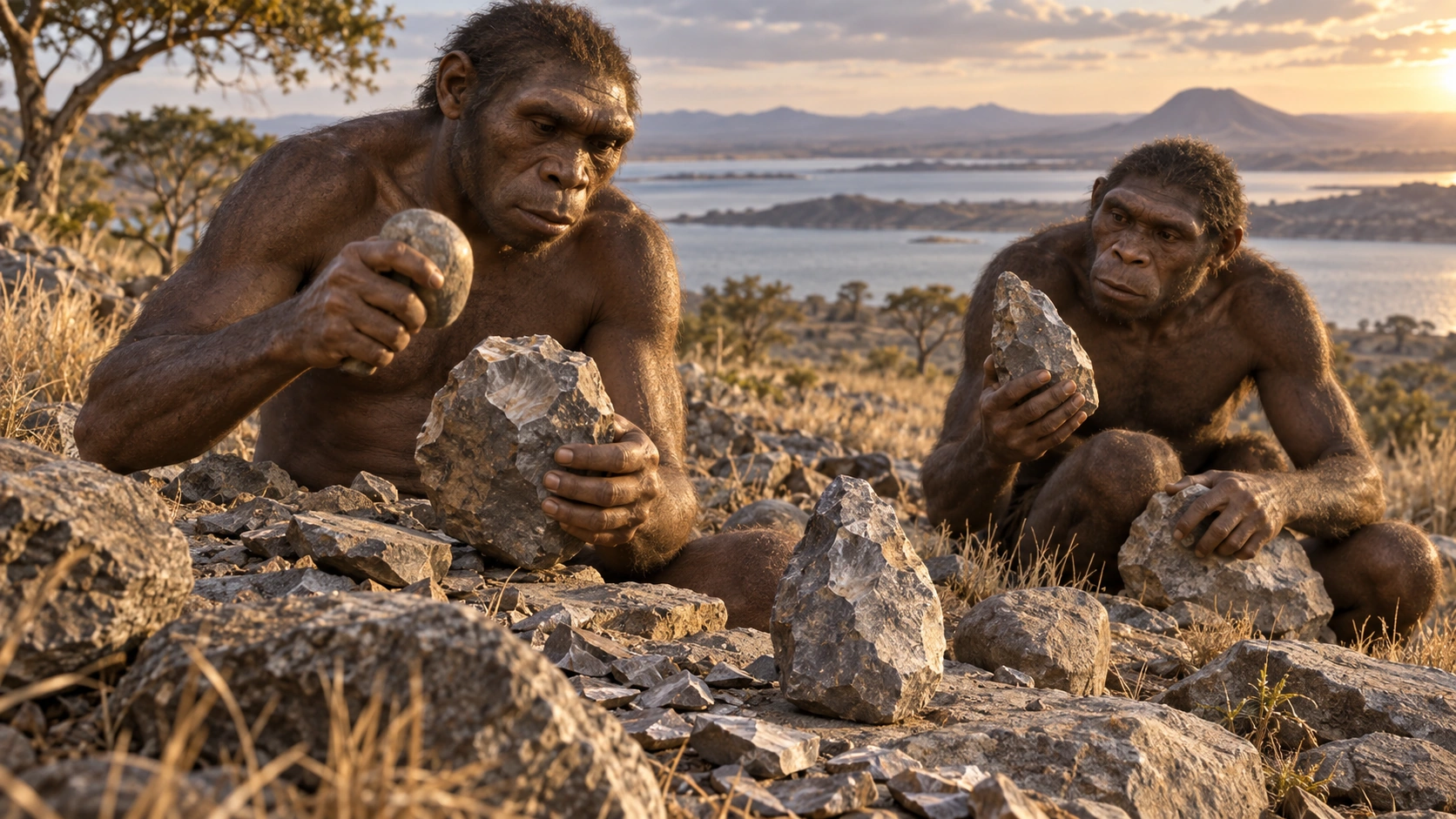
“What happened next?”
The youngest child was already eager for more.
“Nearly a million years went by.”
Their mouth fell open.
“And the next part of the story happens a million years later?”
“That happens in my stories sometimes.”
“What did you do all that time?”
“Lived.”
The children stared at me. Even I knew that answer had been too short.
In the years between, rivers changed course again and again. Forests dried, then grew dense once more. We moved wherever water and food led us. People I had watched being born grew old and died. The children they left behind grew old in turn. We broke stone, ate, suffered injuries, and moved on, repeating it all too many times to count.
“And you were the only one who kept living?”
The child who had been laughing a moment ago spoke more quietly now.
“Yes.”
I left it at that. I did not want to make light of a single person’s death merely to explain a million years.
By then, breaking stone was no longer strange. We chose good rock and struck off a fresh flake when an edge went dull. When one person succeeded, the hands beside them copied the sequence. But the goal was always one edge we could use right away. If it cut well and we could hold it, it was enough.
“So you kept making the same kind of stone?”
“Not exactly. Every stone had a different shape, and every break sent off a different flake. But what we needed was much the same: an edge to cut meat now, or a point to force between bones now.”
“If it already cut well, why keep working on it?”
The question came from the girl in the school uniform, the youngest child’s older sister.
“For a long time, I thought the same.”
Then one day, I found myself readjusting my grip on a stone that was already good enough to use. Its edge was sharp, but one side was so thick that the stone twisted in my hand whenever I applied force. Rough projections still covered the other side. Before, I would have used it as it was.
But another stone I had once used by chance had felt different. It stayed steady when I pressed down, and my hand knew at once which end to hold and which end to use. I could not forget that feeling.
I set down the stone I had been using and chose another. A man in our group with unusually long arms sat beside me and watched. His real name is gone from my memory, so I remember him as Longarm.
Longarm bared his teeth and laughed when I set aside a perfectly usable stone and began striking a new one. When I knocked a piece from the end, he picked up the fallen flake and immediately used it to cut meat. Longarm already had a useful edge. I was still holding a stone I could not use. His grin was irritating.
“That’s annoying.”
The youngest child muttered.
“I felt the same at the time.”
Still, I picked up the stone again. I struck once, stopped to run a finger over the place where the flake had come away, then turned the stone and struck the part that jutted out.
I did not know from the beginning where every blow should fall. Removing one flake revealed the next place that felt wrong. Once I struck there, another thick section caught against my palm. I kept striking, turning, and feeling. Before, I had broken stone to get a single edge. That day, I spent longer on the changing stone as a whole than on any one edge it gave me.
By the time the sun hung low, the stone was longer and flatter than before. Its tip had narrowed, the middle was a little wider than my palm, and marks left by removed flakes covered both faces.
I used the new stone to split hide. Its long edge cut through more with each stroke, and with the thick parts removed, it no longer twisted in my grip. When I pushed the narrow tip between two bones, the joint opened more easily than before.
Only then did Longarm stop laughing. He looked from the flake he had been using to my stone and back again. Then he took mine and tested it on the meat. A little later, he picked up a fresh stone. Just as I had, he struck once, turned it over, and ran his hand across the surface.
The next day, two stones of similar shape lay before us.
“Were they identical?”
“No. The stones were different, and so were Longarm’s hands and mine. But even without touching them, you could tell which end to hold and which to use.”
“So that was when you started turning out identical handaxes?”
The girl asked.
“Not quite. Similar shapes had begun to recur, but that didn’t mean every tool followed one fixed size and shape.”
“Did you use handaxes to chop wood?”
“Not just for that. The name makes them sound as though they were only for chopping wood, but we used them for many different jobs. We split hide, cut meat, pried apart joints, scraped hard surfaces, and broke things open.”
One of the children raised a hand again.
“Did you already have the finished shape in mind?”
“I can’t say exactly. Looking back now, I can use the word design to describe what I was doing. But I would be lying if I said I had a finished picture of a handaxe in my mind that day.”
“Then what told you what to fix next?”
“The thick places against my hand. The direction the stone twisted when I pressed down. The place where the last flake had come away. Once I fixed one problem, the next one became easier to see.”
Before, if breaking a stone gave us an edge, we used that edge immediately. Now we kept turning the stone even after it had an edge, removing thick spots and refining the tool as a whole. Toolmaking had expanded from obtaining a useful flake to creating a form that was easier to hold and useful for many different tasks.
“So you had no blueprint, and you didn’t think the stone in front of you was finished either.”
“That’s right.”
I kept watching the way Longarm worked stone after that. He no longer stopped as soon as he had an edge. He turned the stone over, searched for a thick place with his thumb, and struck again. The others copied that movement before they ever copied a finished tool.
The stones we made still varied. Some were long, some broad, and in less experienced hands they sometimes broke halfway through. But the change was clear.
Before, the work ended as soon as an edge appeared. Now we turned the stone over one more time even after it was ready to use.
As that extra step was repeated, stone tools began to take on recognizable forms, with a clear end to hold and another to use.