The first judgment I ever copied put a price on a man's eye.
The price changed depending on who had lost it.
The woman sitting beneath the wall frowned.
“They put a price on an eye?”
“The law did not look only at the injury. It also looked at the injured person's rank.”
Near the end of Hammurabi's reign in Babylon, I worked as an assistant to a court scribe.
My job was not impressive. I checked the names of witnesses and pressed the senior scribe's words into wet clay. If I made a mistake, I smoothed the line with my finger and wrote it again. Once judgment had been given, that was no longer so easy. When the tablet dried and received its seal, spoken words became a record.
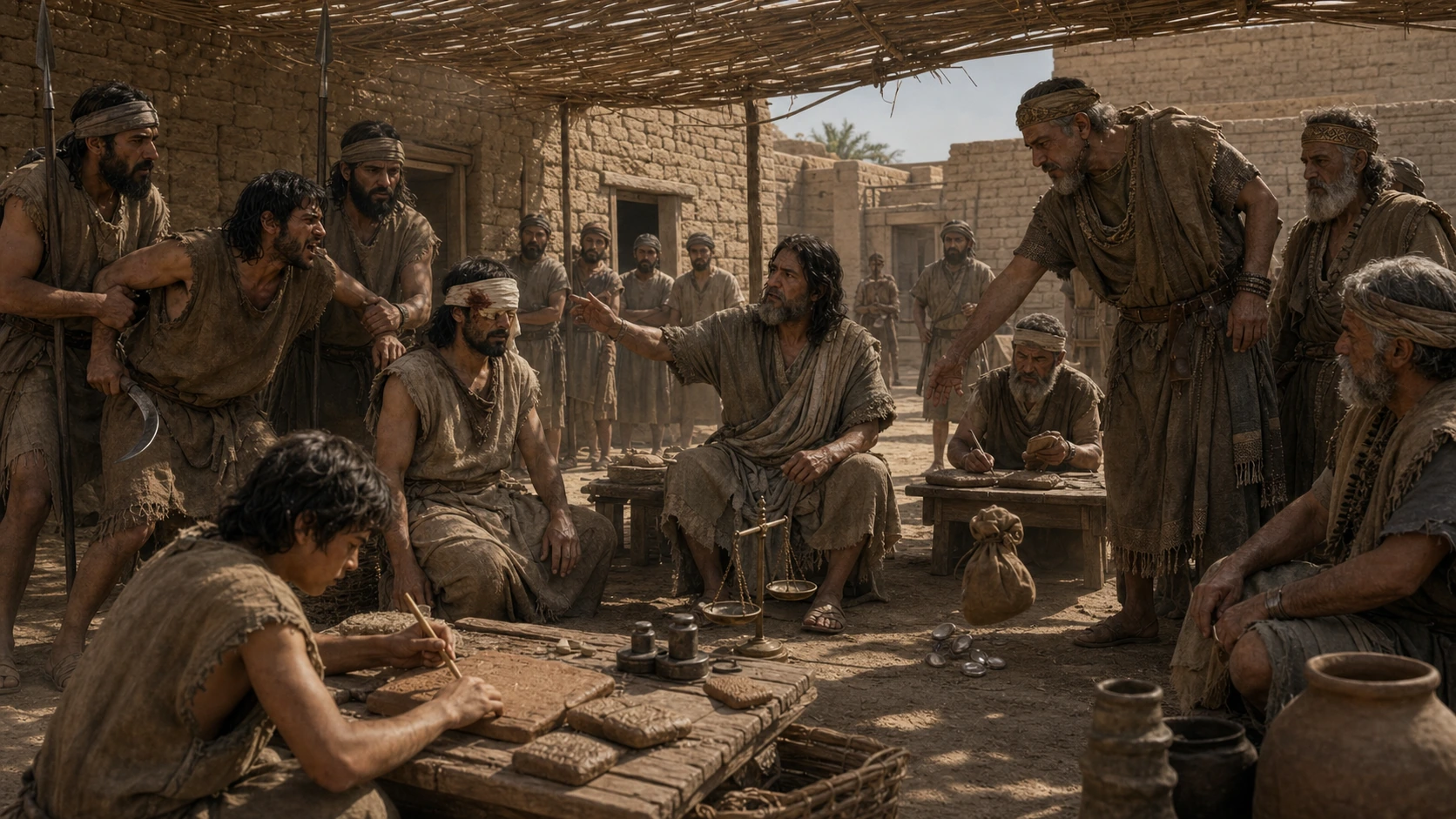
The man carried into court that day hauled sacks at a grain storehouse. He had tried to break up a fight when a young man from an official's household struck him in the face with a staff. Blood kept soaking through the cloth wrapped around one eye.
His older brother arrived at the courthouse carrying a sickle. Two guards seized his arms.
“He ruined my brother's eye. Give me his eye in return.”
The young man's father threw a small purse of silver onto the floor.
“That will pay for treatment. Let this end here.”
The purse was far too light. The brother struggled against the guards until their spearpoints stopped at his chest. If both families were sent home like this, more blood would be spilled before nightfall.
The judge called the witnesses one by one: the guard at the storehouse door, another porter, and the healer who had treated the wound. Where their accounts differed, he asked again. Where they agreed, the scribe pressed their words into clay.
Then the judge turned to the senior scribe.
“What do the king's judgments say about the loss of an eye?”
The scribe recited two provisions from memory.
If a man destroyed the eye of his equal, his own eye was to be destroyed.
If he destroyed the eye of a lower-ranking man dependent on the palace, he was to pay a fixed weight of silver.
The injured porter was classified as a palace dependent. The judge ordered the official's family to pay one mina of silver instead of allowing retaliation—far more than the amount in the purse on the floor.
The young man's father protested.
“Since when is that man entitled to so much silver?”
“I did not choose the amount,” the judge said.
That answer changed the balance of power in the room. The victim's brother would not get the vengeance he wanted. The official's family could not bargain the payment down to the sum they preferred. Once neither household could impose its own ending, the dispute became the king's affair.
I wrote down the weight of silver, the names of the witnesses, and the date by which payment had to be made. We made two copies of the judgment and sealed them so the official's family could not deny it later.
Written law did not begin by giving everyone equal justice. It tied similar disputes to royal judgments and durable records, making it harder for a powerful household's bargaining or an injured family's vengeance to decide the outcome alone. But rank still determined who counted as an equal. Writing could restrain arbitrary judgment, and preserve inequality at the same time.
A few days later, I helped prepare text for a black stone monument. At the top, King Hammurabi stood before Shamash, god of the sun and justice. Below them, line after line of cuneiform dealt with property, debt, marriage, injury, wages, and building work.
Most provisions began in the same way.
If a person did this, then this would follow.
The inscription did not cover every possible dispute. Witnesses, contracts, status, and circumstance could change a case. Most people could not read the monument for themselves. Nor did judges routinely stand before the stone and look up a numbered rule as though it were a modern statute book.
Still, the king had carved a public statement of what he called justice. Judges and scribes gained a body of cases to compare. Generations of scribes would copy its language, study its order, and practice reasoning through new disputes.
Rules carried only by speech could die with the speaker or bend with a powerful person's mood. Once judgments were organized in writing, the king could project his vision of justice without sitting in every courtroom. Putting law in writing preserved rules, but it also carried the power to define justice far beyond the ruler's physical reach.
The woman beneath the wall spoke again.
“Did that make the world more just?”
“It made the outcome easier to predict. Predictable inequality was still inequality.”
After the hearing, I followed the injured man and his brother on their way home. The brother glared at the purse of silver.
“Is that what your eye was worth?”
The injured man tightened the cloth around his face.
“No. It is what will keep my children fed through winter.”
He took the silver. Not because he forgave the man who struck him, but because his living family still needed grain.
No more blood was spilled that day.
The written judgment stopped the revenge.
It also left a lasting record that one man's eye was not worth the same as another's.