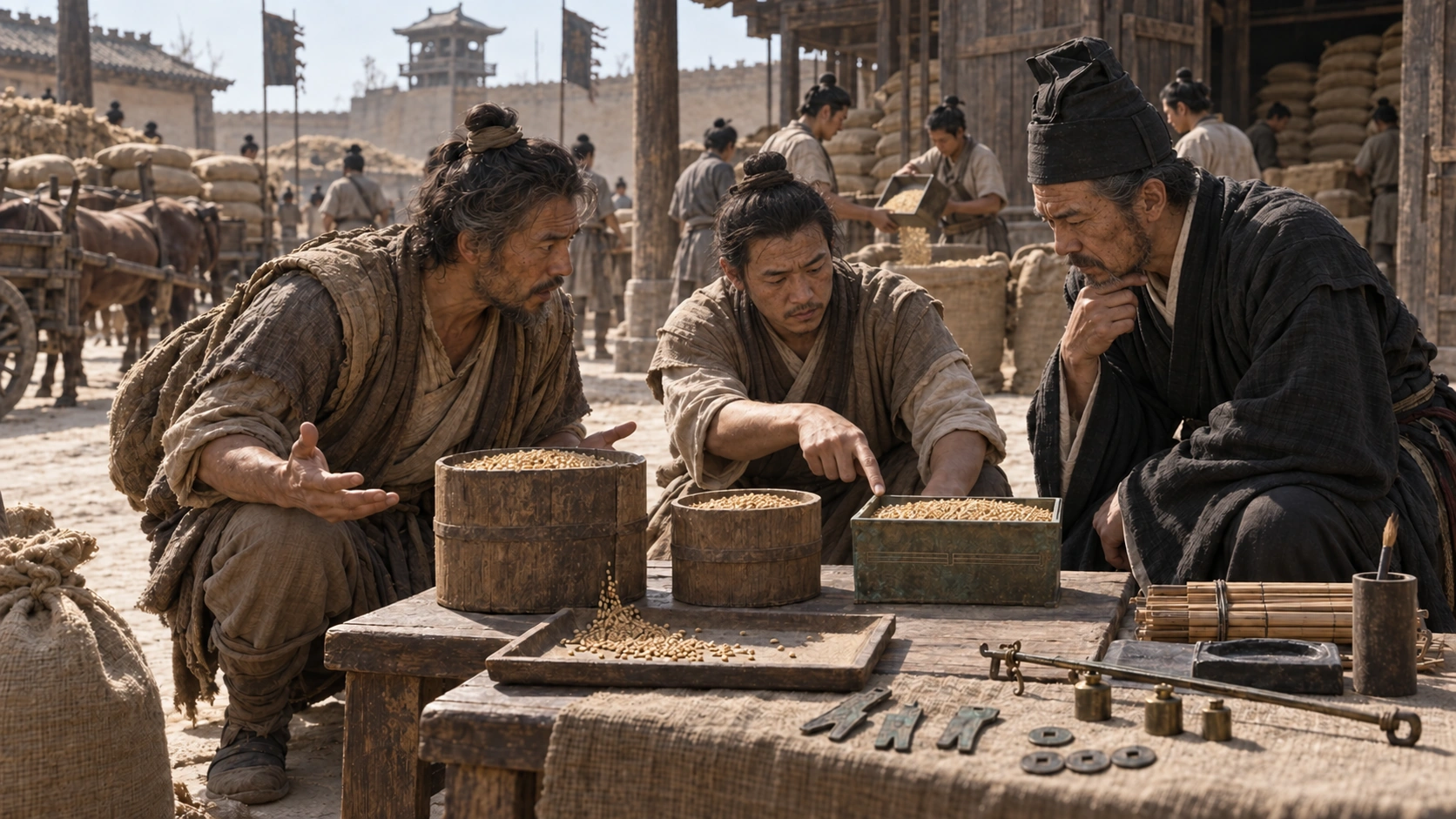
Qin conquered its last rival and unified the realm. In my life, that change arrived as a single bronze measuring vessel.
An imperial decree was cast into its surface. From then on, the different measures of length, volume, and weight used across the conquered states were to follow a common standard.
At the time, I kept records at a granary in former Zhao territory. Arguments broke out at its gate almost every day. A merchant from the east might claim to have brought a hundred measures of grain, while our storekeeper counted only eighty-nine. Both sides used the same name for their measuring vessels, but those vessels did not hold the same amount.
Coins were no better. Round coins, knife-shaped coins, and spade-shaped coins could all appear in one purse. Their weights and values differed, so every transaction began with another calculation. Travelers learned to distrust the scales before they even looked at the goods.
On the day the new standard arrived, a grain merchant was stopped at our gate. His cart was piled with sacks of barley, but an official refused to admit the load because the figures did not match the record.
“I loaded one hundred measures.”
“Our vessel counts ninety-two. Where did you hide the other eight measures?”
The merchant's face reddened.
“Are you calling me a thief?”
Neither man was lying by his own standard. That made the problem worse. Catch a liar and the argument can end. Give two honest people different measures, and the measures will start the argument for them.
I placed the merchant's wooden vessel beside the one from our granary and the new bronze standard. I filled each with water and poured it into the others. The difference between the three vessels was obvious. One hundred of the merchant's measures came to almost exactly ninety-two of ours.
The official froze.
“Then where is the missing grain?”
“It was never missing. The vessels shared a name, not a capacity.”
The merchant had stolen nothing. The storekeeper had not deliberately taken anything from him either. They had simply been using the same word for different quantities.
From that day, we began rewriting the granary records in the new units. At first, standardization created more work. Old totals had to be converted. Market weights had to be checked. Even the forms of characters used in official documents had to be brought into line. Many people did not want to abandon the vessels and characters they had used all their lives.
But the following month, twenty carts from another district did not spend an entire day waiting outside our gate. The office that sent the grain and the office that received it now used the same standard. Officials no longer disputed the quantity in every sack. At least in transactions with government offices, Qin's new coinage provided a common reference. Merchants no longer had to explain every coin's shape and value from the beginning.
A standard did not make the grain better or the cart stronger. It allowed people from different regions to work together without renegotiating every meaning, value, and measurement. Once strangers could trade through the same writing and the same numbers, distances across the empire began to shrink before its roads did.
The man seated near the gate leaned forward for the first time.
“I understand the writing and the scales. But why standardize the distance between a cart's wheels?”
“Wheels cut deep ruts into busy roads. If a cart's width differed too much, one wheel could fall into a rut while the other rode outside it, leaving the vehicle tilted and hard to control. Repairs were also slower when every region used different dimensions. Moving carts and roads toward a common gauge made travel and replacement parts easier. But one decree did not make every cart and road identical overnight.”
Standardization did more than make markets convenient. Officials trained to use the same forms of writing could read reports from distant districts more quickly. They assessed taxes with common measures, demanded military grain in common units, and sent orders along an expanding road network.
The emperor did not need to inspect the grain vessel in every town. His standard arrived first, cast into bronze.
Common standards reduced the friction of trade, but they also extended the reach of power. They allowed the state to count distant people and supplies more precisely, collect from them more efficiently, and mobilize them on a larger scale. Convenience and control entered carrying the same ruler.
That autumn, the merchant who had been stopped at our gate returned to pay his tax. This time, no one shouted that grain had vanished. We used the new standard vessel, and the amount matched the record on the first count.
He pointed to the imperial inscription on the bronze.
“At least we no longer have to fight over which town's vessel is correct.”
The tax official nodded.
“True. We can also see at a glance how much each town can be made to pay.”
The merchant looked from the official to me, then pulled his empty cart away.
I turned the bronze vessel over in my hands. The standard was the same for everyone. The reasons for welcoming it were not.