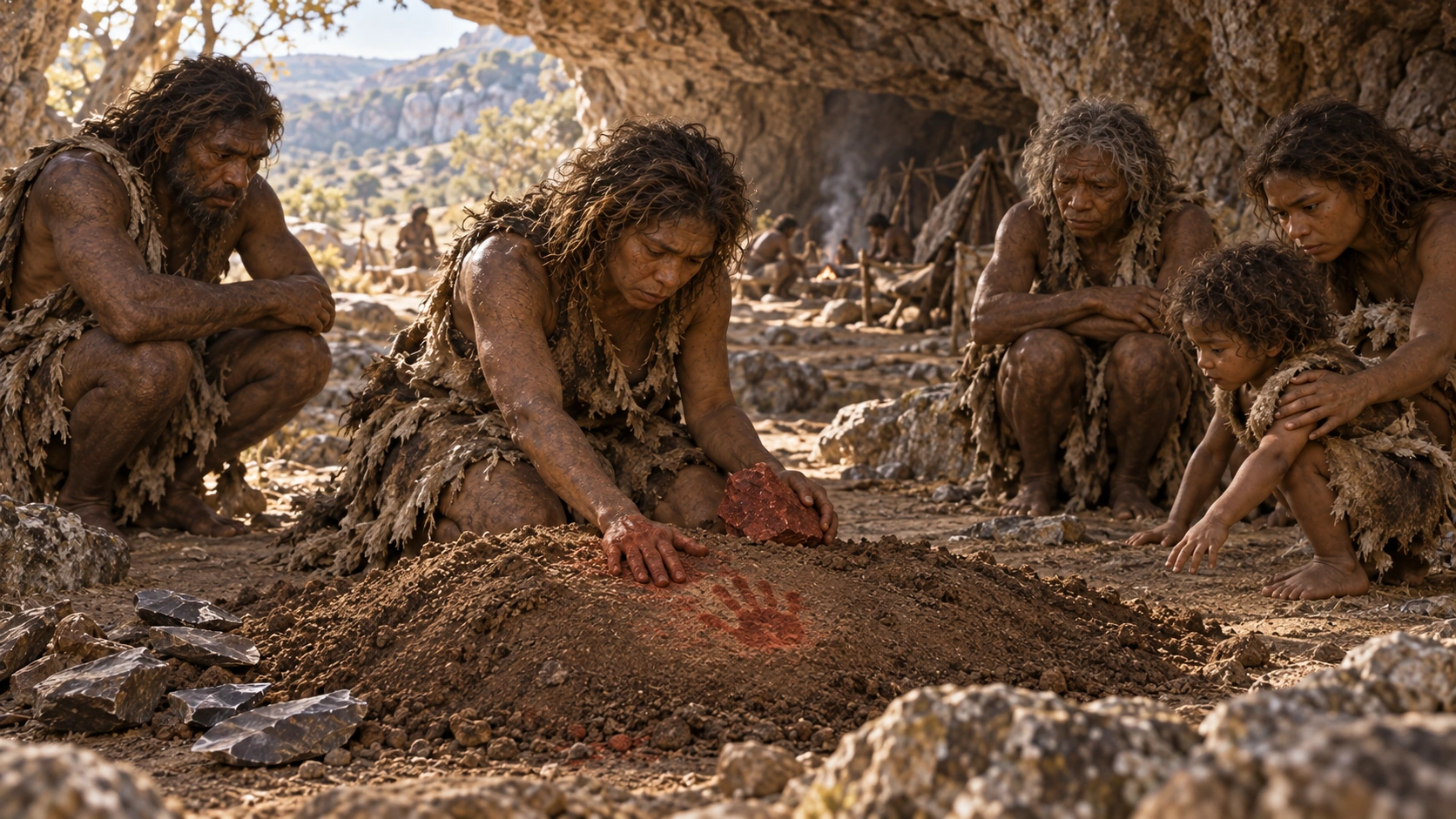
I placed a red stone in a dead child’s grave—a stone precious even to the living.
“But a dead person can’t use it.”
The youngest child was right.
“I know. So did the child’s mother.”
The girl spoke next.
“Then why put it in the grave?”
“It took me some time to understand that too.”
Around that time, there was a child in our group who reached for every red stone they saw. Today, we call that mineral ochre. When wet and rubbed across skin, it leaves a red mark brighter and more lasting than blood.
Ochre was not something we could find just anywhere. We had carried that piece from far away, and every mark made it smaller. I hated to waste it, yet the child snatched it whenever I set it down. One day, they drew a thick line down the center of my palm, then marked their own hand the same way.
I took the stone away. The child pouted, then ran off in search of something else to play with.
I did not know that, only a few days later, the red line would be the last trace the child had left me.
After three days of fever, the child stopped breathing. The mother held the small body for a long time without moving, and we waited. As the sun dropped, someone gestured that we should carry the body out of the cave. Our group often did this to keep the smell and scavengers away.
The child’s mother shook her head.
She began scraping at the hard earth farther inside the cave. Someone brought a stone flake and sat beside her. Before long, I was scooping out soil as well. The pit was only wide enough for the child to lie on their side.
The mother drew the child’s knees toward the chest and brought both hands close to the face. It looked almost like sleep, but no one thought the child would ever open their eyes again.
The mother pointed at my hide pouch.
Inside was the red stone I had taken from the child. I clutched the pouch to show that the living still needed it. We had walked a long way to get that stone, and the piece that remained was not large.
The mother opened my hand. Water and sweat had washed away almost all the line the child had drawn, but red still clung to the creases in my palm.
“The child’s,” the mother said.
I pointed to the child lying there, then opened my own empty hand. I meant that the child could no longer use the stone.
The mother nodded.
“I know.”
After that, I could no longer argue. She understood death. She was not imagining that the child could still use the stone. She wanted to place it in the child’s hand despite knowing the child could never use it again.
I took the red stone from my pouch.
The mother left a red mark on the child’s palm and placed the remaining piece beside the bent legs. As we covered the body with earth, no one reached in to take it back.
That night, the mother divided the meat she had cooked over the fire into two portions. Her hands were following an old habit. She began to place the smaller piece where the child used to sit, then stopped. Only much later did she add it to her own share. The child was gone, but the habit of caring for the child remained in the mother’s hands. All of us looked at the empty place and thought of the same child.
Burial became more than a way to remove a body. Once we buried someone in one place and left an object they had used beside them, many people could look at that spot and remember the same person. Remembering the dead began to belong not to one person alone, but to the community.
The next day, a younger child nearly stepped on the grave, and several people reached out at once to stop them. The child could not see what lay beneath the earth. But when an adult held out a palm marked red with ochre, the child understood whose place it was.
We returned to that cave even after the seasons changed. We showed the grave to people who joined us and had never known the child. When another person died much later, we made a place beside it.
The child beneath the earth could do nothing. Even so, the grave kept changing the behavior of the living. People walked around it. They moved the places where they lit fires and broke stone.
A symbol was a way to connect invisible memories and relationships to a visible object or place. The red stone was no longer merely a source of color. Anyone who saw the stone and the grave thought of both the dead child and the community that still remembered the child.
“So they thought people kept living somewhere else after they died?”
The youngest child lowered their voice.
“I still don’t know.”
“Even after you’ve lived this long, mister?”
“Living a long time does not let me see past death. But more times than I can count, I have watched people imagine a world after death and, by doing so, change the behavior and rules of this one.”
Until then, I had always been the one who remembered the dead the longest. But in front of that grave, it was different. I was not the only one who remembered the child.