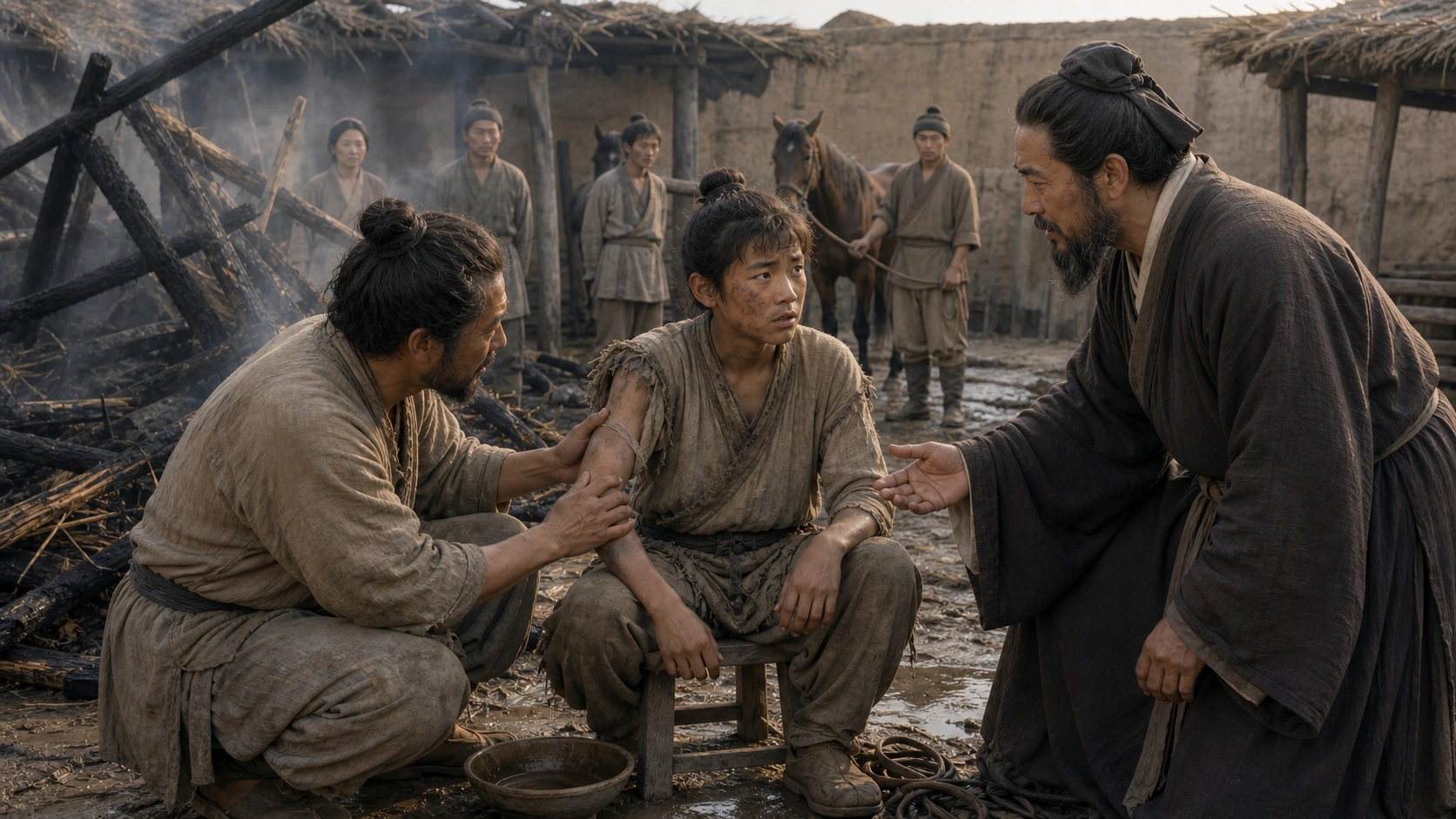
When the stables burned down, I knew how many horses had survived. I did not know how many people were hurt.
I was helping tend the horses at Confucius’s home in the state of Lu. We had finally put out the fire, but part of the roof had collapsed. Loose horses and scorched harnesses filled the courtyard. I checked the animals’ legs while adding up the cost of everything we had lost.
One sleeve of the boy who worked beside me had burned away, leaving his arm exposed. Yet he was still gathering reins from the ground.
“Leave those. Let me see your arm.”
“If these go missing too, they might think I stole them.”
He kept the wet reins clutched to his chest. I let the matter drop. Good horses and harnesses cost money, and when the master came home, someone would have to explain the loss. I was choosing my own words as well. Before saying where the fire had started, I wanted to make clear that it was not my fault.
When Confucius returned, the others stepped aside. I opened my mouth to report on the surviving horses.
“Was anyone hurt?”
So much for the speech I had prepared. I turned to the boy. I had seen his arm, but only now did I realize that I had never asked how badly he was burned.
“This boy’s arm is burned.”
Confucius had the boy sit down. He did not begin by demanding a count of the horses we had lost. The boy finally put down the reins, and I could examine the sleeve where it clung to his arm.
The horses and harnesses did not cease to matter. The broken roof still had to be rebuilt. What changed was the order in which we attended to things. I had been gathering whatever remained to keep our losses down. Confucius had asked about the injured people first.
The man beneath the wall unfolded his arms.
“I think I would have counted the horses first too. That was your job, after all.”
“That was how I saw it. Take good care of the horses, and I had done my part. Yet I had checked their legs without properly looking at the arm of the person beside me.”
The man glanced down at his own arm. I went on without waiting for him to say more.
After that day, I began listening when Confucius spoke with his disciples. At first, I thought his teaching amounted to speaking respectfully to superiors and treating elders well. I could have heard that in any number of households.
But he did not place all the obligations on those at the bottom. A ruler had to act as a ruler should. A father had to meet a father’s responsibilities. Holding a high position did not, by itself, make someone a good person. They had to treat others as their position required and keep their own desires in check.
He was not calling for the abolition of rank. Quite the opposite: he placed great importance on the duties within human relationships. But taken seriously, those duties meant that a superior could not simply do as he pleased. Someone who demanded proper conduct from others could be judged by his own.
This was not entirely comfortable for me either. I had a sharp eye for the failings of powerful men and a generous supply of explanations for my own. I had been ordered to do it. I had to earn my food. Everyone else did the same. I had lived a long time, and learned plenty of excuses.
Confucius’s teaching made me consider not only what I had accomplished, but what kind of person I had become in doing it. Not getting into trouble was not the same as doing the right thing.
Widen the view by a few centuries on either side, and people in several regions were asking more searching questions about how to live. In India, followers of the Buddha asked why suffering arose and what attachments and actions kept it going. In Greece, Socrates placed examining one’s life above the pursuit of money and reputation. In West Asia, Hebrew prophets condemned wealth amassed by trampling on the poor.
These people had not gathered in one place and agreed on a single answer. Some teachings centered on duties within families and society; others on a path out of suffering. Much later, I learned that people had come to group these different developments under a name: the Axial Age.
To me, that name brings back a boy clutching reins with a burned arm more readily than it brings back the faces of sages.
People could build larger cities, collect more grain, and send armies farther from home. But the ability to command more people was no guarantee of governing them well. Knowing how to become rich was not the same as knowing how to live well, either.
Conscience was not invented in this period. An important change lay in turning standards for life and government into teachings that later generations could learn, dispute, and pass on. Having power or making a profit did not, by itself, prove that a person was right. Technology and institutions expanded what people could do, but they could not decide what people ought to do. Where should that growing power be used, and for whose sake should it be restrained? Those choices, too, demanded reasons.
Learning such teachings did not mean everyone lived by them. Plenty of people applied exacting standards to others while making generous allowances for themselves. I did not change easily either. Remembering good advice was much easier than changing an old habit.
When we were building the new stables, the boy started up a ladder. I was about to hand him a plank when I saw the red marks still on his arm.
“You stay below and hold the ladder steady. I’ll go up.”
He came straight back down. An offer to do his work for him did not need repeating.
Confucius was not at home that day. I picked up the plank and climbed the ladder anyway.