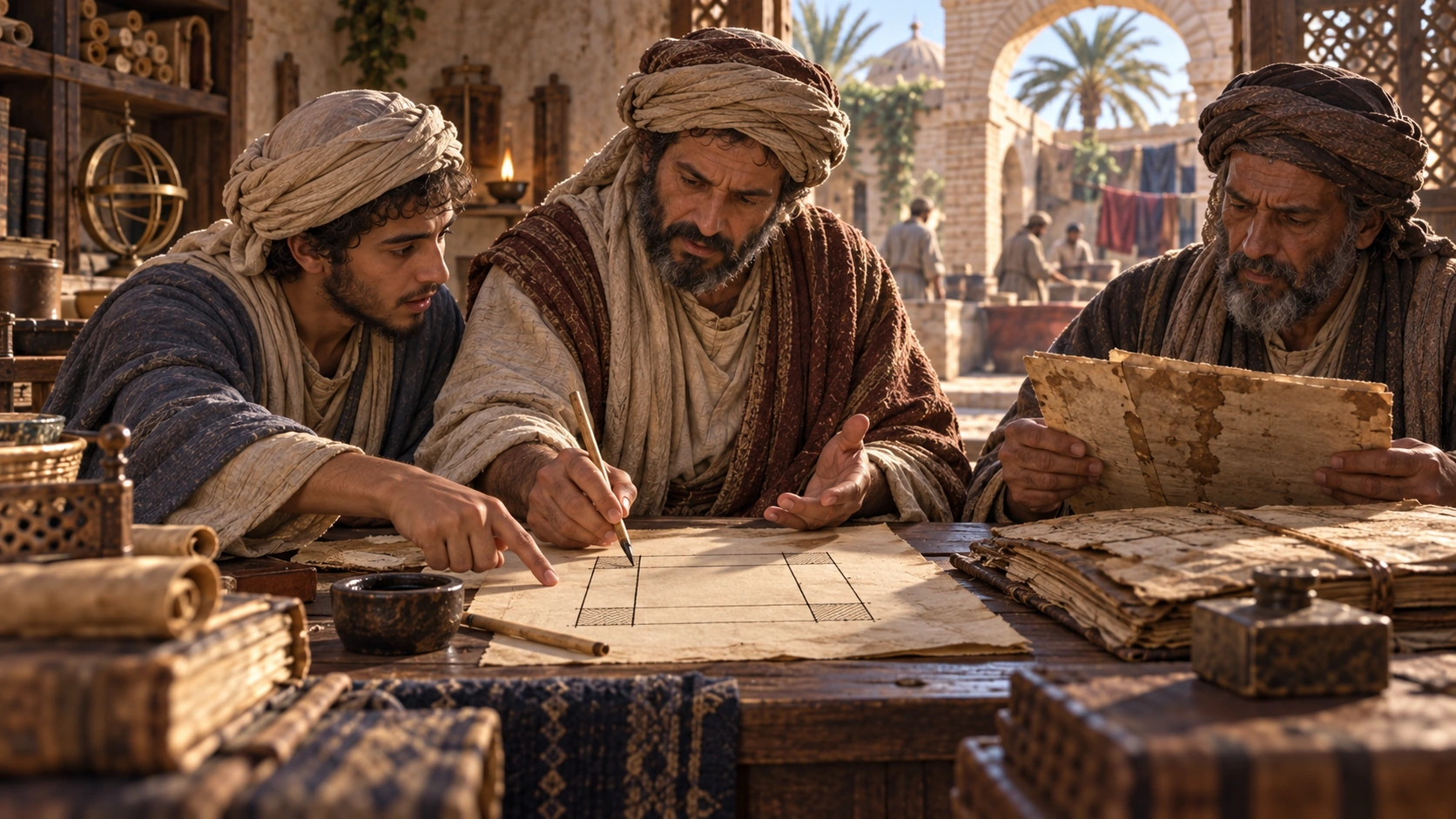
When the boundary wall collapsed, Fatima's workshop became one cubit narrower overnight.
A canal had overflowed in Baghdad. The water swept away a mud-brick wall between two dye works. As soon as the wall was gone, Sa'id, who owned the warehouse next door, moved his marker into Fatima's ground.
“The boundary was always here.”
Fatima shoved a damp tax register against his chest.
“I paid tax on thirty-nine square cubits, and now you claim my workshop was only two cubits wide?”
They took the dispute before an official. I was working there, sorting land records, and a young clerk named Nasr spread out the two documents that had survived.
One gave the workshop's area as thirty-nine square cubits. The other said its long side was ten cubits longer than its short side. The wall had vanished, but those two relationships remained.
Nasr began trying numbers on an empty calculation board.
“If the short side is one cubit, the long side is eleven. That gives eleven square cubits. If it is two, the long side is twelve, which gives twenty-four. If it is three, the long side is thirteen—and that gives thirty-nine.”
Fatima answered at once.
“Then the short side was three cubits.”
Sa'id gave a scornful laugh.
“He happened to find a number that worked. If the figures were different, how long would he keep guessing?”
It was an irritating objection. It was also fair. Nasr had found the answer, but he had not shown a method that could be followed when the numbers changed.
That evening, I took the two records to Muḥammad ibn Mūsā al-Khwārizmī. He had been organizing many kinds of calculations into a small number of common forms.
Al-Khwarizmi did not begin by drawing Fatima's workshop. He stripped away the names and kept only the relationship between the numbers.
“Let the short side be a length we do not yet know. Its square, together with ten of that same length, must equal thirty-nine.”
Once the names and boundary markers were removed, a dispute involving real people and land took the same form as a one-line calculation.
He drew a square whose side was the unknown length, then divided the extra area—ten cubits times that length—into strips along its four sides. Filling the four empty corners required another twenty-five square cubits.
Adding that to thirty-nine made a larger square with an area of sixty-four square cubits. Its side was eight cubits. Subtracting the five cubits added to the side length left the original side: three cubits.
Nasr had guessed the answer that afternoon. Al-Khwarizmi showed why it worked—and left a path that could be followed when the numbers changed.
People had been finding unknown quantities long before Al-Khwarizmi. His breakthrough was not that he guessed the answer to one problem first. He turned different problems into the same kinds of relationships and organized procedures that could solve them again.
His book had no `x` and no equals sign. Roots, squares, and numbers were all written out in words, and problems were sorted into six basic forms. The operations used to complete and balance the expressions were called al-jabr and al-muqabala.
The man seated near the gate opened the notes app on his phone and wrote a large `x`.
“Was it really algebra without letters?”
“Symbols are not the whole of algebra. First came the idea of placing an unknown inside a relationship, reducing the problem to a familiar form, and solving that form by a repeatable rule. The symbolic notation we recognize developed much later.”
The next day, Nasr worked through the dispute again before the official, Fatima, and Sa'id. This time he did not test one, then two, then three. He combined the two surviving relationships into one problem and explained what he added or removed at every step.
Sa'id interrupted him.
“Who is supposed to check all that?”
Nasr turned the calculation board around.
“Follow the same steps. If I made a mistake, you will be able to point to the step where it happened.”
The official followed the calculation himself. The result was three cubits. He ordered Fatima's boundary restored according to the old records.
Once the procedure was organized, difficult calculations depended less on one gifted person's instinct. Other clerks and surveyors could turn the same relationships into the same forms and find the exact step where two answers diverged. Mathematics was becoming more than the art of getting an answer. It was becoming a shared tool that could be taught, checked, and passed on.
Of course, a correct calculation could not prove that its starting records were true. If the figure of thirty-nine had been false, algebra would have calculated that falsehood precisely. Al-Khwarizmi's method showed what followed from the stated relationships. People still had to judge which records and testimony deserved belief.
The moment the ruling was given, Fatima ran back to her workshop. She pulled up the marker Sa'id had moved and drove it into the ground one cubit farther out.
By evening, three dye jars stood side by side inside the space she had recovered.