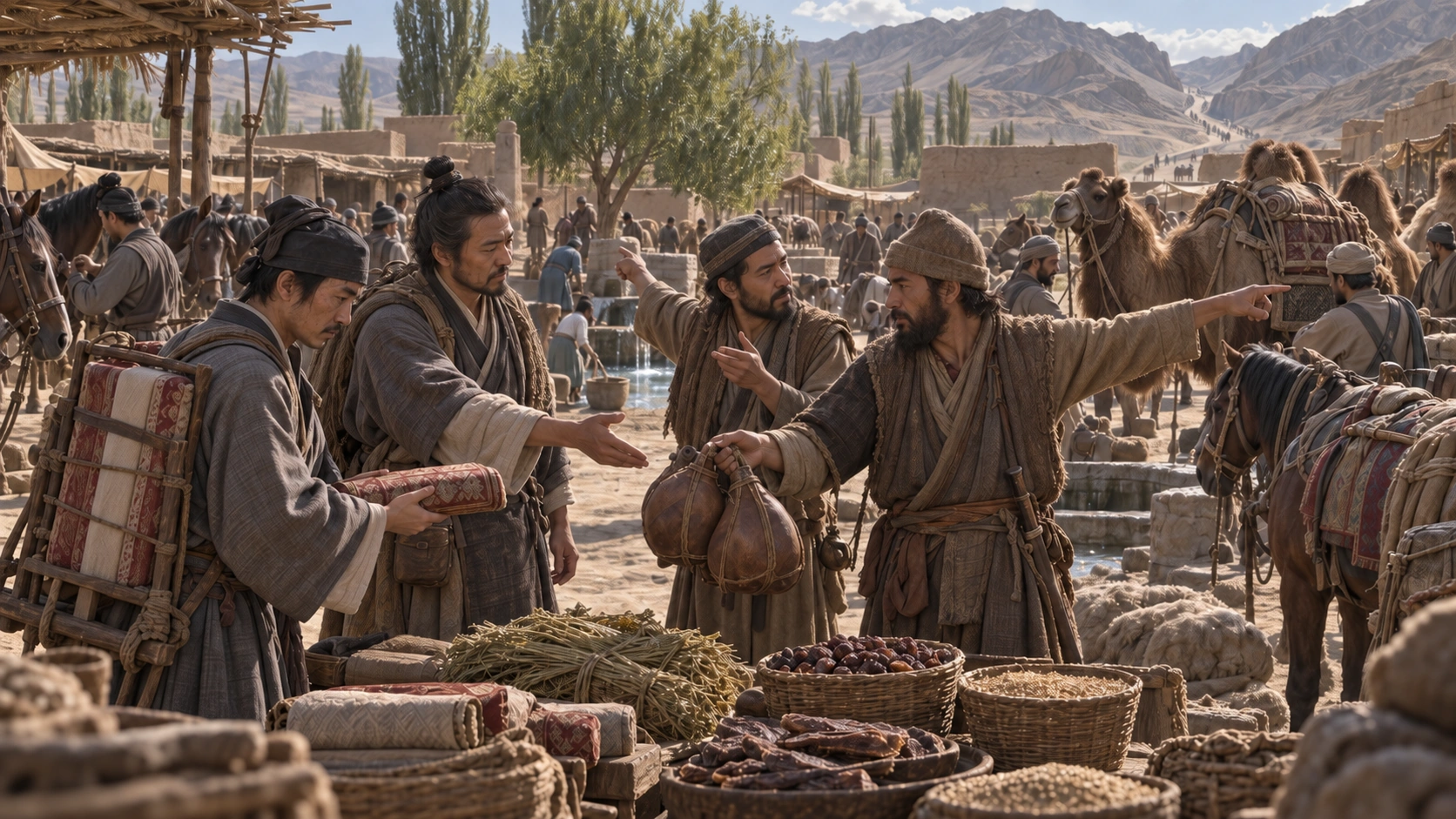
We left Chang'an with twenty bolts of silk. Before we even reached Dayuan in the west, we were down to eleven.
Not one had been stolen.
After Zhang Qian returned from the west, the Han court filled with the names of countries it had never heard before. He had failed to secure an alliance with the Yuezhi against the Xiongnu. Judged by his original mission, he had failed. But he came home with reports of the great horses of Dayuan in the Ferghana Valley, the vast markets of Daxia, and kingdoms that lay even farther west.
Emperor Wu began sending more envoys into the Western Regions. I handled the animals and baggage for one of the smaller missions. We were to reach Dayuan with gifts of silk and return with western horses and whatever reliable news we could gather.
The young envoy in charge thought we only had to find one road. Learn the route from Chang'an to Dayuan, follow it west, then take the same road home.
That plan fell apart at the first oasis on the edge of the desert. Our guide refused to continue to the next settlement. He knew the wells as far as this town, and his family lived here.
“You were paid in Chang'an.”
The guide shook his head.
“I was paid to bring you here. Those men know the next road.”
He pointed toward a group of merchants sitting beside their camels. One offered to find us another guide and enough dried food to reach the next well. His price was one bolt of silk.
The young envoy lowered his voice.
“At this rate, we'll give away every gift before we arrive.”
“If we die holding the silk because we can't find water, I doubt the emperor will be pleased.”
He scowled, but he surrendered the bolt.
The same thing happened again and again. At one settlement we bought water and fodder. At a mountain pass, we paid a local ruler for permission to cross. Where no interpreter knew both our language and the local one, two people relayed every sentence between us. Each sentence grew longer or shorter as it passed through two languages, and our bundle of silk grew thinner with it.
When our third guide announced that he too was turning back, the young envoy finally lost his temper.
“Has no one traveled all the way to the end of the west?”
The merchant waiting for us laughed. He pointed at the ground beneath his feet, then at the mountains in the distance.
“I travel from here to the market beyond those mountains. A merchant there goes on to the next city. No one needs to know the whole road when someone at every stop knows the next market.”
“So every one of you takes a cut along the way.”
The merchant nodded toward the desert.
“Try going without us. Then you won't pay in silk. You'll pay with your life.”
The envoy had no answer. Tracks in the ground were not enough to make a road. We needed people who knew the wells, people who could bargain in another language, people who could exchange our exhausted animals, and people who could vouch for strangers seeking shelter in the next town.
The Silk Road was never one road running straight from China to the Mediterranean. People who had no idea where the entire network ended passed goods to the next market. As thousands of short exchanges joined together, they formed trade routes that crossed a continent. The middlemen were not an unnecessary cost attached to the road. They were part of what kept it open.
We eventually reached Dayuan. The silk we had left became two good horses, food for the return journey, and wages for a new guide. The young envoy still hated that we had spent almost half our silk on the road. On the journey home, however, he handed over the first bolt without an argument. Now he understood what its price purchased.
As we left the market in Dayuan, I saw one of our bolts strapped to a stranger's camel. The merchant said he was heading farther west. When I asked how far, he named three cities and shrugged. Beyond them, the silk would belong to another merchant's route.
The woman seated by the wall pulled the coat on her lap a little closer as the night air turned colder.
“So Zhang Qian wasn't the first person to create the Silk Road?”
“No. Regional trade routes already linked the steppe, the oasis towns, and lands toward India before he set out. Zhang Qian did not create those connections from nothing. What he did was make the Han court see the western kingdoms and markets in concrete terms. As envoys and merchants traveled more often, existing routes joined into a much larger network.”
She thought for a moment.
“Then the people using it didn't call it the Silk Road either.”
“That name came much later. Most travelers knew their own route and the next market. They did not imagine themselves standing on one road that crossed all of Eurasia.”
Once a trade network connected distant regions, it did not carry only the things people wanted. Craftspeople, monks, and soldiers followed the same routes as silk and horses. Technologies, beliefs, stories, and diseases traveled with them. Connection expanded not only the size of the market, but also the distance over which change in one region could affect another.
Back in Chang'an, the young envoy began his report with the words, “We found a road to the west.” He stared at the sentence for a long time, then brushed it out with ink.
He wrote a new line beneath it.
“We found the people who link one westward road to the next.”