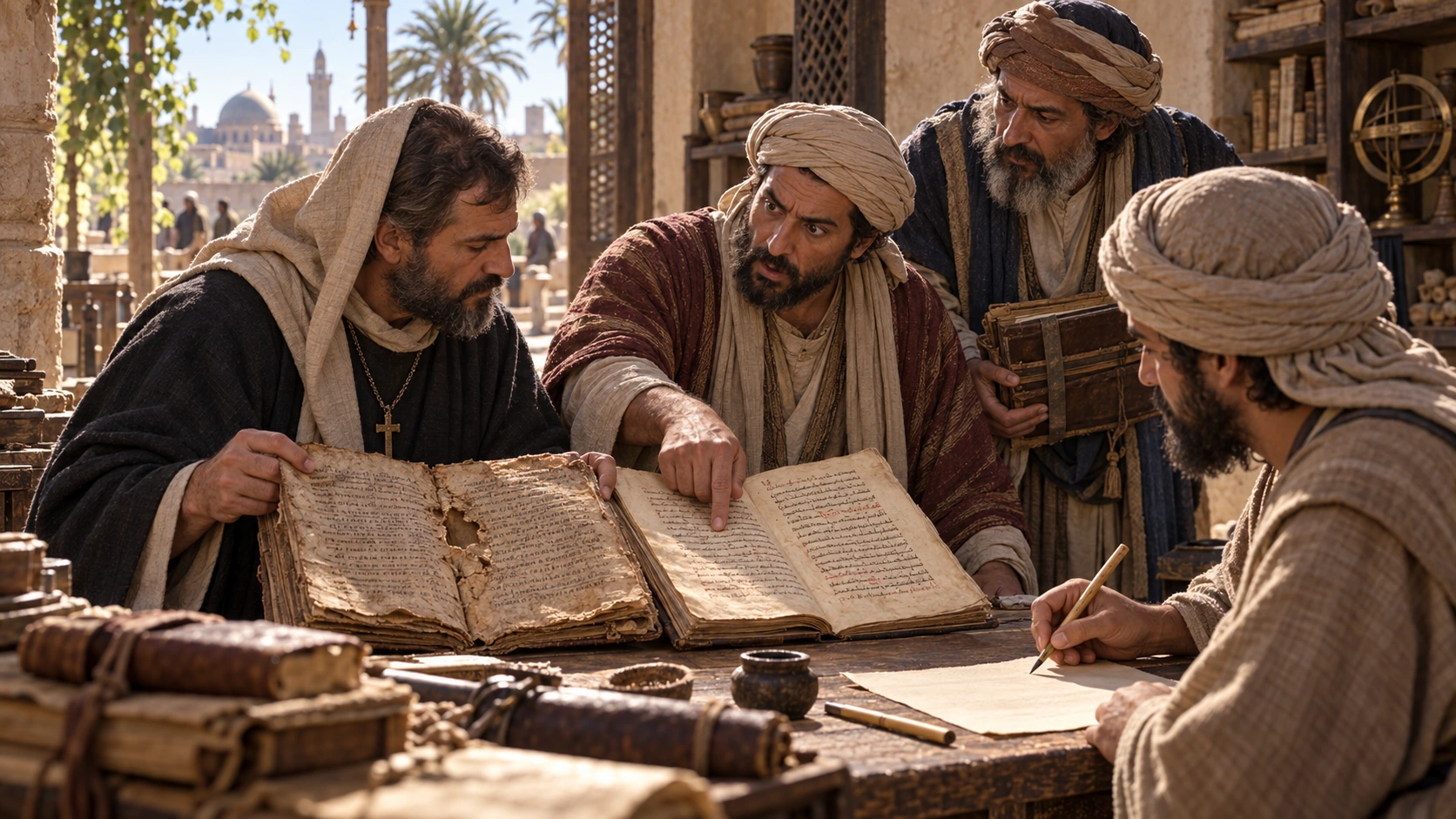
In Baghdad, I tried to sell a book with a missing leaf at the price of a rare masterpiece. I nearly lost more of my reputation than the book was worth.
It was a Greek medical manuscript I had found in Asia Minor, a copy of a work by Galen. The corners were worn, but the writing was still clear. The problem was that an entire leaf was missing from the middle.
I could read Greek. I knew exactly what was gone. But how many people in Baghdad could possibly notice?
“This is a rare copy. The only one of its kind.”
I opened it before Hasan, a secretary who acquired books for court physicians.
Hasan was not impressed. He pushed the manuscript toward the translator sitting opposite him. Yuhanna was a Christian translator who read Greek and Syriac and rendered both into Arabic.
He turned several leaves, then stopped.
“A leaf is missing.”
“It is an old book. These things happen.”
“When the book is about medicine, the patient may end up paying for the missing page.”
He pointed to the place where one sentence broke off and an entirely different treatment began. I reached to close the book, but Hasan held it open.
“Can you recover the missing passage?” he asked.
“I need other copies and translations.”
I gave a short laugh.
“I just told you. This is the only copy.”
Yuhanna looked at me.
“That is not a boast. It means we have nothing to compare it with.”
A few days later, my Greek manuscript was no longer alone on the table. Beside it lay an older Syriac translation and a fragment of another Greek copy borrowed from a different collector. The Syriac preserved the passage missing from my manuscript. Where its wording became unclear, the second Greek fragment helped settle the meaning.
Yuhanna compared all three versions as he composed the Arabic text. When no Arabic word matched a Greek term exactly, he worked through its meaning with physicians. When an earlier translation appeared mistaken, he did not copy the error. He explained the problem and revised it.
As far as I was concerned, far too many people had become involved in moving one book from one language to another.
“Once the translation is finished, there will still be only one copy, yes?” I asked.
Hasan smiled.
“Then the scribes make copies.”
“You plan to turn my one book into dozens?”
“Not the book. What is inside it.”
Only then did I see the danger to my business. Once Arabic copies began to circulate, physicians who knew no Greek could read the work. Fewer of them would need to come looking for my manuscript.
But when the first Arabic version was read aloud, something happened that I had not expected.
A young physician who knew no Greek spoke up at one passage.
“This treats similar fevers as one illness. The patients I have seen did not show the same symptoms.”
I stared at him. He had just suggested that Galen might be wrong. Yuhanna did not take offense.
“Then write down what you saw,” he said. “And where it differed.”
They did not erase the old passage. They added the new observation beside it. Another physician challenged that account, and Yuhanna marked the disagreement clearly in the next copy.
The translated book did not disappear quietly onto a shelf. As more people became able to read it, more people could question it. Working in the same scholarly language, physicians, astronomers, mathematicians, and philosophers could examine older knowledge together, test it, and put it to work on problems of their own.
Translation did more than change the language of a book. As knowledge from Greek, Syriac, Persian, and Indian traditions gathered in Arabic, people who had once been separated by language could compare, challenge, and correct the same ideas. The amount of knowledge grew, but so did the opportunities to compare one tradition with another.
The woman seated by the wall gathered the handles of the shopping bag resting on her lap.
“If they were translating books written by other people, can we really call that an achievement of Islamic civilization?”
“If they had merely copied the books and placed them on shelves, it would have ended with preservation. Instead, they gathered works from different languages, compared them, created terms where they needed them, and tested what they read through observation and calculation. Translation became a shared workbench for new research.”
Abbasid patrons paid to obtain works on medicine, astronomy, mathematics, and philosophy. Translators did not work alone. A chain formed among people who hunted for manuscripts in distant lands, compared different versions, rendered them into Arabic, copied them by hand, taught them, and tested their claims.
In the end, I did not get my original asking price. That was the cost of hiding a missing leaf.
I did, however, learn a better trade. There was more lasting profit in finding books that could be compared and bringing them to Baghdad than in hiding one copy and proclaiming it unique.
A civilization did not have to discover every answer by itself in order to advance. If it could bring what others had learned into its own language, connect those answers, and correct what was wrong, centuries of earlier effort could become the starting point for the next search. The ability to absorb knowledge was itself part of the ability to create new knowledge.
On my next journey, I acquired two books containing the same work. One was in Greek. The other was in Syriac.
Yuhanna looked from one to the other.
“Which one is the only copy in the world this time?”
“I don't know. That is why I brought both.”
He nodded in approval—until he saw the price I was asking.
“Why does it cost twice as much?”
“Because now you can compare them.”
Yuhanna stared at me for a moment, then laughed.
“At least you learned what translation is for.”
“And I hadn't forgotten what business is for.”