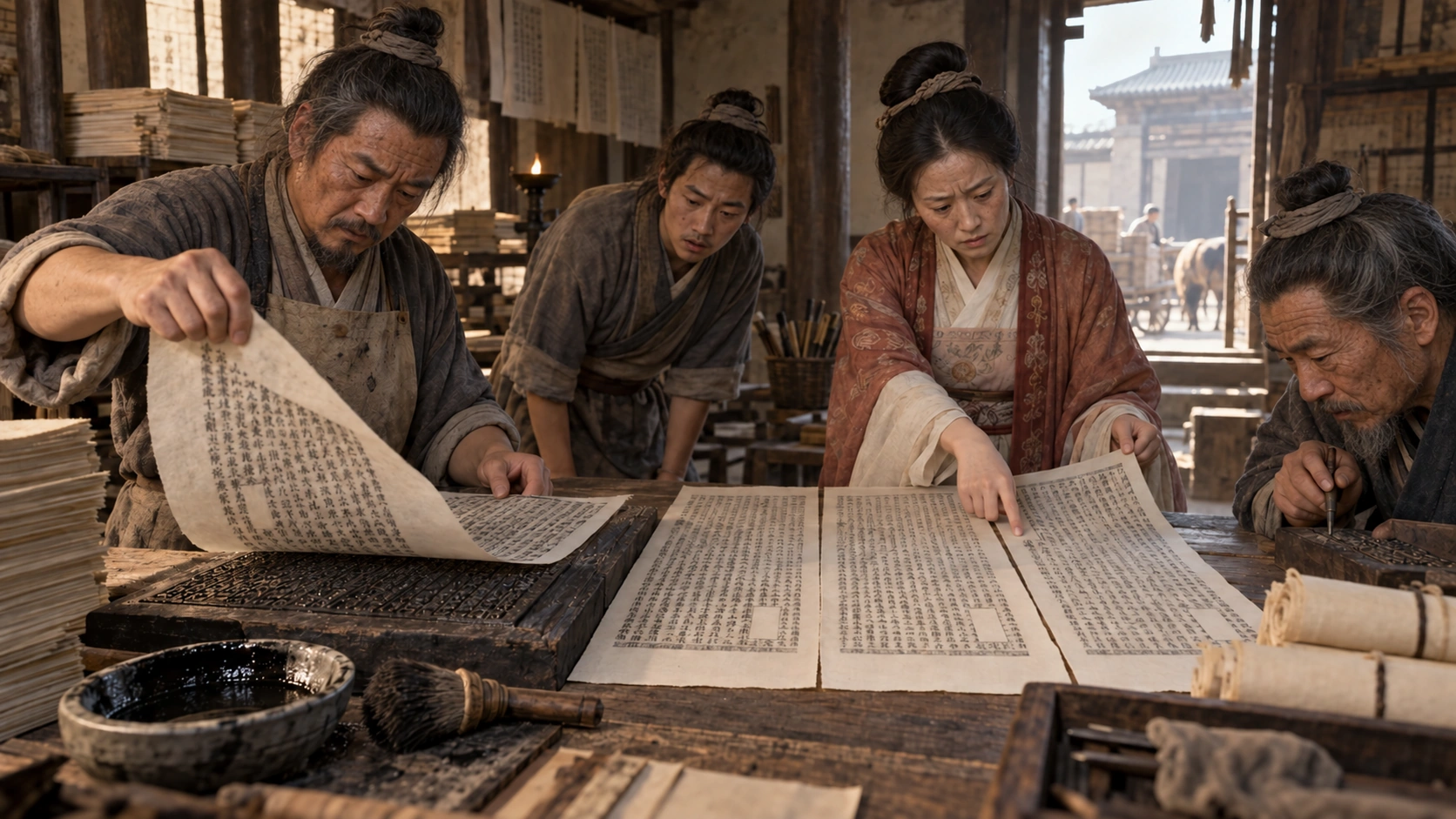
Lihua had paid to print the Diamond Sutra in honor of her parents. Somehow, her mother had been left out of it.
By the time we spotted the mistake, six of the twenty-four finished scrolls were already on a cart. I dropped the bundle I was tying and ran out of the print shop.
“Where are you going?”
“To get those six back!”
That morning, I had thought the work was done. Lihua wanted copies of the sutra sent to different places, with the merit of giving them away dedicated to both her parents. Copying a scroll by hand meant writing it out from the first character to the last. To produce twenty-four, someone had to do that twenty-four times.
A carved block worked differently. Preparing the text and illustration still took skilled hands and a great deal of time. But once the blocks were ready, they could print the same pages again and again. Instead of choosing one temple to receive a single scroll, Lihua could send several with each departing cart.
I had checked the image of the Buddha at the front of the first print. The black lines were crisp. I rolled up the text without opening it at the other end. Then I did the same thing twenty-three more times.
Lihua unrolled a copy to take home to her parents. At the dedication at the end, she stopped.
“Where's my mother?”
“At home, isn't she?”
“On the scroll. I asked for these to be given in honor of both my parents. It only names my father.”
The character for mother was missing. I opened another scroll. It was missing there too. And in the next one. This was not a fresh oversight in each copy. The character had never been carved onto the block.
I caught the cart at the far end of the market. The driver thought I had come to ask for a lower fare.
“We've already agreed on the fare!”
“I don't want your money. Give me the scrolls for a moment.”
He lowered the bundle with a look that said I had lost my mind. Now we had to fix it before he left town.
Back at the shop, the printer was inspecting the last block. We could not throw away all twenty-four scrolls. Paper cost money, and people were already waiting for them.
“We'll add the missing character by hand to these,” Lihua said. “Fix the block before you print any more.”
We opened each scroll at the end. I found the gap; Lihua brushed in the character. When I tried to roll one up too soon, she rapped the back of my hand.
“The ink's still wet. Do you want to smear it too?”
I laid the sheet flat and waited. This time I checked it all the way to the end.
A scribe had to start over for every new copy. A woodblock took time to carve, but once it was finished, the same words and image could be printed repeatedly. Paper, ink, and people to carry the scrolls were still needed. What changed was that one text could reach several towns at once.
The woman seated by the wall folded the leaflet on her lap in half.
“But what good were extra copies to people who couldn't read?”
“They couldn't read one alone. But if a town had a copy, someone who could read it could recite it to everyone gathered there. Getting books into people's hands and helping them understand the words were two different problems.”
After correcting the block, the printer made a fresh impression of the final section. Lihua read the dedication from beginning to end. I followed the line beside her. The character for her mother was there.
Every copy from a block carried the same text. That was its strength, and its danger. A carefully chosen passage could travel farther, but so could a mistake. Printing gave us more copies; it did not decide what deserved to be printed or check the first impression for us.
We tied up the twenty-four repaired scrolls. Lihua took one home to her mother. If her mother could not read it, they would ask a neighbor to read it aloud with them.
I returned the six scrolls to the driver. This time he unrolled one, checked the dedication himself, and put it back on the cart.
“Nothing else missing?”
“You just checked.”
The cart left. Back at the shop, the printer pulled another sheet from the corrected block. I opened it at the end. The character I had spent the afternoon adding by hand was already there.