Royal documents usually told us what to surrender.
Money. Horses. Grain. Fines.
In the summer of 1215, a royal document told a royal official to stop.
I kept records for a county court in southern England. When the sheriff imposed a fine, I wrote down the name and amount. When Osbert, a royal forester, seized an animal, I recorded what he had taken.
Knowing how to write had won me the position. The trouble was that my writing sometimes cost someone a winter's food.
That spring, a free tenant named Martin and a villein named Wulf, who was bound to his lord's land, released their pigs into the royal forest three days before they were allowed. Osbert claimed the animals had damaged young trees and imposed a heavy fine on both men.
He took Martin's packhorse and Wulf's plow ox. It felt less like a penalty for an offense than an order to give up the next harvest.
Martin protested. Osbert had him locked up.
“Defy the king's officer in the king's forest, and you add another offense.”
Wulf came to me carrying the court roll.
“You wrote it down, so you must know. Were the leaves eaten by two pigs truly worth an ox?”
“I did not set the fine.”
“No. But your handwriting makes it look as though the rule was always there.”
That hurt because he was right. I had not imposed the penalty, but my record made Osbert's whim look like the king's settled law.
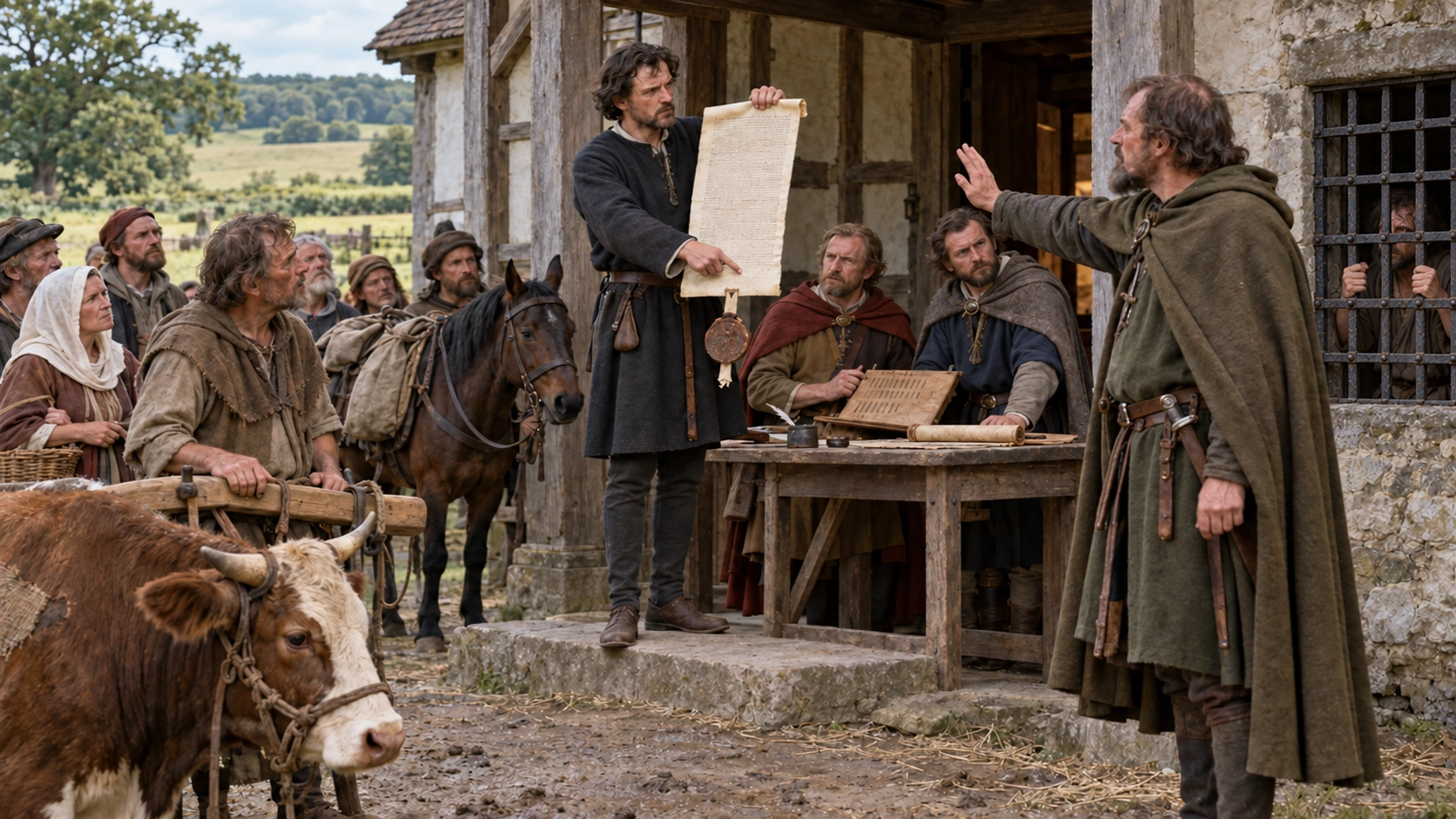
A few days later, an order bearing the king's seal arrived. King John and the rebel barons had reached an agreement at Runnymede, and its terms were to be proclaimed across the country. The sheriff gathered everyone outside the court, and I began turning the long Latin charter into words they could understand.
It dealt with the rights of the Church, inheritance payments, debts, bridges, forests, and the movement of merchants. The crowd soon began to look bored.
Then I reached the passage about fines.
A minor offense could draw only a proportionate penalty. A free tenant could not be fined so heavily that he lost his livelihood. A merchant's goods and a villein's farming tools were also to be spared. Reputable neighbors, not one angry official, were to assess the amount.
Wulf looked up.
The next passage said that a free man could not be seized or imprisoned without lawful judgment and the law of the land. Justice was not to be sold, refused, or deliberately delayed.
Inside the jail, Martin gripped the bars.
Osbert cut off my reading.
“That is enough. The clergy can read the rest.”
I pointed to the royal seal hanging beneath the document.
“The king's order says it must all be proclaimed.”
The crowd had heard it. Osbert could no longer pretend those words did not exist.
Several days later, local knights investigated the fines and the practices used to manage the royal forest. Wulf's ox was returned, and Martin was released until his case could be heard in public. Their troubles were not over, but Osbert could no longer settle the matter simply by saying, “I speak for the king.”
Magna Carta did not strip the king of his power overnight. What changed was that people now had a public standard against which they could compare the conduct of the king and his officials. The same words could be read and copied in many places, making it possible to demand that those in power explain which rule justified what they had done.
The man in the front row stopped peeling the label from his water bottle and looked up.
“Did King John truly keep his promise just because he attached a seal to it?”
“No. Within ten weeks, the pope declared the charter invalid, and John and the barons returned to war. After John died, however, the new king's government reissued the charter in 1216 and 1217, and it was issued again in 1225. The first agreement failed, but the document did not disappear with it.”
I heard the charter proclaimed more than once. Its wording grew shorter and changed, but the claim that the king also had rules to obey kept returning. A new king had to place his own seal beneath promises his predecessor had tried to escape.
Law's power to restrain rulers did not depend on their keeping every promise. Once a promise was written down, people could show who had broken it and demand the return of a discarded rule. That was how a failed peace settlement survived as a standard that could be placed before the next king.
The standard was still narrow. Much of the charter dealt with barons, free men, and feudal customs. Wulf had recovered his ox, but the famous protection against imprisonment without lawful judgment began with the words “no free man.”
When the new charter had been read, Wulf turned to me.
“I got my ox back. But if they lock me up, which line am I supposed to read?”
I searched the document from beginning to end. This time, even my handwriting could not produce an answer.
Wulf looked at the charter.
“A good document, then. Just a better one for men freer than I am.”