Mounted armies were not the only frighteningly fast thing in the Mongol Empire.
Orders could arrive ahead of them.
In 1206, Temüjin united the peoples of the steppe and was acclaimed as Chinggis Khan. At the time, I thought it was simply the rise of another powerful tribal confederation.
Just over a decade later, I learned how wrong I had been.
I was a caravan clerk in Samarkand, keeping records of cargo and road fees. When the Mongol armies drove west, city gates fell and homes and warehouses burned. Craftsmen and other skilled people were taken from the survivors and sent far from home.
I survived because I could read Turkic and Persian and knew the caravan routes. Survival came with a price: I had to keep records for Mongol officials. Before long, I was counting horses and fodder at a relay station east of Samarkand.
A relay station did more than house horses. A courier carrying official orders could leave an exhausted horse behind and take a fresh one. At the next station, he changed horses again. Food and a place to sleep waited along the route as well.
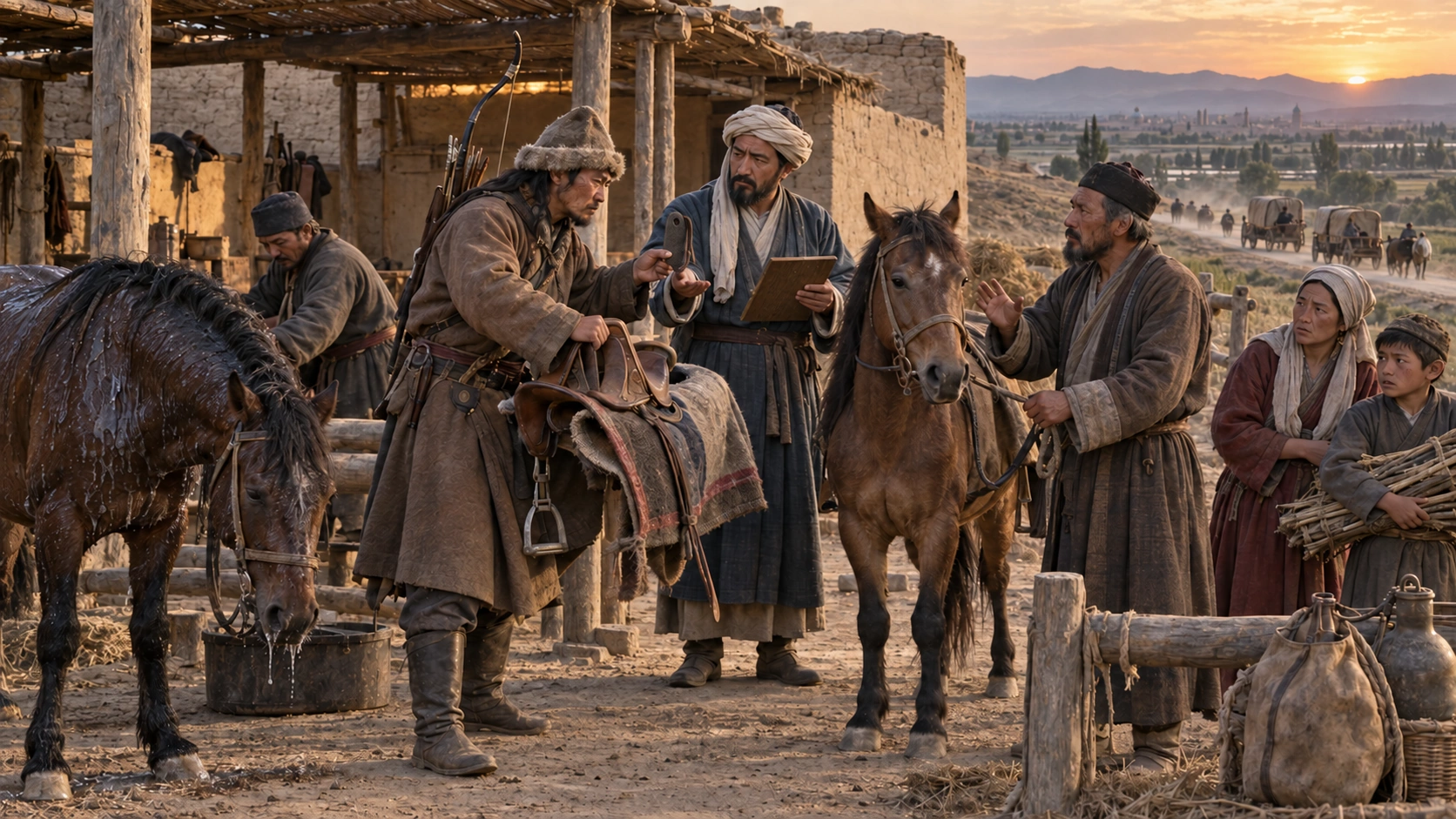
One evening, just before sunset, a courier named Boro rode in on a mare flecked with foam. He pulled a metal tablet from his belt and held it in front of me. It marked him as a bearer of the khan's orders.
“One fresh horse. Now.”
Only one sound horse remained in the stable. It had been supplied for relay duty by the household of a local herder named Saran.
Saran stepped between me and the stall.
“Take that horse and my family will be hauling everything by hand until spring.”
Boro raised the tablet again.
“The river has risen and taken out the bridge. I have orders to divert the grain carts to the northern road. If I am late, twenty carts stop at the river.”
I handed over Saran's horse. Boro dismounted, transferred his saddle, took two sips from a water skin, and rode for the next station.
Several days later, the grain carts passed us on the northern road. If Boro's message had not arrived first, the carts and their escort would have lost days at the broken bridge.
That did not erase Saran's loss. Until the horse returned, his family carried water and firewood themselves. Every fast order rested on households that supplied horses, fodder, and labor to the relay line.
Mongol speed did not come from one exceptional horse. Relay stations kept fresh mounts and provisions ready, and an official tablet gave couriers priority along a defined route. Riders and horses became exhausted, but the message kept moving. This information network let distant armies and supply trains respond to the same command and turned conquered territory into land the empire could actually govern.
The woman seated near the entrance to the alley pulled her chair inward to let a bicycle pass.
“Could any merchant use those relay stations?”
“No. It was never an open road for everyone. Military orders, officials, and envoys came first, and only travelers with the required passes or protection could claim relay horses and lodging. But once the routes were maintained and armed raiding was brought under tighter control, protected merchants also found it easier to travel.”
The people passing through the station grew more varied. A Persian physician heading east and a Chinese craftsman heading west might sit at the same fire looking for an interpreter. Merchants carried silk, dyes, medicines, and paper. Envoys brought news and maps from other courts.
Not all of them had chosen to travel. Many artisans and specialists selected from conquered cities were separated from their families and sent to distant workshops. When they worked beside local craftsmen, weaving methods, metalworking skills, and artistic styles mixed. The exchange was real, but forced relocation often stood at its beginning.
Mongol rule brought many Eurasian routes under one vast political system, allowing protected travelers, goods, and knowledge to move farther. The same routes also carried invasion orders and demands for taxes, horses, and food. Greater connection was not automatically a greater good. To understand the price of an imperial network, we must ask who could use it, who supplied it, and who was moved against their will.
A few years later, two groups arrived at our station at the same time. One included a physician traveling west. The other belonged to a merchant bound for an eastern market. Both carried valid tablets.
Saran looked from one tablet to the other, then turned to me.
“I thought our horses might get some rest when the war ended.”
I opened the stable door.
“The empire has only found more ways to use the road.”
Saran stared into the empty stalls and sighed.
“Then our horses have found fewer ways to rest.”